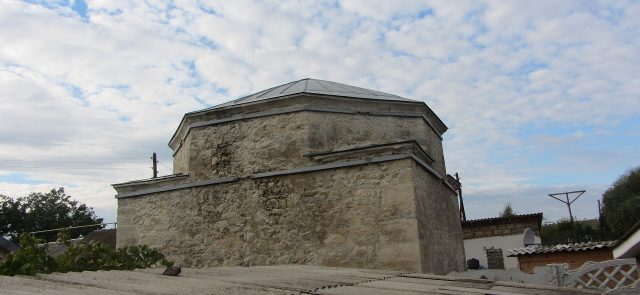
The Plum Tree House of Culture sits on the edge of a quiet southern village, a place that has drawn people in for generations. Built in the middle of the last century, it became a gathering spot not just for locals but for those from neighboring settlements too. In an era when entertainment was scarce and roads led mostly to fields or markets, such community centers were the heart of social life. Here, people came together for concerts, plays, and dances. On holidays, the air filled with the sound of accordions and amateur choirs, and the whole village would turn out for celebrations.
The building itself is unassuming, much like other Soviet-era houses of culture. Its lines are simple, the facade symmetrical, with large windows that let in plenty of light. Inside, a spacious hall stretches under a high ceiling, complete with a stage, dressing rooms, and smaller spaces for clubs and workshops. Outside, the brick walls are modest, topped with a low pediment and a small awning over the entrance. Beside it lies an old garden, where in summer people spread out blankets for picnics, and in winter children build snowmen. For many, this garden holds childhood memories—running between the trees, hiding in the bushes, or sitting on a bench with an ice cream.
Life here isn’t just about performances and rehearsals. The House of Culture hosts clubs for all ages, from handicrafts to theater. On weekends, old films flicker on a screen, and in the evenings, people dance to records that have been spinning for decades. Occasionally, performers from the regional center visit, but more often, it’s locals who take the stage. The hall carries the scent of wood and dust, and the walls are lined with photographs from years gone by—black-and-white snapshots of past celebrations, portraits of amateur actors, and faded certificates. It feels as though time has slowed down here, preserving moments that elsewhere have long since faded.
Holidays bring the biggest crowds. On May Day, Victory Day, and New Year’s, the hall fills to capacity. Families arrive with food to share, catching up on news while children from the dance club recite poems and sing on stage. For a few hours, the building seems to slip back in time. Even those who moved away years ago make the trip back, eager to reconnect with old friends and revisit the days of their youth.
The House of Culture holds more than just memories—it keeps an archive of them. Documents, photographs, and old playbills fill its storage rooms, offering a glimpse into how people lived here decades ago. School groups sometimes visit on field trips, learning about the traditions of their village, the songs their grandparents sang, and the way celebrations once unfolded. For many, it’s a revelation: history isn’t something distant and abstract, but something tangible, hidden in the cracks of old posters and the faded edges of photographs.
The building shows its age. The roof leaks in places, the floorboards creak, and an old piano sits in the corner, its keys worn from use. But no one here seems bothered by the wear and tear. This isn’t a museum—it’s a living place, still serving the people who call it their own. Repairs happen as they can, walls get fresh paint, and lightbulbs are replaced when needed. What matters is that people still gather here, not just for events, but to talk, laugh, and reminisce.
In recent years, the House of Culture has started to attract visitors from beyond the village—travelers curious about life in the provinces. There are no souvenirs for sale, no guided tours, no polished displays. What you find instead are the quiet details: the creak of chairs, the scent of tea from a samovar, and the photographs on the walls, each telling a small story of its own. It’s the kind of place where authenticity lingers, untouched by the gloss of modern tourism.
This is an ordinary rural community center, and perhaps that’s what makes it special. There’s nothing staged or performative about it. The people who come do so because they want to, not because they feel they should. The history here isn’t preserved behind glass—it lives in the corners of the room, in the way the light falls through the windows, in the laughter that still echoes in the hall. Maybe that’s why it endures, despite the passage of time and the changes that have swept through so many other places. It’s not just a building; it’s a piece of the past that refuses to let go.