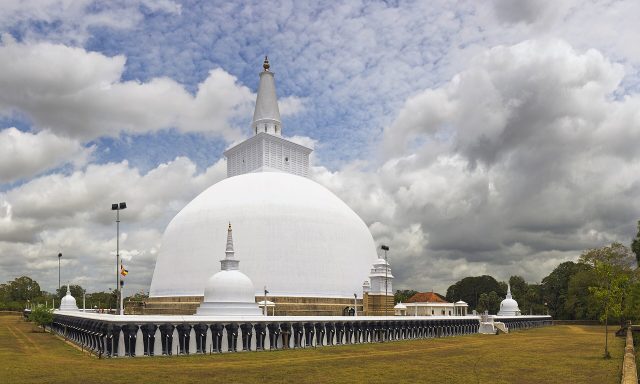
Standing on the plains of Anuradhapura, Abhayagiri Dagaba is one of those rare places where the weight of history feels almost tangible. This ancient stupa, once among the tallest structures of the ancient world, was more than just a monument—it was the heart of a vast monastic complex that shaped Buddhism across Asia. Built in the 2nd century BCE, it became a center of learning, debate, and devotion, drawing scholars and pilgrims from distant lands. Today, its weathered brick walls and scattered ruins still carry the echoes of a time when this was a place of intellectual and spiritual ferment.
The story of Abhayagiri begins with King Valagamba, who ruled Sri Lanka in the 1st century BCE. According to legend, a hermit named Kumara, living in a cave on this very spot, prophesied that the king would reclaim his throne from Tamil invaders if he built a monastery here. Valagamba kept his word, and after his victory, the Abhayagiri Vihara rose on the hill, named after Abhayagiri, a guardian spirit of the land. Over time, the monastery grew into one of the most influential Buddhist centers in the region, rivaling even the more conservative Mahavihara in its openness to new ideas.
What remains of Abhayagiri today is only a fraction of its former grandeur. Originally towering nearly a hundred meters high, the stupa was a marvel of ancient engineering, its massive brick base designed to withstand the test of time. Though centuries of neglect and natural wear have reduced it to a shadow of its original size, the structure still commands attention. The surrounding ruins—crumbling staircases, broken columns, and remnants of small shrines—hint at the scale of the complex that once stood here. One of the most impressive features is the ancient drainage system, a testament to the sophistication of its builders, who understood the need to protect the monument from the island’s heavy rains.
Abhayagiri was not just a religious site but a hub of intellectual life. Monks here studied and translated Buddhist texts, engaged in philosophical debates, and preserved sacred scriptures. In the 5th century, the Chinese pilgrim Faxian visited the monastery and wrote about its vast library, where texts from the Mahayana tradition were carefully copied and disseminated. Unlike the more orthodox Mahavihara, Abhayagiri embraced a broader interpretation of Buddhist teachings, attracting thinkers from across Asia. This openness made it a crucial link in the exchange of ideas between India, China, and Southeast Asia, shaping the development of Buddhism far beyond Sri Lanka’s shores.
Walking through the ruins today, it’s easy to imagine the monastery as it once was—a bustling center of activity where monks in saffron robes recited sutras, pilgrims left offerings at the stupa’s base, and scholars debated the nature of enlightenment. The site is especially atmospheric at dawn or dusk, when the rising or setting sun casts a golden glow over the brickwork, and long shadows stretch across the ground. In these quiet moments, the past feels closer, as if the centuries between then and now have momentarily dissolved.
Abhayagiri is often overshadowed by more famous sites in Anuradhapura, like the Ruwanwelisaya or Jetavanaramaya, but that only adds to its appeal. There’s a sense of solitude here, a chance to explore without the crowds that gather at the better-known stupas. Yet it remains a living place of worship—locals still come to leave flowers, light lamps, and pay their respects, ensuring that the connection to the past is never truly broken. The stupa may be a ruin, but it’s far from forgotten.
For those interested in Buddhism or Sri Lanka’s history, Abhayagiri offers a glimpse into a world where faith, scholarship, and art once intertwined. The monastery was more than just a religious institution; it was a microcosm of a civilization at its height. Even now, the ruins carry the stories of the people who built, prayed, and studied here—monks, kings, and ordinary devotees whose lives were shaped by this place. And perhaps that’s what makes Abhayagiri so compelling: it’s not just a relic of the past, but a reminder of how deeply the past can still resonate in the present.