Sevastopol and Balaklava: What to See in Two Days

Photo: Yevgeny Khaldei, Public domain
Sevastopol is not a resort, and coming here for the beach means not understanding the city. It is a port standing in a deep winding bay, with history read right on the streets: two defenses, an ancient polis on the outskirts and a closed military base where outsiders were not allowed until the nineties.
Two days unfold naturally: the first — the city itself and antiquity, the second — Balaklava and the capes.
Day One: Center, Chersonesos, Malakhov Kurgan
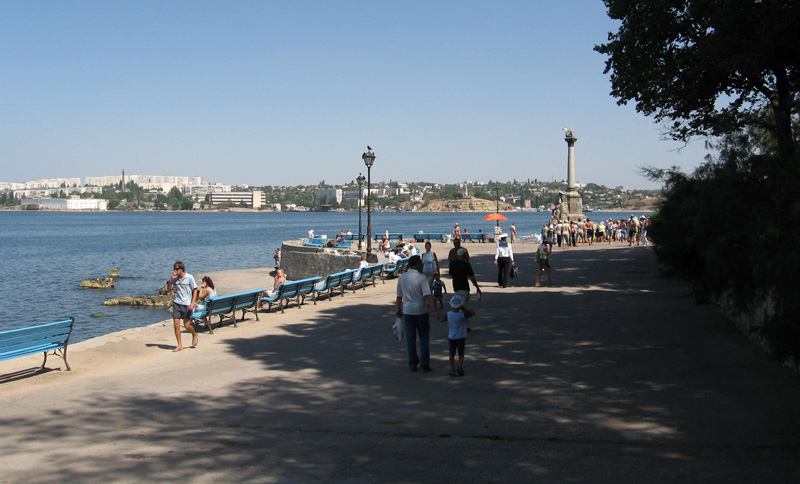
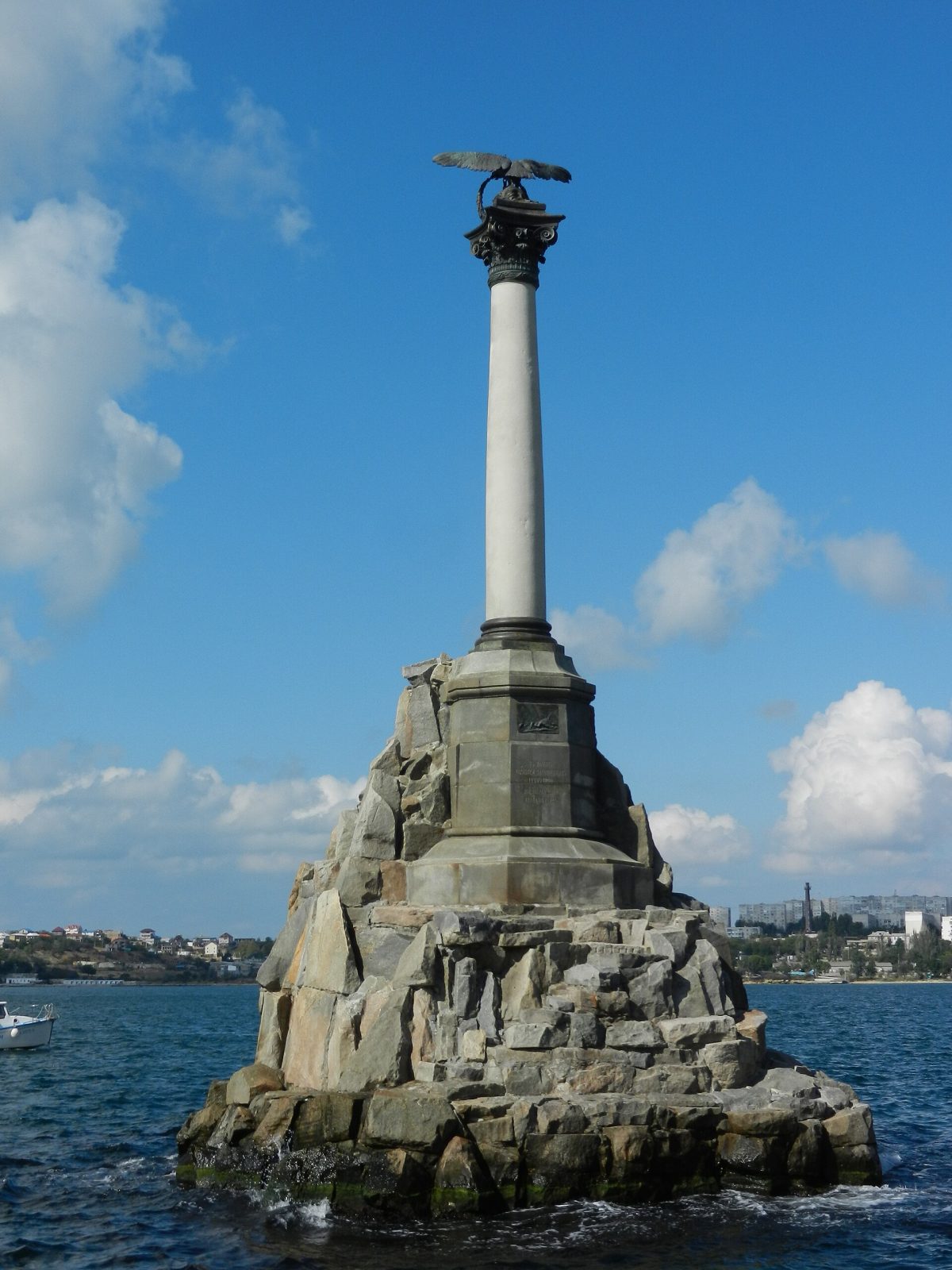
It is easiest to start from Primorsky Boulevard. A few meters from the shore stands the Monument to the Scuttled Ships — a granite column with a bronze eagle, erected in 1905. The reason is heavy: in the autumn of 1854, their own sailing fleet was scuttled across the entrance to the bay to prevent the enemy from entering, and the crews and guns went ashore to the bastions.
Nearby is the Grafskaya Pier with a colonnade — the main sea gates of the city, from where boats also run to the North Side.
Further — the Panorama "Defense of Sevastopol" on Historical Boulevard. The canvas one hundred fifteen meters long was painted by Franz Roubaud for the half-century anniversary; between the viewer and the canvas lies a subject plan of real sacks, guns and boards, and the boundary between things and paint is not read. The current panorama is not the original: in 1942 the building caught fire, the canvas was cut and carried out under fire, but the saved pieces turned out to be unusable, and the picture was painted anew.
In the second half of the day — Chersonesos Tauric, a Greek polis founded in the fifth century BC and lived for two thousand years. Streets with ruts, basilicas, an ancient theater and a bell on the shore have survived. The place is included in the World Heritage List. There is almost no shade there, better to go towards evening.
If time remains — Malakhov Kurgan, the key height of both defenses, with a defensive tower and a park.
Day Two: Balaklava and Fiolent
Balaklava Bay cuts into the land for almost one and a half kilometers and makes two bends, due to which its entrance is not visible from the sea at all. Homer, according to a widespread version, placed the harbor of the Laestrygonians here — the description is too accurate to be accidental.
For the entire twentieth century this was a closed city: a submarine base worked in the rock, and even residents of Sevastopol could not get here without a pass. Now there is a underground museum there: a channel inside the mountain through which the boat entered from the sea, watertight doors weighing tens of tons, adits and an arsenal. Down below it is about fifteen degrees year-round, a jacket is needed, and tickets in season are sold out in a few days.
Above the bay stands the Genoese fortress Cembalo, laid in 1357; the climb to the towers takes about twenty minutes and gives the best view of the bay.
The second half of the day — Fiolent Cape. A cliff of volcanic origin, black and orange rocks under two hundred meters, transparent water below. A staircase of almost eight hundred steps leads to Yashmovy Beach: the descent is fifteen minutes, the ascent is twice as long and noticeably harder.
About Water and Transport
Boats and ferry across the bay are not an attraction, but ordinary city transport: fifteen minutes, price like a bus. From the water the city looks completely different, and Mikhailovskaya Battery on the North Side cannot be seen otherwise.
The best time is May, June and September. In July and August it is hot and crowded, and in open areas, which are the majority here, there is no shade at all.
Everything else that is open in the city is collected on the Sevastopol page.


