Where to Go for New Year’s by the Sea: Warm Destinations for December 31st

Photo: CEphoto, Uwe Aranas, CC BY-SA 4.0
If you want to swim on New Year’s without any reservations, choose Pattaya or La Romana in the Dominican Republic: the sea there is 28°C, and rainfall for the entire December is 13 and 33 millimeters, respectively. Phuket is almost as good, though December is still humid there. Egypt offers sun and sea for the holidays, but not heat: in Hurghada, it’s 25°C during the day and 14°C at night. Sri Lanka, the Maldives, and Zanzibar have the warmest water at 29–30°C, but they get around 250 millimeters of rain in December, with drier weather only arriving in January. For Vietnam, the south is best for the holidays, while the country’s central region with Da Nang and Hoi An is better left for spring.
Decisions need to be made now. According to OneTwoTrip data cited by Kommersant on September 20, early bookings account for 52% of international trips, nearly ten percentage points higher than last year. The Russian Union of the Travel Industry names Vietnam, Egypt, Thailand, and the United Arab Emirates as leaders for the New Year season (Rossiyskaya Gazeta, September 30). Fun&Sun reports that 36.2% of its sales are for Egypt alone. Anex notes growing demand for Sri Lanka and Tanzania, with direct flights now available to Zanzibar. According to the Russian Union of the Travel Industry, most flights will take place between December 28 and January 4, with the holidays lasting 11 days, from December 31 to January 10.
All figures below are based on long-term averages from Meteostat and Open-Meteo weather stations. These represent the typical climate over many years: in any given year, December can be drier or rainier. Additionally, monthly precipitation totals don’t indicate how the rain falls—whether as a short afternoon shower or a week of overcast skies. Where data is available, the number of daily sunshine hours provides a better sense of the weather than millimeters of rain.
New Year’s Weather: Comparing Destinations
| Destination | December, day / night | Sea, December / January | Precipitation, December / January, mm |
|---|---|---|---|
| Pattaya | 30°C / 24°C | 28°C / 27°C | 13 / 6 |
| Phuket | 33°C / 25°C | 29°C / 29°C | 128 / 46 |
| Hurghada | 25°C / 14°C | 24°C / 23°C | 1 / 0 |
| Da Nang | 25°C / 21°C | 25°C / 24°C | 270 / 104 |
| Ho Chi Minh City | 32°C / 24°C | no sea | 27 / 33 |
| Colombo | 31°C / 24°C | 29°C / 28°C | 261 / 104 |
| Malé | 31°C / 26°C | 29°C / 28°C | 252 / 125 |
| Zanzibar | 32°C / 25°C | 30°C / 29°C | 246 / 123 |
| La Romana | 30°C / 21°C | 28°C / 27°C | 33 / 16 |
| Dubai | 28°C / 19°C | 25°C / 22°C | 11 / 31 |
Thailand: Pattaya Is Drier, Phuket Is Warmer
Among Asian destinations, Thailand is the most reliable for New Year’s, but its two main resorts differ significantly. Temperatures are nearly the same: in Pattaya, December brings 30°C during the day and 24°C at night, while in Phuket, it’s 33°C and 25°C. The sea is also similar, at 28°C and 29°C, respectively. However, Phuket gets nearly ten times more rain. In Pattaya, December sees 13 mm of rain, and January just 6 mm—making it a fully dry season. In Phuket, December brings 128 mm: the west coast is just emerging from the rainy season (November sees 196 mm) and only becomes truly dry in January, when the average drops to 46 mm. Krabi follows the same pattern, with 145 mm in December.
Pattaya
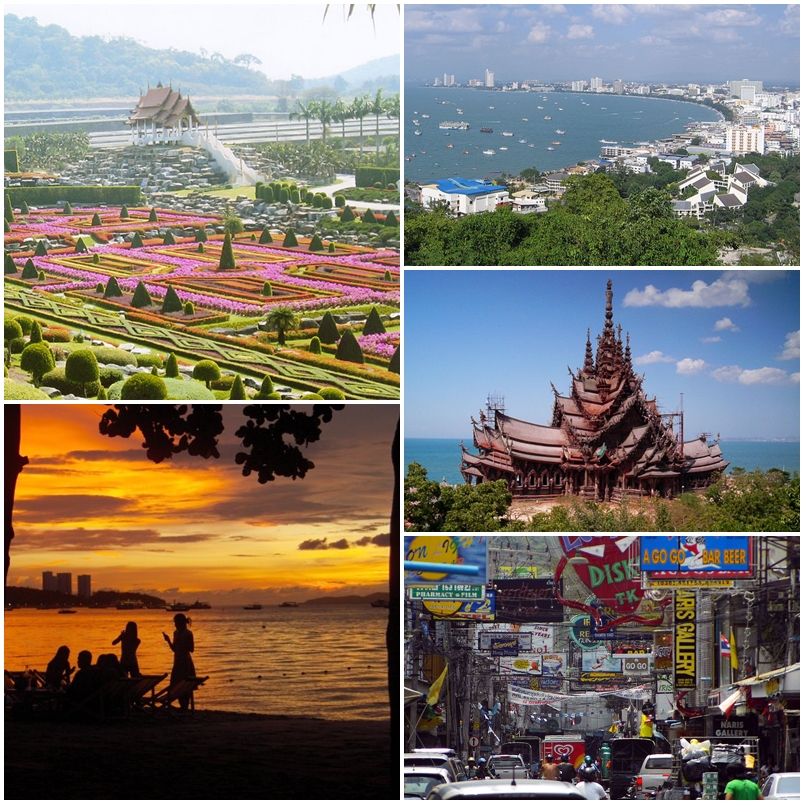
Pattaya is ideal for those who don’t want to lose a single beach day. Its weak point is well-known to visitors: the water near the city’s beaches isn’t the cleanest, and for clear seas, travelers head to Ko Lan Island. Located seven kilometers offshore, the water around it is noticeably clearer. In January, the sea near Pattaya cools to 27°C, nearly two degrees lower than in Phuket.
On the shore, be sure to visit the Temple of Truth—a 105-meter-tall wooden structure on a cape by the water. Construction has been ongoing since 1981 and isn’t finished yet. The main viewpoint in the city is on Pratumnak Hill, which separates the center from the southern beaches. Twenty kilometers from Pattaya lies Nong Nooch Tropical Botanical Garden, covering about 240 hectares and one of Southeast Asia’s largest botanical gardens. It takes half a day to explore, and it’s best to go in the morning before temperatures reach 30°C.
Phuket
Phuket wins with its sea and variety of beaches, but December is a transitional month. Rainfall drops quickly: 196 mm in November, 128 mm in December, and 46 mm in January. So, the last days of December are usually closer to the dry season than the start, though there’s no guarantee like in Pattaya. Phuket is also hotter: 33°C during the day and 25°C at night, rising to 34°C in January.
Patong Beach is the island’s most famous and liveliest. Those seeking a quieter experience head south to Karon. Beyond the beach, Wat Chalong Temple is often mentioned first. It’s one of the island’s most revered sites, frequented by locals as well as tourists. The Big Buddha of Phuket sits on a hill in the island’s southern part, and the view alone is worth the climb, even for those not interested in temples. The Siamese Twin Heroines Monument honors two sisters who organized the island’s defense against the Burmese army in 1785.
Egypt: Sun and Sea, But Not Heat
Egypt is one of the most popular destinations this winter, but it’s also where expectations often go wrong. New Year’s in Hurghada isn’t hot: 25°C during the day and 14°C at night in December, dropping to 23°C and 12°C in January. The sea is 24°C in December—similar to Yalta or Anapa in September. By January, the water cools by another 1.5°C. However, there’s virtually no rain, less than a millimeter per month.
Sharm El Sheikh is the opposite: the water is slightly warmer at 25°C in December, but the air is cooler at 22°C during the day and 12°C at night. The choice between the two resorts comes down to warmer air or warmer water.
The main attraction in Hurghada is the water and what lies beneath it. Giftun Island is a short boat ride away, known for its sand and shallow waters. Abu Ramada House Reef, a small island in the Red Sea, is one of the most famous diving and snorkeling spots near the resort. In the evening, stroll along Hurghada Marina and the promenade. The most land-based activity here is a desert safari, which is easier in winter than summer: July sees 39°C during the day, while December is 25°C.
The biggest downside of Egypt is the 14°C nights. Celebrating New Year’s Eve outdoors will require a jacket, and evenings by the sea are chilly. With Egypt being so popular, this is noticeable during peak holidays, both in hotels and on boat trips to the reefs.
Vietnam: Only the South for the Holidays
Vietnam is becoming increasingly popular this season, but it’s also where weather mistakes are easiest to make. The country’s central region, including Da Nang and Hoi An, is still in the rainy season in December: 270 mm of rain for the month, 25°C during the day, 25°C sea temperature, and an average of two hours of sunshine per day. November sees 442 mm, January 104 mm, and only in February does it become dry: 42 mm and over seven hours of sunshine. Meanwhile, the sea only warms to 28°C by May. Central Vietnam is a great destination—just not for New Year’s.
If tickets are already booked, Da Nang offers attractions that don’t depend on the beach. The Marble Mountains are five limestone and marble hills south of the city center, near the sea, with caves and sanctuaries inside. Further south, in Hoi An, lies the Old Town with the Japanese Covered Bridge, and beyond it in the mountains, the My Son Sanctuary—ruins of Champa temples in the jungle. My Khe Beach, long with fine light sand and a gentle slope, is better for walks than swimming in December.
For the holidays, southern Vietnam is the place to be. In Ho Chi Minh City, December brings 32°C during the day, 24°C at night, and 27 mm of rain for the month. January sees 33 mm—this is the dry season. The city itself has no sea, so travelers usually fly to Phu Quoc for beaches. We don’t yet have specific figures for the island. In Ho Chi Minh City, set aside a day for the Cu Chi Tunnels northwest of the city—a 250-kilometer underground network dug by hand over more than twenty years. Another half-day can be spent in the center: Ben Thanh Market with its clock tower, built in 1914 and now a city symbol, and Independence Palace. The downside of the south is simple: the city is hot and noisy. With Vietnam’s growing popularity, coastal areas should be booked earlier than it might seem necessary for the holidays.
Sri Lanka: Rainy December, Pleasant January
On Sri Lanka’s west coast, the season picks up just in time for the holidays. In Colombo, December brings 31°C during the day, 24°C at night, and a 29°C sea, but 261 mm of rain falls, with an average of six hours of sunshine per day. In January, rainfall drops to 104 mm, sunshine increases to eight hours, and in February, it’s just 70 mm. In Mount Lavinia, a beach suburb south of the capital, the pattern is the same: 286 mm in December and 140 mm in January. For this island, the second half of the holidays is better. If you fly not on December 28 but on January 3–4, the trip will be noticeably drier based on averages.
Colombo is usually visited for a day or two before or after the beach. Colombo Fort is the old colonial center, where historic buildings stand alongside modern office towers. Galle Face Promenade runs along the ocean, and evenings are lively there. Gangaramaya Temple is both an active Buddhist monastery and a collection of various offerings accumulated over the years. From Colombo, travelers also head to the mountains, to the tea plantations of Nuwara Eliya. December there is entirely different: 20°C during the day, 12°C at night, and 172 mm of rain. If mountains are in the plans, warm clothing is a must in the beach suitcase.
Maldives: Warmest Nights and Wet December
In Malé, December brings 31°C during the day and 26°C at night—the warmest nights of any of these resorts. The sea is 29°C. However, rainfall reaches 252 mm for the month, with about six and a half hours of sunshine per day. In January, precipitation drops by half to 125 mm, sunshine increases to nearly nine hours, and in February, rainfall is just 29 mm. Like Sri Lanka, shifting the trip to January or February only benefits the Maldives.
A rainy day here is more disappointing than anywhere else: the Maldives are all about the water, and if it’s overcast, there’s little to replace it. Most visitors only see the capital en route to their island, though half a day is enough to explore it. The Islamic Center Mosque, also known as the Sultan Mohammed Thakurufaanu Al Auzam Friday Mosque, stands under a golden dome visible from afar. Next to it is the Maldives National Museum. The liveliest spot in the capital is Malé Market, where fishermen bring their catch.
Zanzibar: 30°C Water and the Last Rains
Zanzibar has the warmest sea of all these destinations: nearly 30°C in December and 29°C in January, with air temperatures of 32°C during the day and 25°C at night. With direct flights available, demand for it during the holidays has noticeably increased. Its weak point is the same as the Maldives: December sees 246 mm of rain, and November 296 mm. This marks the end of the short rainy season. By January, rainfall drops by half to 123 mm, and in February, it’s just 34 mm.
The island is great because there’s plenty to do after the beach. Stone Town is the old part of Zanzibar, a labyrinth of coral-stone streets with carved doors. On its waterfront stands the House of Wonders, and nearby is the Sultan’s Palace. In the evenings, everything converges at Forodhani Gardens: the square by the water hosts street food stalls, drawing both locals and visitors. Christ Church, an Anglican church, was built on the site of a former slave market and is one of the island’s most somber places. Not far away stands St. Joseph’s Cathedral. A half-day trip can take you to Jozani-Chwaka Bay National Park, the island’s only national park, home to Zanzibar red colobus monkeys.
Dominican Republic: Dry, Warm, and Far Away
La Romana in the southeast of the Dominican Republic is the most consistent option of all. In December, it’s 30°C during the day, 21°C at night, the sea is 28°C, and rainfall is 33 mm for the month. January is even drier: 16 mm, with the sea at 27°C. The rainy season here ends in November, when 106 mm falls, and by the holidays, it’s over. In Santo Domingo, the capital, the weather is similar: 28°C during the day, 28°C sea, and 45 mm of rain.
Near La Romana lies Cotubanamá National Park, which includes Saona Island, a popular boat trip destination from this area. The city itself has little to offer: Santa Rosa de Lima Cathedral, Guarao Theatre, Central Park, and the market. This is enough for an evening, but people don’t come here for the city.
The Dominican Republic has two downsides. It’s the farthest to fly. And nights are cooler than in Thailand or the Maldives: 21°C in December and 20°C in January. A long-sleeved shirt is enough for evening walks by the sea, but there’s no tropical night like in the Maldives.
What to Choose
If you’re traveling during the peak, December 28 to January 4, and want guaranteed beach and sun, the options are limited: Pattaya, La Romana, or southern Vietnam. Phuket is almost in the same category, especially closer to January. Egypt is for those who want sun and sea close to home but aren’t expecting the tropics—just a warm September-like Black Sea. The UAE is less popular this season: according to ATOR, demand for the Middle East has dropped by 35–40%. Weather-wise, it’s slightly warmer than Egypt: in Dubai, December brings 28°C during the day, 19°C at night, and a 25°C sea, cooling to 22°C by January.
Sri Lanka, the Maldives, and Zanzibar offer the warmest seas, but December is rainy by the averages. The 11-day holiday period allows for flexibility: January’s rainfall is half of December’s for all three, so flying in early January instead of late December significantly increases the chances of a dry week. Da Nang and Hoi An are best saved for spring, when the rains end and the sea warms up.


