Aguas Calientes railway station isn’t just a place where trains arrive and depart—it’s the threshold to one of Peru’s most legendary journeys. Nestled at the foot of the Andes, in a town that feels suspended between worlds, the station serves as the final stop for travelers coming by rail from Cusco or Ollantaytambo, and the starting point for the last leg of the pilgrimage to Machu Picchu. The air here carries a quiet anticipation, as if the station itself is holding its breath before the ascent into the clouds.
The building is modest, its design a quiet testament to an era when railways symbolized progress and connection. Low stone walls, wooden beams beneath the roof, and large windows give it a practical warmth—no grandeur, just purpose. Inside, a small waiting area, ticket counters, and a few stalls selling last-minute souvenirs offer the essentials. There’s no pretension, only the sense that this is a place of transition, where the rhythm of the journey shifts from the steady clatter of wheels to the slower, more deliberate steps of those about to walk the final miles.
The station’s history is woven into the rise of Machu Picchu as a global destination. In the early 20th century, when the ruins were still largely unknown beyond a handful of explorers, the railway was the key that unlocked them. The first trains ran sporadically, taking far longer than today’s efficient service, but even then, Aguas Calientes was the vital link between the Urubamba Valley and the outside world. As Machu Picchu grew into one of South America’s most iconic sites, the station’s importance only deepened, becoming the gateway through which countless travelers pass each year.
Today, the station hums with the energy of a crossroads. Voices in a dozen languages blend with the sound of arriving trains, while backpacks, hiking boots, and cameras signal the shared purpose of those who gather here. There’s a sense of controlled chaos—people checking schedules, rushing to catch buses, or pausing to take in the moment—but beneath it all, a current of excitement runs through the crowd. Everyone here is on the verge of something extraordinary, and the station seems to absorb that energy, reflecting it back in the way people move and interact.
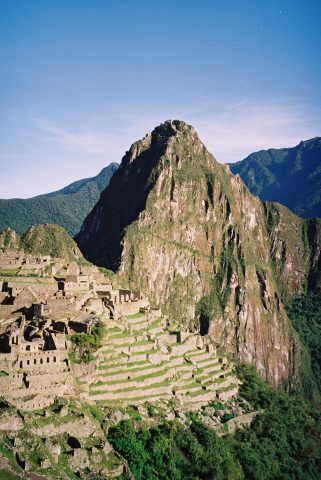
From here, the path to Machu Picchu splits in two. Some choose to walk, leaving the station and following a narrow trail that winds upward through the forest. It’s a route for those who want to earn their first glimpse of the ruins, to feel the burn in their legs before the reward of the view from above. Others opt for the buses that wait just outside, climbing the switchback road in a matter of minutes. The choice depends on time, energy, and inclination, but either way, the station marks the beginning of the final stretch—one that will end with the sight of ancient stone rising from the mist.
Aguas Calientes itself moves to the rhythm of tourism. The town is small, its streets narrow and lined with cafés, guesthouses, and shops selling alpaca wool and handmade crafts. There are no factories or office buildings, just the quiet pulse of a place that exists almost entirely for visitors. By day, it’s lively with travelers wandering between restaurants or browsing for souvenirs; by evening, when the last buses descend from Machu Picchu, it softens into something more intimate. The Urubamba River runs through the heart of town, its murmur a constant backdrop to the comings and goings of those who pass through.
The station is more than just a stop on a map—it’s a piece of a much larger story. Long before the first train arrived, the Inca built their roads and cities in these mountains, never imagining that centuries later, their legacy would draw people from every corner of the globe. The railway, carved through valleys and gorges, became a bridge between past and present, and the station its quiet guardian. It doesn’t demand attention like the ruins do, but it holds its own kind of significance, a place where history and modernity brush against each other.
For many, the station is where one journey ends and another begins. It’s where strangers who shared a train from Cusco say goodbye, and where new companions are found among those about to climb the same steps. The mood shifts here—fatigue from the long ride gives way to the thrill of what’s ahead. In that sense, Aguas Calientes station isn’t just a point on a route; it’s a place where the weight of expectation becomes part of the experience itself.
Despite its unassuming appearance, the station is a lifeline for the region. It connects Aguas Calientes to the rest of Peru, making tourism possible but also serving the everyday needs of locals. For many who live here, the train is the only way to reach larger towns for supplies, medical care, or visits with family. In that way, the station is more than just a gateway to Machu Picchu—it’s a vital artery for a community tucked into the folds of the Andes.
In the end, what lingers about Aguas Calientes station isn’t its architecture or even its history, but the role it plays in the stories of those who pass through. There’s no grand monument here, no sweeping vistas—just the quiet promise of what comes next. It’s a place that stays with you long after the train has left, after Machu Picchu has faded into memory, because it’s where the journey truly begins.