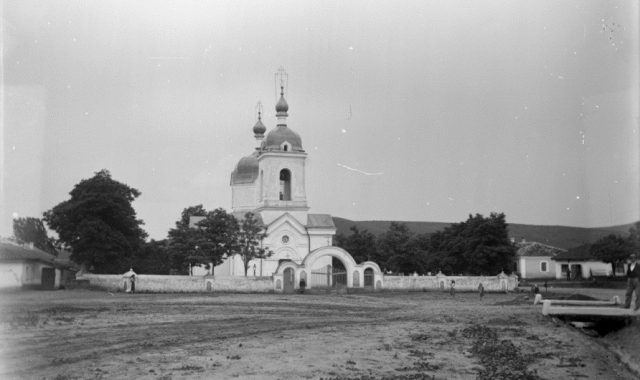
Zuya is one of those quiet Crimean settlements that rarely appear on tourist maps, yet it carries a subtle charm of its own. At its heart stands the local administration building, an unassuming structure that holds more significance than its modest appearance suggests. Unlike the grand Soviet-era buildings found in larger cities, this one blends seamlessly into the life of the village, serving as both a functional space and a quiet witness to Zuya’s past.
Built in the mid-20th century, when the settlement was expanding alongside Crimea’s agricultural development, the building follows the straightforward, utilitarian style typical of its time. Its facade is clad in light stone, giving it a clean, understated look that fits well with the surrounding low-rise houses. The architecture is unpretentious—symmetrical windows, simple lines, and a practical layout—but there’s a certain care in how it was designed to fit the landscape. Inside, the corridors are narrow, the ceilings low, and the rooms functional, reflecting the no-nonsense approach of an era when form followed necessity.
In front of the building lies a small square, the kind of place that becomes the social heart of a village. In summer, benches appear, and locals gather to chat, watch the world go by, or simply enjoy the shade. Children might play nearby, and the occasional street vendor sets up a stall. Come winter, the square empties, but it never loses its role as a meeting point. For a place that sees few outsiders, this is where life unfolds in its most ordinary, yet meaningful, ways.
Zuya was never a major hub, but in the Soviet period, it played a key role in the region’s agriculture. The village was part of Crimea’s vineyard and orchard expansion, supplying grapes and fruit to the broader economy. The administration building was constructed during this time of growth, when Zuya was becoming a small but important center for local farming. Today, the agricultural legacy lingers in the fields that stretch beyond the village, though the pace of life has slowed.
For the people of Zuya, the administration building is more than just an office. It’s where they come to handle paperwork, attend community meetings, or seek help with local matters. The staff here know most of the villagers by name, and the conversations often go beyond official business—birthdays, harvests, the latest news from neighboring towns. In a place where everyone knows each other, the building serves as a quiet anchor, a place where the past and present intersect.
Unlike the well-preserved historic sites that draw crowds to Crimea, Zuya offers something different. There are no ancient ruins or palaces here, just the quiet rhythm of village life. The administration building, with its worn steps and slightly faded facade, is a small but telling piece of that life. It doesn’t demand attention, but if you take the time to notice it, you’ll see how it fits into the broader story of the region—one of modest ambitions, steady work, and the slow passage of time.
Tourists rarely stop in Zuya, and that’s part of its appeal. The village doesn’t put on a show; it simply exists, much as it has for decades. If you wander its streets, you’ll find a market where locals sell homemade preserves and fresh produce, a few small shops with basic goods, and houses with gardens that spill over with flowers in summer. The administration building stands among them, unremarkable yet essential, a reminder that history isn’t just in grand monuments but in the places where people live, work, and carry on.
Crimea is often seen through the lens of its famous landmarks, but its true character lies in places like Zuya. Here, the past isn’t preserved in museums or restored facades—it’s alive in the daily routines of the people who call the village home. The administration building, with its quiet presence, is a small part of that story. It doesn’t tell tales of empires or revolutions, but of a community that has endured, adapted, and found its own way of living in a changing world.