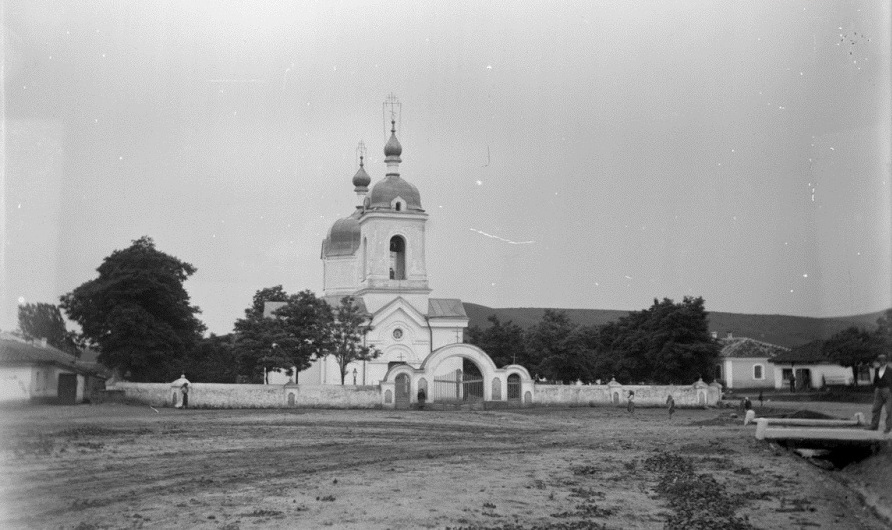
The Church of St. Nicholas in Zuya is one of those quiet places that seem to blend into the landscape, yet hold a story that reveals itself only with time. Tucked away on the edge of a small Crimean village, it stands surrounded by gentle hills and scattered houses. From the outside, it looks unassuming—a simple log structure with a pitched roof and a small dome topped by a cross. There’s no grandeur here, no ornate stonework or towering spires, just a sense of authenticity, as if the early 20th century had paused and never quite moved on.
Dedicated to St. Nicholas the Wonderworker, one of the most revered saints in Orthodox Christianity, the church carries a name tied to protection and guidance, especially for travelers and seafarers. In Crimea, where Christian traditions have long intertwined with Muslim and pagan influences, devotion to St. Nicholas ran deep. It’s no surprise, then, that Zuya, like many other villages across the peninsula, would have a church in his honor. While the exact date of its construction remains unclear, historians place it somewhere between the late 1800s and early 1900s, a period when wooden churches were being built across the region.
The architecture of St. Nicholas Church follows the *kletsky* style, common among rural churches of that era. It’s a straightforward rectangular structure with a gabled roof, free of elaborate details. Inside, the space is divided into a small narthex, the main prayer hall, and the altar. The wooden walls, either left bare or whitewashed, give the interior a warm, understated feel. The iconostasis was likely crafted by local artisans, and the icons themselves were probably donated by parishioners—churches like this rarely had the means to commission works from renowned painters.
Zuya, the village where the church stands, has a history as layered as the land itself. Founded in the 19th century as a modest settlement, it remained a typical rural community for decades. Like much of the Soviet Union, it saw its share of upheaval—churches were repurposed, abandoned, or demolished. St. Nicholas Church was fortunate to survive, though it fell into disrepair for a time. When religious life began to revive in Crimea during the 1990s, the church was returned to the faithful. Since then, it has been gradually restored, with efforts made to preserve its original character.
Today, the church remains active, though it doesn’t draw the crowds of larger cathedrals in Simferopol or Bakhchisarai. Most visitors are locals, with the occasional traveler stopping by out of curiosity about Crimea’s history. Inside, the scent of wood and candle wax lingers in the air, prayers are murmured softly, and sunlight filters through small windows. On Sundays and feast days, the sound of the bell carries across the countryside, a quiet reminder of a slower, more measured way of life.
The surrounding area is worth exploring as well. Zuya sits in the foothills of the Crimean Mountains, offering views of rolling green hills and distant peaks. Unlike the arid southern coast, this region is lush in spring and autumn, with wild grasses covering the land, while summer brings the scent of wormwood and thyme. Nearby, the Zuya River winds through the landscape, narrow but picturesque, its banks lined with willows and stones. During the Soviet era, pioneer camps and rest houses were built along its shores, but many have since been abandoned, slowly reclaimed by nature.
St. Nicholas Church is more than just a place of worship—it’s a cultural landmark, a window into the lives of people who lived here a century ago. Back then, churches weren’t just for prayer; they were community hubs where people gathered for festivals, shared news, and celebrated weddings and baptisms. In a world that has changed beyond recognition, places like this help maintain a connection to the past.
If you ever find yourself in this part of Crimea, it’s worth making the trip to Zuya. Not for a guided tour or a photo opportunity, but simply to stand by the wooden walls of the church, listen to the silence, and reflect on the generations who have passed through here before you. Perhaps the real magic of travel lies in these quiet corners, where history isn’t shouted from the rooftops but quietly embedded in every beam and stone.