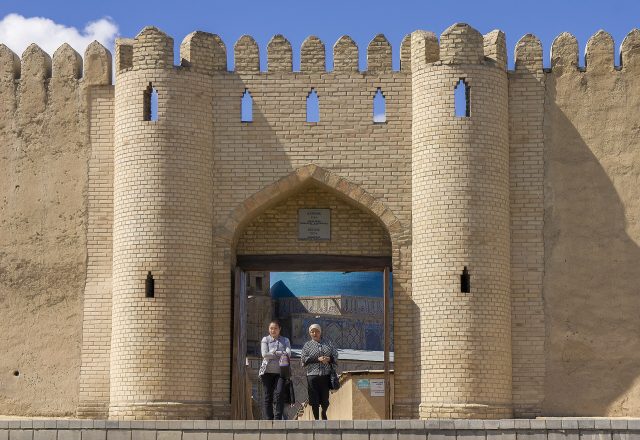
The district akimat building in Old Ikan is one of those structures that quietly blends into the urban landscape, carrying the marks of time and change. Standing in the heart of this small Kazakh town, it doesn’t draw crowds with flashy facades or dramatic historical events. Yet for locals, it serves as a familiar landmark and a symbol of administrative life. This is where daily matters are settled, documents are processed, and officials meet with residents. In that sense, the akimat is more than just an office—it’s a place where the interests of the town and its people intersect.
The building’s architecture is typical of the Soviet era, when functionality took precedence over decoration. Its rectangular shape, clean lines, and minimal ornamentation reflect the utilitarian approach to construction common in the mid-to-late 20th century. The facade is clad in light brick or tile, giving it a neat but somewhat impersonal appearance. Inside, you’d likely find spacious corridors, high-ceilinged offices, and large windows that flood the space with natural light. Such buildings were constructed from standard designs, and the Old Ikan akimat probably doesn’t differ much from hundreds of similar structures across Kazakhstan.
The history of this place is closely tied to the town’s own development. Like many settlements in the region, Old Ikan has seen waves of administrative reforms. The district akimat originated during the Soviet period, initially serving as the local executive committee, or raiispolkom. After Kazakhstan gained independence, the system of governance changed, but the building remained, adapting to new realities. For longtime residents, it may evoke memories of different eras—Soviet bureaucracy, perestroika, or the early years of an independent state.
Today, the akimat is more than just an administrative hub; it’s a place where the pulse of the town can be felt. Public meetings, citizen receptions, and occasional small exhibitions or cultural events take place here. The lobby or ground floor often features information boards detailing local government work, district development plans, and social programs. For visitors, the building might not be a reason to linger, but for those who live in Old Ikan, it’s a familiar part of the landscape—a reminder that the town moves at its own steady, eventful pace.
The surrounding area tells its own story. Near the akimat, you’ll usually find other administrative buildings, shops, cafes, and sometimes a small square or park. During the Soviet era, such places often became centers of public life—where people met after work, strolled, or discussed the latest news. Some of that tradition lingers today, though the rhythm of life has shifted. In summer, benches outside might host elderly men playing chess or watching passersby. In winter, the building stands stark against the snow, which blankets the ground until spring, giving the scene a particularly austere look.
Architecturally, the Old Ikan akimat doesn’t claim to be unique, but there’s a quiet harmony to it. Buildings like this are often taken for granted, yet if you look closely, you can spot details that reveal their age and character. The heavy entrance doors, which once closed with a metallic clang, or the wide staircases designed to accommodate crowds, hint at a time when public institutions were built to last. Inside, old light fixtures or standard-issue paintings of local landmarks might still adorn the walls, adding a touch of nostalgia.
For historians or urban planners, the akimat building could be of interest as an example of Soviet-era urban development policy. Cities expanded rapidly in those years, and standardized designs allowed administrative centers to be built quickly. Old Ikan, like many other Kazakh towns, received its building through such a process. Today, it no longer feels modern, but it continues to serve its purpose, adapting to new circumstances. There’s a certain continuity in that—a structure built for one system now functions within another, retaining its role in the life of the town.
The Old Ikan district akimat isn’t a tourist attraction, nor is it just another faceless office block. It’s a thread in the fabric of the town, reflecting the changes Kazakhstan has undergone over the decades. For some, it’s associated with bureaucratic queues and paperwork; for others, it’s a place to resolve important matters or simply catch up with neighbors. Either way, the building is an integral part of Old Ikan, woven into its history and daily life.