Otrar is one of those rare places where the weight of history feels almost tangible, as if the past hasn’t so much faded as settled into the very ground beneath your feet. Located in southern Kazakhstan, not far from the modern city of Turkestan, this ancient settlement was once a thriving hub along the Silk Road, a crossroads where merchants, scholars, and travelers from distant lands converged. Today, little remains of its former grandeur—just the weathered ruins of walls, foundations, and scattered fragments of a city that once stood at the heart of Central Asia’s cultural and economic life. Yet even in its silence, Otrar speaks volumes about the people who built it, the empires that shaped it, and the slow, inevitable march of time.
The city’s origins stretch back to antiquity, when it was known as Farab, a name that appears in early historical records as a key stop on the trade routes linking China to the Mediterranean. By the medieval period, Otrar had grown into a bustling urban center, its markets filled with the scent of spices, the clatter of pottery, and the murmur of languages from across the known world. It wasn’t just a place of commerce; it was a center of learning, home to scholars whose work would influence generations. Among them was Abu Nasr al-Farabi, the renowned philosopher and scientist, whose legacy is still tied to the city’s name. His presence here underscores Otrar’s role as a place where ideas were as valuable as silk or silver.
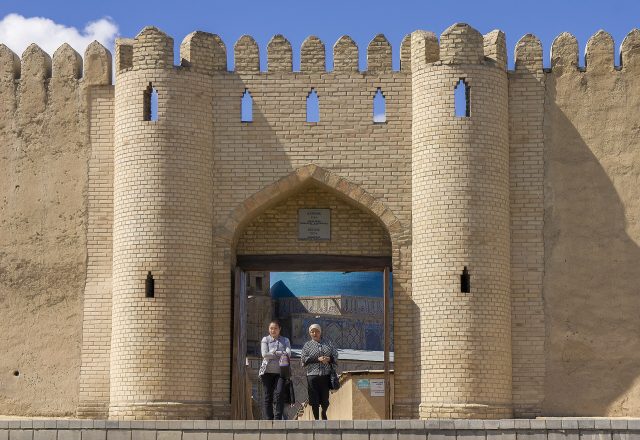
The layout of the city, as revealed by archaeologists, followed the typical pattern of Central Asian urban design. Thick defensive walls, punctuated by watchtowers, encircled the settlement, offering protection against the raids of nomadic tribes. Inside, the streets were lined with buildings made of baked brick and clay—mosques, madrasas, bathhouses, and residential quarters, all arranged in a way that reflected both practicality and the social hierarchy of the time. At the city’s core stood the citadel, a fortified complex where rulers conducted affairs of state and where the most important institutions were housed. Though only the foundations remain today, they hint at the scale of what once was: a city built to endure, even as the world around it changed.
Otrar’s history is marked by moments of both brilliance and tragedy, but none so defining as its fall to the Mongols in the early 13th century. The city was known for its resilience, its walls considered nearly impregnable, yet after a prolonged siege, it succumbed to the forces of Genghis Khan. The aftermath was devastating; according to some accounts, the Mongols deliberately destroyed the city’s irrigation systems, a blow from which Otrar never fully recovered. Yet even in decline, it lingered for centuries, a shadow of its former self, until the shifting sands and the passage of time buried its streets beneath the earth.
Today, Otrar is an open-air museum, a place where archaeologists continue to uncover its secrets layer by layer. Excavations, ongoing since the mid-20th century, have revealed a trove of artifacts—coins, jewelry, pottery, and tools—that offer glimpses into the daily lives of its inhabitants. What makes these discoveries particularly fascinating is the way they reveal the city’s long and complex history. Beneath the medieval structures lie remnants of earlier settlements, and beneath those, traces of even older civilizations. Each layer tells a different story, a reminder that Otrar was never just one city, but many, built and rebuilt over centuries.
Visiting Otrar is a quiet experience, far removed from the crowds and noise of more famous historical sites. There are no tour buses here, no souvenir stalls, just the vast expanse of the Kazakh steppe stretching toward the horizon, the wind sweeping across the ruins, and the occasional sound of a shovel striking earth as archaeologists work. The landscape itself is stark and beautiful, a mix of golden grasslands and distant mountains that frame the ruins in a way that feels almost timeless. It’s easy to imagine the caravans approaching from afar, their camels laden with goods, or the scholars debating philosophy in the shade of a madrasa’s courtyard.
For those with an interest in history, Otrar is a place of deep significance. It’s not just a collection of ruins, but a physical connection to the Silk Road’s golden age, a chance to walk the same paths as merchants, soldiers, and thinkers who shaped the course of civilizations. There are no grand reconstructions here, no attempts to recreate the past in flashy displays. Instead, Otrar invites you to engage with history on its own terms, to piece together the fragments and imagine the rest. It’s a place that rewards patience and curiosity, where the most profound experiences often come from simply standing still and listening.
Beyond its archaeological value, Otrar holds a special place in Kazakhstan’s cultural identity. Its story is intertwined with the broader history of Central Asia, a region that has long been a crossroads of empires and cultures. In recent years, efforts have been made to preserve and promote the site, with academic conferences, cultural festivals, and guided tours helping to keep its legacy alive. These initiatives serve as a reminder that Otrar is more than just a relic of the past; it’s a living part of the region’s heritage, a bridge between what was and what is.
If you find yourself in this part of Kazakhstan, take the time to visit. Walk among the ruins, trace the outlines of walls that have stood for centuries, and let the silence settle around you. There’s no need for grand narratives or dramatic revelations—Otrar’s story is written in the stones beneath your feet, in the wind that carries the echoes of a thousand years. All you have to do is listen.