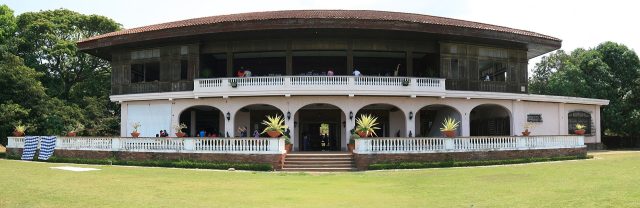
Paoay’s municipal hall isn’t just another government building—it’s one of those rare places where history and architecture merge into something far greater than its original purpose. Tucked away in a quiet town on the northern edge of Luzon, this structure feels like a portal to an earlier era, when the Philippines was under Spanish rule, yet it also carries the unmistakable imprint of local life. Its walls don’t just hold records of bureaucratic decisions; they’ve witnessed the shifts and upheavals that shaped the country over centuries.
Built in the late 1800s, the building reflects a moment when Spanish colonial design began blending with practical Filipino adaptations. The façade is classic in its proportions, but the details reveal a deep understanding of the climate. High ceilings, wide windows, and spacious verandas weren’t just aesthetic choices—they were necessities in a place where heat and humidity demanded constant airflow. The architects of the time managed to balance grandeur with functionality, using wooden beams, stone walls, and clay roof tiles to create a structure that could withstand both scorching sun and torrential rains.
Inside, some of the original features remain, offering a glimpse into how life unfolded here in the past. Wooden panels, intricately carved railings, and antique chandeliers hint at a time when this building wasn’t just a local government office but a place where decisions with regional consequences were made. Over the years, its halls have hosted Spanish officials, American administrators, and eventually Filipino leaders, each era leaving its mark. The building itself has become a kind of archive, its layers telling the story of a town—and a nation—that has seen multiple waves of change.
What makes Paoay’s municipal hall unusual is that it hasn’t been turned into a museum. Unlike many historic buildings that are preserved behind glass, this one remains very much alive. The corridors still echo with the footsteps of employees, voices drift from open doors, and somewhere in the back rooms, stacks of old documents might still be gathering dust. There’s no sense of artificiality here—just the quiet persistence of a place that has continued to serve its purpose, decade after decade.
Paoay itself is a small town, and the municipal hall stands as one of its most significant landmarks. It sits in the center, surrounded by other old structures that together create a sense of stepping back in time. There’s no hustle here, no crowds of tourists—just a quiet square where locals gather in the evenings to sit on benches and talk, much as they have for generations. The trees around the building provide shade, and the slow pace of life makes it easy to imagine how things might have looked a hundred years ago.
The building is also tied to the broader history of the Ilocos region. In the 19th century, this area was a hotbed of resistance against Spanish rule, and many of the decisions that shaped those struggles were made within these walls. Later, during the American occupation, the municipal hall continued to play a key role, serving as a meeting point between colonial authorities and the local population. Today, that history isn’t immediately obvious—there are no grand monuments or plaques—but the building itself carries the weight of those times, its very presence a reminder of how power has shifted over the years.
Architecturally, the municipal hall reflects the evolution of building techniques and tastes in the Philippines. A closer look reveals the use of local materials that set it apart from other colonial structures. The stone for its foundation was quarried nearby, while the wood for its interiors came from neighboring provinces. This makes the building more than just a copy of Spanish designs—it’s a unique blend of imported styles and local craftsmanship, shaped by the environment and the people who built it.
More than just a historic landmark, Paoay’s municipal hall is a symbol of continuity. It hasn’t been frozen in time; it’s still a working government office, where people carry on the traditions of those who came before them. That’s part of what makes it so compelling—there’s no pretense here, no attempt to turn it into a tourist attraction. It’s a place where history isn’t preserved in amber but lives on in the daily routines of those who work there.
For visitors, the municipal hall often serves as a starting point for exploring Paoay. From here, it’s easy to wander through the town’s narrow streets, past old houses, the local church, and the market. Together, these places paint a picture of small-town life in the Philippines, where the past and present coexist without fanfare. The municipal hall isn’t just a building—it’s a key to understanding how this place has endured, adapting to change while holding onto its identity.
In the end, the real value of Paoay’s municipal hall isn’t in its age or its architectural details, but in the way it quietly tells a story. It’s a place where you can feel the weight of history without reading a single plaque. There are no grand declarations here, just the unassuming presence of a building that has served its people for over a century, regardless of who was in charge. And perhaps that’s what makes it so powerful—it’s not a monument to the past, but a living part of the present.