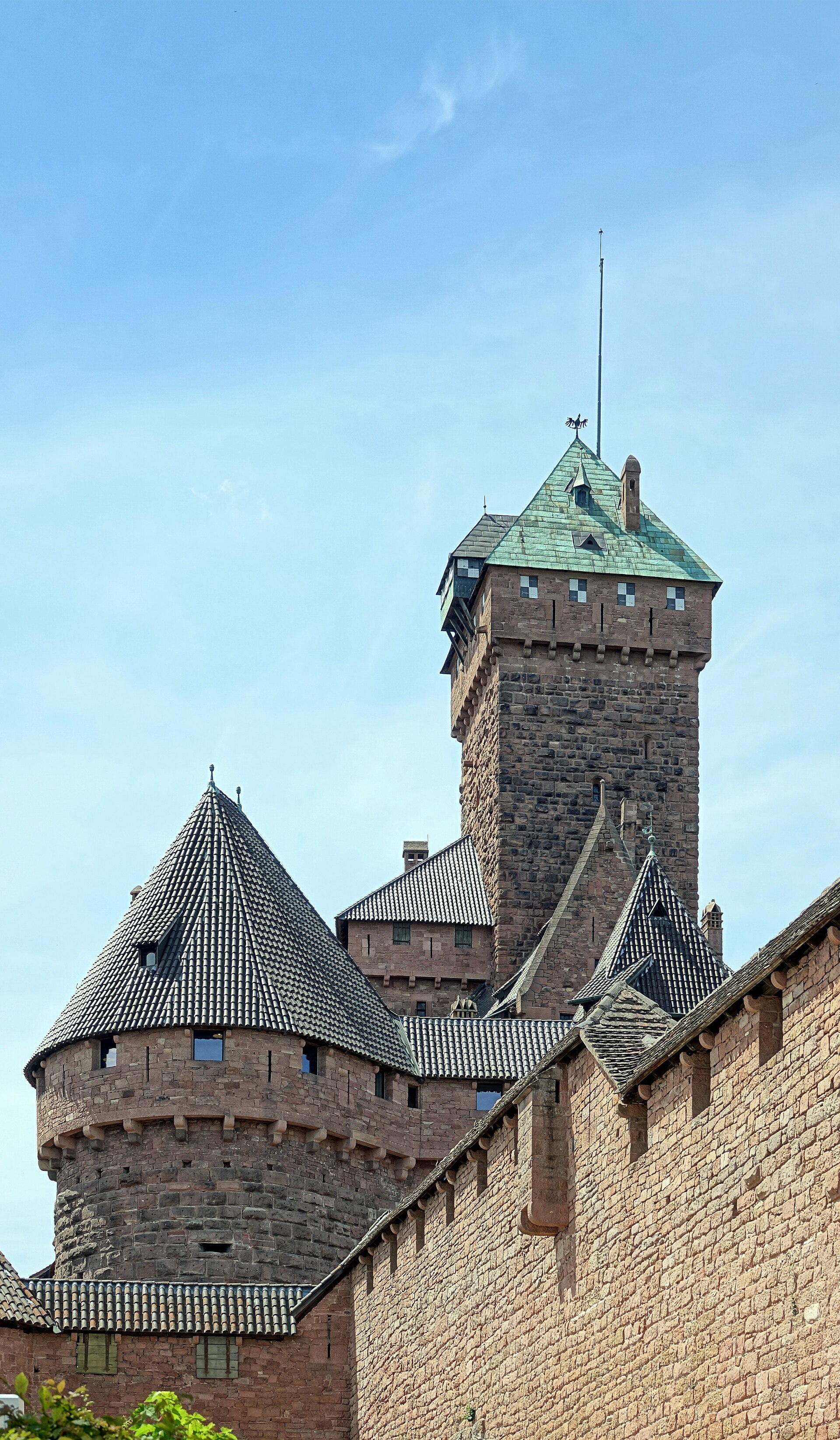
Perched on a rocky spur of the Vosges Mountains, Haut-Kœnigsbourg Castle watches over the Rhine Valley like a silent guardian of centuries past. From its height of nearly eight hundred meters, the view stretches across dense forests, rolling vineyards, and the winding ribbon of the Rhine—a river that once marked the boundary between worlds. This is a place where history feels tangible, where the shifting borders of Alsace and Germany have left their mark in stone and memory. The castle has seen empires rise and fall, wars rage and fade, its walls bearing witness to the ebb and flow of power across Europe.
The first records of Kœnigsbourg date back to the twelfth century, when these lands belonged to the Hohenstaufens, one of medieval Europe’s most formidable dynasties. Built as a strategic stronghold, the castle controlled trade routes and safeguarded the territories of the Holy Roman Emperors. Originally known as Staufeneck, or "Proud Castle," it lived up to its name, standing as a symbol of imperial authority. Over the centuries, it passed through the hands of the Tierstein family and later the Habsburgs, who fortified and expanded it into an imposing fortress. Each new owner left their mark, reinforcing its defenses and adding to its grandeur.
Yet the castle’s history was far from peaceful. In the fifteenth century, it was sacked by the Armagnacs, mercenaries who roamed Europe in search of plunder. The Thirty Years’ War brought further destruction—Swedish troops set it ablaze in 1633, leaving it in ruins for over two hundred years. The forest slowly reclaimed the stones, and locals whispered of ghosts haunting its crumbling halls. It wasn’t until the nineteenth century, when Alsace became part of Germany, that the ruins caught the attention of romantics and historians, who saw in them a relic of a lost era.
The castle’s revival began in the early twentieth century, when Kaiser Wilhelm II commissioned its restoration as a monument to German history and culture. Between 1900 and 1908, architects painstakingly reconstructed not just the exterior but the interior as well, relying on surviving documents and comparable medieval structures. The work was meticulous, with every beam and stone fitted to match historical accuracy. The result is a castle that feels both grand and lived-in, a place where the past isn’t just preserved but brought to life.
Today, Haut-Kœnigsbourg is more than a museum—it’s a journey into medieval life. Walking through its halls, you can almost hear the clatter of feasts in the great hall, the clang of armor in the armory, and the murmur of servants in the kitchens. The keep offers sweeping views of the surrounding landscape, where on clear days the dark outlines of the Vosges Mountains stretch into the distance. The interiors are so carefully recreated that time seems to stand still: heavy oak doors, carved fireplaces, tapestries depicting hunting scenes, and even the faint scent of old parchment in the library.
The castle is deeply tied to Alsace’s complex history, a region that has changed hands between France and Germany countless times. After World War I, when Alsace returned to France, Haut-Kœnigsbourg became a symbol of the shared cultural heritage between the two nations. Today, it welcomes visitors with guided tours in multiple languages, and in the summer, medieval fairs and jousting tournaments bring the past to life. But even without the pageantry, the castle has a presence all its own—a place where history isn’t just learned but felt.
Beyond the castle walls, the Vosges Mountains offer quiet forests and winding trails, while the Rhine Valley is dotted with picturesque villages, vineyards, and ancient monasteries. Autumn is especially beautiful here, when the forests blaze with color and the air is thick with the scent of ripe apples and young wine. Locals take pride in their traditions, from Alsatian cuisine to the legends of knights and outlaws who once roamed these hills.
Visiting Haut-Kœnigsbourg isn’t just about seeing a historic site—it’s about stepping into another time. There’s no rush here, no modern distractions, just the weight of centuries pressing against the stones. In the quiet of the inner courtyard or the dim light of the dungeons, it’s easy to imagine the clank of armor, the fanfare of heralds, and the rustle of noblewomen’s gowns. Perhaps that’s why the castle still draws people in—it reminds us that history isn’t just a series of dates and battles, but a living story woven from the lives of those who came before.