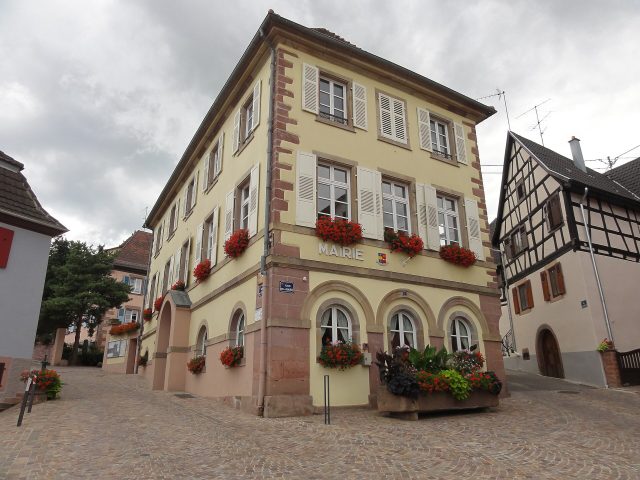
Orschwiller’s cemetery is one of those quiet places that doesn’t demand attention but lingers in the mind long after you’ve left. Tucked away on the edge of a small Alsatian village, it sits where the last houses with their brightly painted shutters and tidy gardens give way to rolling vineyards. The air carries the scent of woodsmoke and fresh bread, and there are no signs pointing the way—most people stumble upon it by accident, or come looking for a family grave. That unassuming quality is what makes it special. This isn’t a curated open-air museum; it’s a living piece of local history, where the past and present exist side by side without fanfare.
The cemetery itself is small, as village graveyards tend to be. It sprawls across a gentle slope, offering views of the vineyards and forested hills beyond. The graves aren’t arranged in neat rows like those in city cemeteries; instead, they seem scattered almost at random, as if each stone found its place by chance. Some are old, their surfaces softened by moss and lichen, their inscriptions in German or French worn nearly smooth—a reminder of Alsace’s shifting borders. Others are well-tended, with fresh flowers and photographs, as if the people buried here are still remembered in daily life. Time moves differently within these walls. Even the occasional hum of a passing car fades into the background, leaving only the quiet rustle of leaves and the distant murmur of the village.
The history of Orschwiller’s cemetery is inseparable from the history of the village itself. Alsace has always been a borderland, and Orschwiller, like so many towns here, has changed hands repeatedly—from the Holy Roman Empire to France, then Germany, and back again. That back-and-forth is etched into the gravestones. Some bear distinctly German names, others French, and a few even carry both, a testament to the mixed marriages that blurred the lines between cultures. Wars and shifting borders didn’t spare the village, and the cemetery holds the memories of those who lived here under different flags, speaking different languages, but always rooted in this land.
The architecture of the graves tells its own story. The oldest date back to the 18th century, when Alsace was still part of the Holy Roman Empire. Those early markers are simple—plain stone slabs with carved crosses and brief inscriptions, reflecting the modest tastes of the time. By the 19th century, when the region was under French rule, the graves became more elaborate. Marble angels, fluted columns, and intricate carvings appeared, mirroring the wealth and aesthetic of the era. Yet even among these grander monuments, you’ll find humble wooden crosses, a reminder that not everyone could afford such finery. By the 20th century, the style had shifted again—graves became plainer, more functional, as if the wars had taught people to value memory over ornamentation.
Among the graves, the military burials stand out, though not in any formal way. Here lie soldiers from both world wars, their white crosses uniform in their simplicity. Some were local men; others came from elsewhere in France or even Germany, drawn into the conflicts that swept through Alsace. The inscriptions are spare—name, rank, date of death—no grand words, just the bare facts. That restraint makes them all the more moving. Each grave represents a life that might have been spent tending these very vineyards, raising a family, or simply growing old in the village. Instead, they ended here, in a quiet corner of a quiet cemetery.
Orschwiller’s cemetery is more than just a resting place; it’s a kind of living archive. The names on the stones reveal which families were prominent in the village, which professions were most common, how traditions evolved over time. Some graves still hold artificial wreaths left by relatives; others have candles or small notes tucked into the flowers. It all gives the sense that the cemetery isn’t cut off from life but remains part of it. Locals visit not just on All Saints’ Day but throughout the year, stopping by to tend to graves, share news, or simply sit in quiet reflection. For them, this isn’t a somber place but a familiar one, where the past feels close enough to touch.
In Alsace, death isn’t something to be hidden or sanitized. It’s treated as a natural part of life, and cemeteries like this one are where that connection between generations becomes tangible. That’s why the graves here are so well cared for—each one represents someone who is still remembered, still honored. Even the oldest, most weathered stones don’t feel truly abandoned. Time and nature may soften the edges, but they don’t erase the memory. The moss that grows on the stones, the ivy that climbs the walls—it all feels like part of the same cycle, a quiet acceptance of how things change and endure.
Visiting Orschwiller’s cemetery isn’t about seeing something grand or unusual. There are no crowds, no souvenir stands, no guides reciting rehearsed stories. What you’ll find instead is silence, the scent of earth and grass, and old stones that hold their secrets close. It’s a place for those who know how to listen, who aren’t afraid to reflect on the fleeting nature of life and what remains after we’re gone. In the end, this cemetery isn’t just about death—it’s about the life that continues around it, the village that carries on, the memories that refuse to fade. It’s a reminder that some things, no matter how quiet, are never truly forgotten.