Pendennis Castle stands on a rugged headland where the River Fal meets the English Channel, a natural stronghold that has guarded the approaches to Falmouth for nearly five centuries. The site was chosen for its commanding position—sheer cliffs drop away on one side, while thick stone walls built in the Tudor era rise on the other. Over the centuries, the castle has witnessed sieges, wars, and the slow transformation of Britain’s defences, its weathered stones holding the echoes of a time when the nation’s borders were constantly under threat.
Construction began in the 1540s under Henry VIII, a king who had broken with Rome and feared retaliation from Catholic Europe. Spain and France loomed as potential invaders, and the king ordered a chain of coastal fortresses to be built along England’s southern shore. Pendennis was one of the most formidable, designed to dominate the bay with its artillery and deter any fleet that dared approach. Local stone was quarried in haste, and within a few years, the castle took shape as a squat, powerful structure, its guns trained seaward. It was never a palace or a noble residence—its purpose was purely military, and its design reflected that uncompromising function.
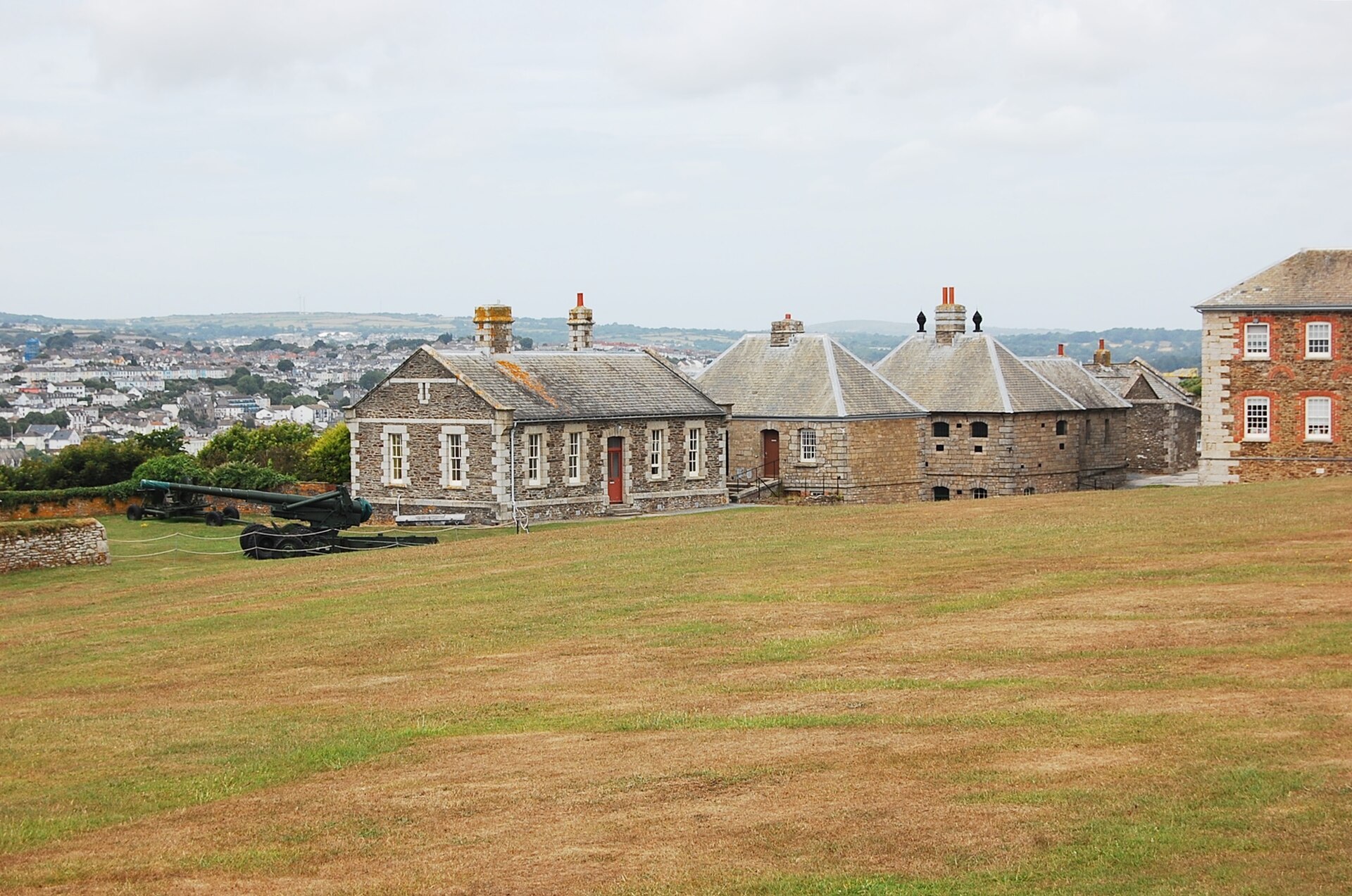
The architecture of Pendennis is a study in contrasts: the raw strength of a fortress built for war, tempered by the lingering elegance of late medieval craftsmanship. The central keep, known as the Keep, is encircled by thick walls punctuated with gun loops and embrasures, their angles calculated to give defenders the widest possible field of fire. Inside, the casemates where gunpowder and shot were once stored remain, along with the cramped quarters where soldiers lived in shifts. Later modifications tell their own story—earthworks added in the 17th century to absorb cannon fire, and 19th-century gun emplacements designed to counter more advanced naval threats. The layers of history are visible everywhere, from the rough-hewn Tudor masonry to the smooth concrete of 20th-century bunkers.
One of the most gripping chapters in the castle’s history unfolded during the English Civil War. By 1646, the Royalists were in retreat across the country, but Pendennis held out as their last stronghold in Cornwall. Under the command of Sir John Arundell, the garrison endured a five-month siege by Parliamentary forces, surrendering only when starvation left them no choice. Local legend claims that the defenders ate their horses, then their dogs, before finally capitulating. The story has been romanticised over the centuries, but there’s no denying the resilience it represents—a stubborn refusal to yield, even in the face of certain defeat.
The castle’s military role didn’t end with the Civil War. During the Napoleonic Wars, Britain braced for a French invasion, and Pendennis, along with its neighbour St Mawes Castle, became a key part of the coastal defence network. The threat never materialised, but the castle remained on alert, its guns ready. In the 20th century, it adapted once more, serving as an anti-aircraft battery in both World Wars and later as a lookout post during the Cold War. Even after its decommissioning in 1956, the castle retained a sense of purpose, as if reluctant to let go of its centuries-old duty.
Today, Pendennis is a place where the past feels tangible. Walking along its ramparts, you can almost hear the shouts of soldiers during a siege or the thunder of cannon fire echoing across the bay. The views from the upper terraces are spectacular—the harbour below, the sweep of the coastline, and on clear days, the distant flash of the St Anthony Head lighthouse, a silent partner in the castle’s long vigil. The landscape itself seems to reinforce the sense of history: the wind-scoured headland, the restless sea, the cries of gulls wheeling overhead. It’s easy to imagine sentries scanning the horizon, watching for the first sign of enemy sails.
Inside the castle, exhibits bring its military history to life. The casemates now house displays of cannonballs, muskets, and the tools of war from different eras, while the old barracks have been restored to show how soldiers lived in the Tudor and Stuart periods. One of the most intriguing collections is the assortment of nautical charts and navigational instruments, a reminder of how closely Pendennis was tied to the sea. In summer, historical reenactments draw crowds, with enthusiasts in period uniforms demonstrating drills, firing muskets, and explaining the workings of the castle’s artillery. It’s a rare chance to see history in motion, rather than just reading about it.
Beyond the castle walls, the surrounding landscape is just as compelling. The headland is a wild, windswept place, covered in heather and gorse, where the air smells of salt and damp earth. Coastal paths lead away from the castle, winding along cliffs and through hidden coves, offering glimpses of seabirds nesting on the rocks below. Nearby, the old fishing villages of the Fal estuary retain their charm, their narrow streets and harbours a testament to Cornwall’s maritime heritage. Falmouth itself, with its bustling port and historic pubs, feels like a place where the past and present coexist easily.
Visiting Pendennis is more than just a history lesson—it’s a chance to step into a landscape shaped by time and conflict. The castle stands as a reminder of how vulnerable, and yet how resilient, this corner of England has always been. It has seen empires rise and fall, wars come and go, and yet it endures, a silent witness to the changing tides of history. Whether you’re drawn by the stories of sieges and battles, the sweeping coastal views, or simply the sense of standing in a place where so much has happened, Pendennis leaves an impression that lingers long after you’ve left its walls.