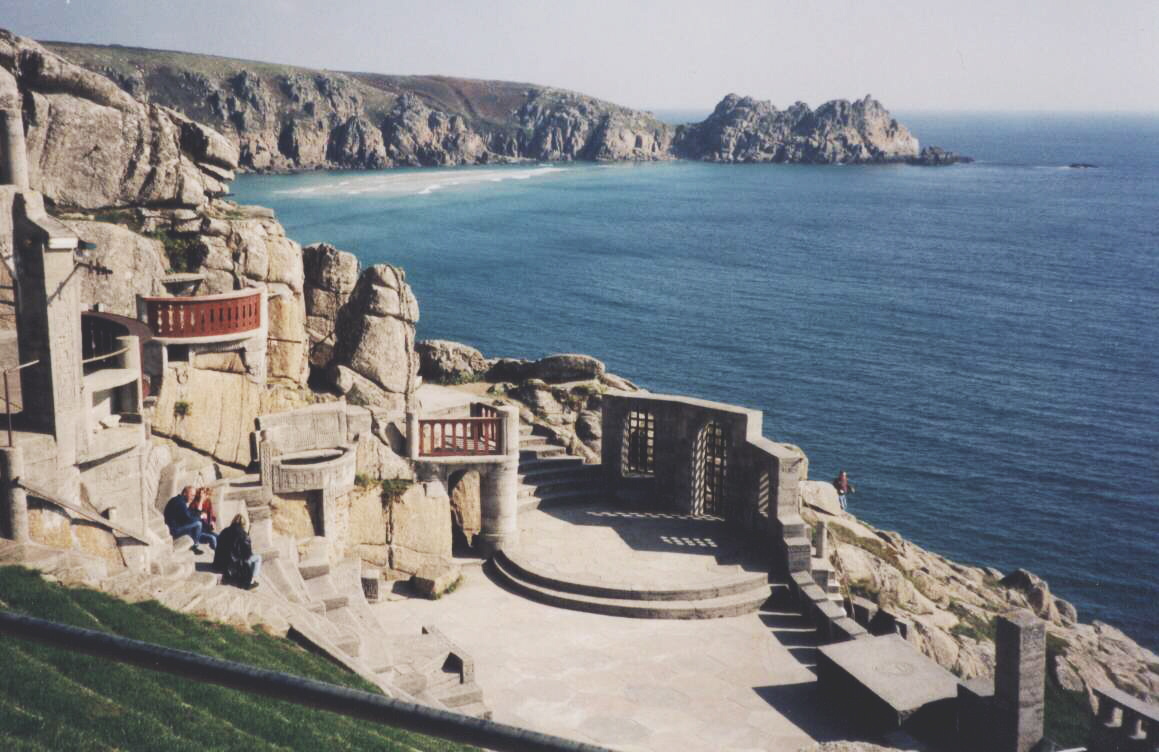
Perched on the edge of Cornwall, where the land gives way to the vastness of the Atlantic, the Minack Theatre feels less like a stage and more like a place where the elements themselves have gathered to watch. It isn’t a grand building with velvet seats and gilded balconies, but an open-air amphitheatre carved into the cliffs, as if the earth had been shaped by centuries of wind and tide just to cradle this small, improbable space. From the moment you step onto the terraced stone seats, the ocean stretches before you, its endless blue merging with the sky at the horizon. The sound of waves crashing against the rocks below becomes part of the performance, a natural soundtrack that no curtain or spotlight could ever replicate.
The theatre’s origins are as unassuming as its setting. In the 1930s, a local actress named Rowena Cade, captivated by the idea of a stage that belonged to the landscape rather than standing apart from it, began transforming a natural hollow in the cliffs near Porthcurno into a place where plays could be performed. There were no grand designs or architectural blueprints—just the land itself, a few helping hands, and the quiet determination to create something that felt inevitable, as though the theatre had always been there, waiting to be discovered. The first productions were modest, put on by amateurs, but even then, the magic of the place was undeniable. During the Second World War, the theatre fell into disuse, its stone seats weathering under the same storms that battered the coast. But in the 1950s, a group of enthusiasts breathed new life into it, and since then, the Minack has become a cornerstone of Cornwall’s cultural life, a place where the past and present coexist without fuss.
What makes the Minack so striking is its refusal to impose itself on the landscape. The seating is cut directly into the hillside, the stone worn smooth by decades of visitors, while the stage itself is little more than a flat expanse of rock, framed by low walls that do nothing to block the view of the sea. There are no elaborate sets or high-tech lighting rigs—just the raw, unfiltered beauty of the surroundings. On clear evenings, the setting sun turns the stage to gold, and the audience watches as the light fades over the water, the boundary between performance and nature blurring with every passing minute. Even when rain sweeps in from the ocean, the theatre doesn’t close its doors. Instead, spectators huddle under makeshift awnings, the sound of the downpour adding another layer to the experience. The Minack doesn’t fight the weather; it lets the weather become part of the show.
Unlike the grand theatres of London or Edinburgh, the Minack has no pretensions. There are no champagne bars or plush lobbies, no crowds jostling for the best seats. Instead, there’s the salt-tanged air, the cry of gulls wheeling overhead, and the quiet rustle of wind through the gorse and heather that cling to the cliffs. Before a performance, people wander along the coastal paths, pausing to watch the waves or to trace the outline of distant headlands. After the final bow, they linger on the benches, talking softly or simply sitting in silence, as if reluctant to leave the spell of the place. There’s no rush here, no sense that the evening must end. The theatre doesn’t demand attention; it earns it, slowly, the way the tide wears down the rocks.
The plays performed at the Minack are as varied as the landscape itself, though they often carry a thread of local history and folklore. Shakespeare is a staple, his words echoing across the centuries in this most timeless of settings, but so too are contemporary dramas, musicals, and even the occasional opera. Yet it’s the stories rooted in Cornwall’s past that feel most at home here—the tales of smugglers and wreckers, of tin miners and saints, of the people who have lived and worked along this coast for generations. In summer, touring companies bring new energy to the stage, but sometimes the performers are locals, people for whom the Minack is a second home, a place where their own stories can be told. The theatre doesn’t just put on shows; it becomes a living archive of the community, a space where the past is never quite forgotten.
What sets the Minack apart is its lack of artifice. There’s no fourth wall here, no strict division between performer and audience. After a show, it’s not uncommon for the actors to join the crowd for a chat, sharing a flask of tea or gathering around a fire as the stars emerge overhead. On nights when the weather turns, performances move to a small covered space nearby, but the atmosphere remains just as intimate, just as unguarded. The theatre doesn’t try to be anything other than what it is—a place where people come together, where the lines between art and life, between the stage and the world beyond it, dissolve into something simpler and more honest.
Porthcurno itself is a place that feels suspended in time. The village is little more than a cluster of stone cottages huddled around a small harbour, where fishing boats still bob in the water and the scent of salt and seaweed lingers in the air. Beyond it, the coastline unfolds in a series of wild, windswept beaches and jagged headlands, their cliffs pockmarked with caves and ancient paths. Nearby, the remains of old tin mines and the mysterious standing stones of the Merry Maidens hint at a history far older than the theatre itself. A walk along the coast before or after a performance feels like a natural extension of the evening, as if the land itself is inviting you to step into its stories. The Minack isn’t just a venue; it’s part of a larger narrative, one that stretches back through centuries of human presence on this edge of the world.
To call the Minack a theatre is almost misleading. It’s more of a meeting place—a convergence of art, nature, history, and the people who carry those things with them. It doesn’t offer grand spectacles or polished perfection. Instead, it offers something rarer: a sense of belonging, of being part of something older and wilder than oneself. Some visitors come once and leave unmoved, seeing only a quaint attraction on a map. But those who stay, who sit through a performance as the light fades and the sea grows dark, often find themselves changed in ways they can’t quite explain. The Minack doesn’t just put on plays; it reminds you that art isn’t something separate from the world, but a way of understanding it. And perhaps that’s why, nearly a century after its creation, it still feels as vital and alive as the land it was built upon.