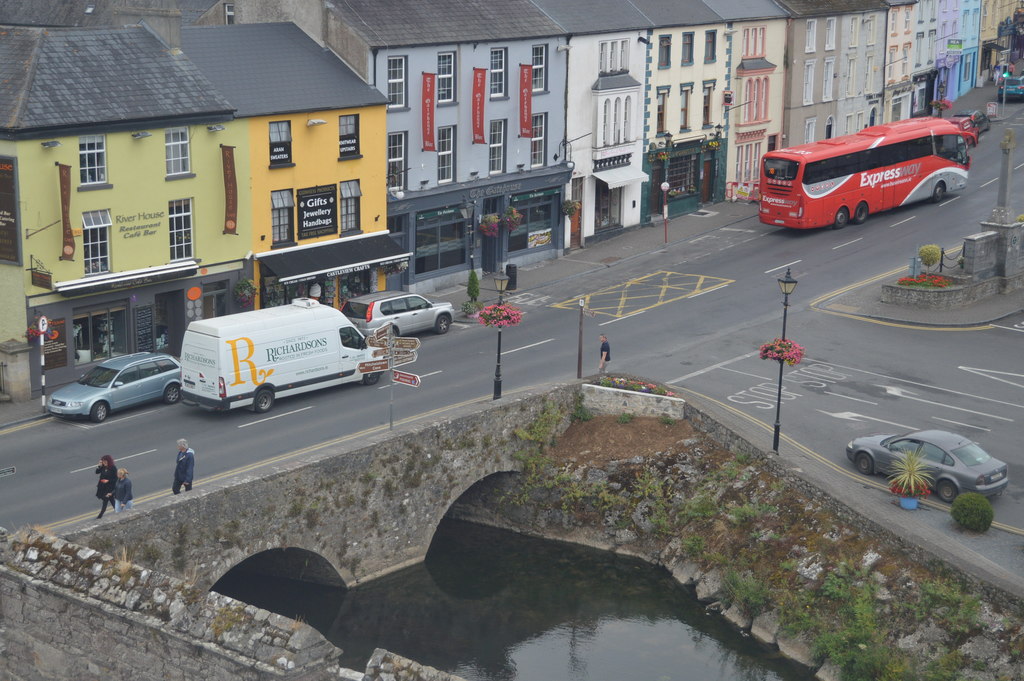
Perched on the banks of the River Suir in County Tipperary, Cahir Castle is one of those rare places where history isn’t just remembered—it lingers in the air, heavy with the weight of centuries. Built in the 13th century as a stronghold for Norman invaders, it was designed not for comfort or grandeur, but for survival. The Normans, who had swept into Ireland after the Anglo-Norman invasion, needed a foothold in the region, and Cahir became one of their most formidable. Over the years, it evolved from a military outpost into a symbol of power, its walls bearing witness to sieges, betrayals, and the shifting loyalties of Ireland’s turbulent past.
The castle’s architecture is a testament to its purpose. There are no ornate carvings or delicate towers here—just thick stone walls, narrow arrow slits, and a squat keep that still dominates the landscape. The design is purely functional, every element serving a defensive role. The inner courtyard, now open to the sky, was once the heart of the fortress, surrounded by high walls that could repel attackers. Though time has worn away parts of the structure, the main tower remains largely intact, its weathered stones standing as a silent reminder of the castle’s former might.
For much of its history, Cahir Castle was controlled by the Butler family, one of the most influential dynasties in medieval Ireland. The Butlers ruled over vast estates in Tipperary and Kilkenny, and Cahir served as one of their key strongholds. Their power, however, was often precarious. During the 16th century, as England’s Reformation took hold, the Butlers—staunch Catholics—found themselves caught between their allegiance to the Crown and the expectations of their Irish subjects. The castle changed hands multiple times, reflecting the broader conflicts of the era. By the 17th century, it had been partially destroyed during the Cromwellian wars, its walls scarred by cannon fire and its halls left to the mercy of time.
Today, Cahir Castle stands in ruins, but it’s far from forgotten. The remains are remarkably well-preserved, offering a glimpse into Ireland’s medieval past without the gloss of modern restoration. There are no museum displays or guided tours here—just the raw, unfiltered presence of history. The River Suir flows past as it always has, its waters reflecting the same hills and skies that would have been familiar to the castle’s original inhabitants. The surrounding meadows, lush and quiet, add to the sense of timelessness, as if the land itself has chosen to keep the castle’s memory alive.
What makes Cahir special is its atmosphere. Unlike the crowded tourist spots in Dublin or Kilkenny, this is a place where you can wander undisturbed, tracing the outlines of old doorways or imagining the clatter of hooves in the courtyard. On a clear day, the view from the tower stretches across the river valley, a patchwork of green fields and distant hills. When the rain comes, the castle takes on a different character—its grey stones blending into the mist, the wind howling through empty chambers like a ghost of the past. It’s easy to lose yourself in the silence, to picture the sentries who once patrolled these walls or the merchants who would have gathered at the foot of the hill.
Cahir Castle is more than just a relic; it’s a piece of Ireland’s story. The surrounding area is rich with other remnants of the past—ancient churches, stone bridges, and manor houses that hint at the region’s layered history. But Cahir stands out as one of the most vivid symbols of Norman influence in Ireland. It’s a place that forces you to confront the complexities of the island’s past: the wars, the alliances, the families who shaped its destiny. The castle doesn’t offer easy answers, but it doesn’t need to. Its very existence is a reminder of how history is carved into the land, one stone at a time.
If you find yourself in this part of Ireland, take the time to visit. Cahir isn’t on the usual tourist trail, and that’s part of its charm. There’s no rush here, no crowds, just the quiet rhythm of the river and the occasional cry of a bird overhead. You might spend an hour or two exploring the ruins, running your fingers along the rough stone or sitting on the grass, listening to the water below. It’s a place where the past feels close enough to touch, where the stories of knights and kings aren’t just tales from a book, but echoes in the wind. Time has worn Cahir down, but in doing so, it’s given the castle a kind of beauty—one that’s all the more powerful for being real.