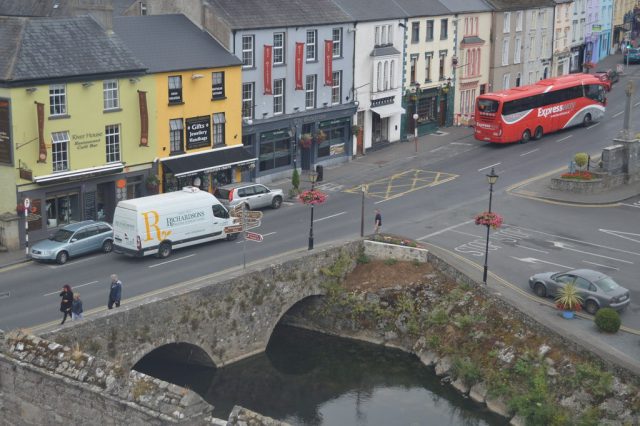
St Mary’s Church in Clonmel is one of those quiet places that seem to hold time still, not just as a relic of the past but as something alive, breathing the same air as the town around it. Standing on the banks of the River Suir, its spire rises above the rooftops, a familiar landmark for anyone passing through. The church has been part of Clonmel for centuries, though no one can say exactly when it first appeared. Records suggest a religious building stood here as early as the 13th century, but the structure you see today is the result of later rebuilds, each layer adding something new while keeping the old.
The architecture tells its own story, blending styles in a way that feels natural rather than forced. The main nave, built in the 14th century, still carries the sharp lines of Gothic design—tall, narrow windows that filter the pale Irish light, pointed arches that draw the eye upward. Inside, though, the space feels different, shaped by Victorian tastes. The pews are dark wood, intricately carved, and the stained glass glows with deep blues and reds, depicting scenes from the Bible in a way that feels almost like a storybook. The altar, gilded and ornate, stands out against the simplicity of the rest of the church, a reminder that even in a small town, faith could be expressed with grandeur.
Clonmel itself is often overlooked in favour of Ireland’s more famous cities, but it has always been a place of significance. In the Middle Ages, it was a fortified settlement, a stop on trade routes that crisscrossed the region. By the 17th century, it had become a battleground during the wars for independence, its streets witnessing both triumph and loss. St Mary’s was part of that history, its walls offering shelter during sieges, its doors opening to both celebration and mourning. Today, the town’s military past is mostly gone, reduced to fragments of old walls and street names, but the church remains, a quiet witness to all that came before.
Stepping inside, you’re met with a stillness that feels almost tangible. The only sounds are the occasional creak of a floorboard or the rustle of a prayer book’s pages. Unlike the crowded cathedrals of Dublin or Galway, St Mary’s sees few tourists. Most visitors are locals, for whom the church is not just a landmark but a place woven into their daily lives. On Sundays, the air fills with hymns, the voices of the choir rising through the nave, and for a moment, the centuries fall away. It’s a reminder that this is not just a building—it’s a living part of the community.
The area around the church is worth exploring, too. A short walk away, a small park stretches along the river, where swans glide past and the water reflects the changing sky. The nearby streets are lined with old stone houses, some still bearing traces of medieval masonry. In the evening, as the sun dips behind the Tipperary hills, the church is bathed in soft light, its silhouette shimmering on the water’s surface. It’s a scene that feels timeless, as if the past and present have merged into something seamless.
St Mary’s isn’t the kind of place that demands attention with grand gestures or overwhelming beauty. Its charm lies in subtler things—the way the light falls through the windows, the quiet strength of the stone, the sense that every crack in the walls has a story to tell. To some, it might just be an old church in a small town, but for those who take the time to look, it offers something deeper. It speaks of faith, of resilience, of the quiet magic that makes Ireland what it is. And sometimes, that’s enough.