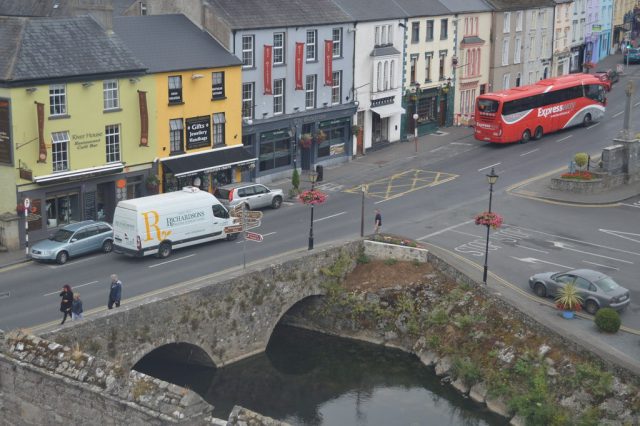
Dickens Bridge in Clonmel is one of those quiet places that don’t demand attention at first glance, yet hold a story worth discovering. This modest stone bridge spanning the River Suir has stood for over two centuries, connecting the banks of a town where life moves at the pace of the water flowing beneath it. There are no crowds here, no souvenir stalls or flashy signs—just the bridge itself, enduring and unassuming, as it has for generations.
Clonmel, a small town in County Tipperary, has never been a place of grand historical events. Its charm lies in its unhurried rhythm, where the main attractions are old churches, cozy pubs, and the riverbanks that shape the town’s character. Dickens Bridge fits seamlessly into this landscape, not as a monument, but as a familiar part of daily life. For locals, it’s simply there—something they pass without much thought, yet it carries a connection to a name known far beyond Ireland’s borders.
The bridge takes its name from Charles Dickens, the celebrated 19th-century English writer. In 1858, during a lecture tour of Ireland, Dickens is said to have passed through Clonmel. By then, he was already famous for novels like *Oliver Twist* and *David Copperfield*, and his readings drew large audiences wherever he went. While Clonmel wasn’t a major stop on his itinerary, the town still claims a brief visit from the writer. Some say he may have walked across this very bridge, taking in the quiet scenery that contrasted so sharply with the bustle of London. Whether he lingered here or simply passed through, the association with Dickens has given the bridge a quiet significance.
Built in the late 1700s, the bridge predates Dickens’ visit by decades. Constructed from local stone, it’s a typical example of the practical engineering of its time—low arches, sturdy piers, and a design meant to withstand both foot traffic and horse-drawn carts. There’s nothing ornate about it; its strength lies in its simplicity. Bridges like this were common in Irish towns where rivers were vital for trade and transport. The Suir, though not a wide river here, was once a busy waterway, with goods moving along its currents and boats docking along its banks.
Today, Dickens Bridge looks much as it did two hundred years ago. The stone has darkened with age, and the railings, once smoothed by countless hands, now bear a faint patina of moss. Cars rarely cross it—the bridge is too narrow for modern traffic—and its visitors are mostly pedestrians, cyclists, and the occasional angler hoping to catch trout or salmon. The Suir here is deep but slow-moving, its surface reflecting the sky on clear days and mist rising in the evenings, lending the scene a timeless quality.
For Clonmel, the bridge is more than just a relic; it’s a living part of the town. Locals might not think much about its history, but ask an older resident, and they’ll likely share memories of playing on it as children, meeting friends here, or sitting by the riverbank watching the water flow. Few places in Clonmel have remained so unchanged, and that continuity gives the bridge a sense of permanence that feels almost rare in today’s world.
Interestingly, Dickens himself left no record of his time in Clonmel. There are no letters or diary entries mentioning the town, yet the story of his visit has endured. It’s possible he did pass through, or perhaps someone in his circle mentioned Clonmel in passing, and the tale took on a life of its own. Either way, the connection to Dickens adds a layer of intrigue to the bridge—not as a grand tribute to the writer, but as a place where history and legend blend naturally.
Dickens Bridge is a reminder that the past isn’t always found in grand monuments or famous landmarks. Sometimes, it’s in the quiet corners of a town, in the stones of an old bridge, in the way the river sounds as it flows beneath. Clonmel hasn’t turned this bridge into a tourist attraction, and that’s part of its appeal. There’s no need for fanfare here—just the chance to stand on the same stones where, perhaps, a literary giant once walked, and to feel the unhurried rhythm of a town that has always moved to the beat of its own time.
If you ever find yourself in Clonmel, take a moment to stop on Dickens Bridge. Look at the river, the old houses along the bank, the people passing by without a second thought. Here, away from the noise of bigger cities, you might just catch that elusive sense of Irish atmosphere—the one that’s often talked about but rarely experienced so purely. It’s not about what the bridge is, but what it represents: a quiet thread connecting the past to the present, and the ordinary to the extraordinary.