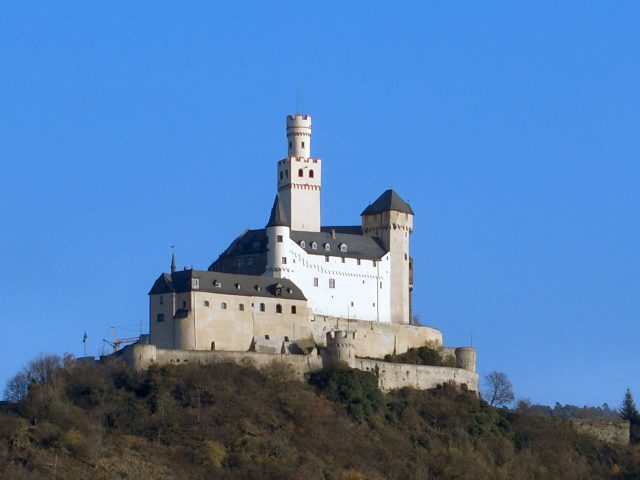
Perched on a hill overlooking the Rhine, Philippsburg Castle has watched centuries unfold from its quiet perch above Braubach. The river below winds through the valley, its banks lined with vineyards and the occasional barge gliding past, while the castle itself stands as a silent witness to the passage of time. Unlike the more imposing fortresses that dot the Rhine, Philippsburg was never built for war. Its purpose was always different—elegance, not defense, shaped its design, and that distinction still lingers in its airy halls and graceful towers.
Construction began in the early 1500s, when the local counts sought a residence that would reflect their status rather than serve as a military stronghold. The result was a blend of late Gothic and early Renaissance styles, with steeply pitched roofs, slender turrets, and large windows that flood the interiors with light. Inside, the original character of the castle remains remarkably intact. Carved wooden ceilings, ornate fireplaces, and faded frescoes hint at the lives of the nobility who once gathered here, their voices echoing in rooms that have seen generations come and go.
The castle’s history is closely tied to one of Europe’s most influential families. In the 17th century, it passed into the hands of the Metternichs, and it was here, within these walls, that Klemens von Metternich was born. Later, as the Austrian Empire’s chancellor and a central figure at the Congress of Vienna, he would shape the continent’s political landscape. Yet despite his global influence, he always returned to Philippsburg, spending summers in the castle and hosting guests in its grand halls. Today, a small museum within the castle preserves his legacy, displaying personal artifacts, documents, and portraits that offer a glimpse into the world of 19th-century diplomacy.
What makes Philippsburg unusual is how little it has changed over the centuries. The interiors still feel lived-in, with antique furniture, tapestries, and paintings arranged much as they would have been in the past. The armory in the cellar houses a collection of weapons and armor, while the knights’ hall, with its massive table and heraldic emblems, evokes the power struggles of an earlier age. In summer, the courtyard comes alive with classical music concerts, the notes drifting through the open windows and mingling with the breeze off the Rhine.
The castle is surrounded by a park that dates back to the 18th century, a place where time seems to slow even further. Ancient trees shade winding paths, and benches offer views of the river below, its waters reflecting the castle’s silhouette. The Rhine here is particularly striking—its curves framed by vineyards and the occasional boat passing by, creating a scene that feels both timeless and effortlessly beautiful. The park is an ideal spot for a quiet walk or a picnic, especially on warm days when the light softens the stone walls and the air carries the scent of grass and distant water.
Braubach itself is a town that moves at its own pace. There are no crowds here, no hurried tourists snapping photos before rushing off to the next attraction. Instead, the streets are lined with half-timbered houses, small cafés, and shops that invite lingering. The castle, with its understated presence, feels like a natural part of the town rather than a relic set apart. It’s a place where history isn’t just observed but experienced—the creak of floorboards underfoot, the coolness of the stone walls, the way the light slants through the windows in the late afternoon.
Philippsburg doesn’t demand attention the way some castles do. There are no towering battlements or dramatic legends of sieges, no stories of ghosts or curses. Instead, it offers something quieter: a sense of continuity, of lives lived within these walls and the slow, steady rhythm of time. It’s the kind of place where you might find yourself pausing in a doorway, running your fingers over the worn wood of a banister, and wondering about the people who stood in that same spot centuries ago.
For those who visit, the castle feels less like a museum and more like a home that has simply outlasted its original inhabitants. The details—the way the sunlight falls across a tapestry, the faint scent of old books in the library, the view of the Rhine from a tower window—are what make it memorable. It’s a place where the past isn’t just preserved but still alive, waiting to be discovered by anyone willing to slow down and listen.