St. Martin’s Church in Braubach is one of those rare places that feels untouched by the centuries, as if the Middle Ages linger in its stones and shadows. Perched along the Rhine, it isn’t just a monument—it’s a thread woven into the fabric of the town, a quiet witness to generations of life unfolding around it. From the outside, its sturdy stone walls and steeply pitched roof command attention, but the real story lies in the details: the worn steps, the uneven floorboards, the way the light filters through ancient glass.
The church took shape in the 12th century, and though it has been altered over time, its core remains unchanged. What began as a Romanesque basilica later absorbed Gothic elements, creating a blend of styles that feels both deliberate and organic. Inside, the space is uncluttered but striking—tall vaulted ceilings, narrow windows casting colored light, pews darkened by age. The pulpit stands out, carved with figures of saints whose expressions seem to shift with the angle of the sun. It’s easy to imagine the voices that once filled this space, the prayers offered in hushed tones.
Braubach’s history is inseparable from the church’s. During the Middle Ages, the town thrived as a trading hub along the Rhine, and St. Martin’s served as more than a place of worship. It was a symbol of stability, a repository for the town’s relics, and a gathering place for decisions that shaped the community. In times of war, its thick walls offered refuge. Even now, as Braubach has settled into a quieter rhythm, the church remains a focal point, a reminder of the bustling life that once defined the town.
Local lore ties the church to St. Martin himself, the patron saint of Braubach. According to legend, it was here, along the Rhine, that he famously cut his cloak in half to share with a beggar. The story has been passed down through generations, and many in Braubach still recount it with pride. A stained-glass window inside the church depicts the saint, his image a quiet testament to the tale. For visitors, it’s a small but meaningful connection to the past.
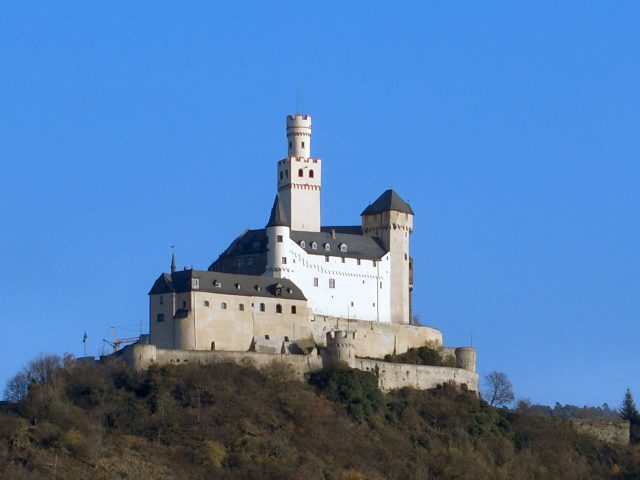
The architecture tells its own story, a layered narrative of changing tastes and techniques. Romanesque arches stand alongside Gothic vaults, while the towering spire offers sweeping views of the Rhine and the surrounding hills. On clear days, the silhouette of Marksburg Castle looms in the distance, perched above the river like a guardian. Scholars have studied the church’s design, but for most visitors, its appeal lies in something less tangible—the sense of time slowing down within its walls.
Inside, the atmosphere is one of quiet reverence. The only sounds are the occasional footsteps of visitors and the soft murmur of the river outside. Light spills through the stained glass, painting the stone in muted hues. There’s no grandeur here, no gilded altars or ornate frescoes, just a simplicity that feels honest. It’s a place that doesn’t demand attention but invites reflection, a pause from the rush of modern life.
The church still serves its original purpose. On Sundays, locals and visitors gather for services, their voices filling the space as they have for centuries. The organ, though old, resonates with a depth that feels timeless. Occasionally, guided tours offer insights into the church’s history, but even without them, the past is palpable. A walk through Braubach’s narrow streets, with the church’s spire always in view, is enough to feel the weight of the years.
St. Martin’s isn’t just a landmark—it’s a living piece of Braubach’s identity. It belongs to the landscape, to the river, to the people who call this place home. Some sites have a way of holding onto the past, of making history feel present. This is one of them. For travelers, it’s a glimpse into another era; for the townspeople, it’s a reminder of where they come from. And perhaps that’s why it endures—not as a relic, but as a place that still matters.