Braubach sits on the Rhine where the Middle Ages haven’t just survived—they’ve stayed in use. The old town, tucked below Marksburg Castle, looks like a Brothers Grimm sketch: cobblestone lanes twist between half-timbered houses with dark beams and white walls, all watched over by the castle’s stone ramparts. Unlike Koblenz or Rüdesheim, Braubach doesn’t hurry. There’s no crowd, no scripted history. The town moves with the past, every corner holding traces of when the Rhine was Europe’s busiest trade route.
The half-timbered houses here were built to save space and materials. Wooden frames filled with clay and straw, then whitewashed. Some buildings later got brighter paint, but most kept their plain look. The sixteenth-century town hall stands out with its carved gable and coats of arms of local rulers. Nearby, St. Martin’s Church rises above the rooftops, its medieval frescoes and carved altar still intact. The real draw isn’t the art—it’s the quiet, the feeling of stepping into a place where time moves slower.
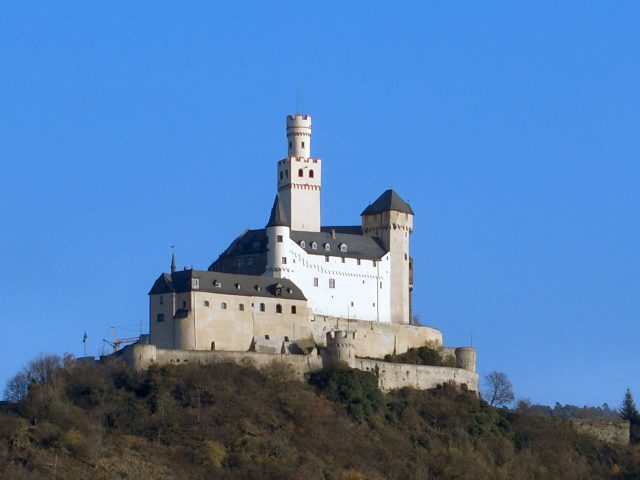
Marksburg Castle is Braubach’s anchor.
It’s the only Rhine castle never destroyed, so it shows medieval life as it was. Built in the twelfth century, the fortress has seen sieges, fires, and repairs, but its core hasn’t changed. You can climb the steep path from the old town or take the funicular, running since the mid-twentieth century. From the castle walls, the Rhine winds between vine-covered hills, villages dotting the opposite bank. Inside, the castle feels lived-in. The great hall with its massive fireplace, the chapel’s stained glass, even the dungeons—all preserved as they were centuries ago. The guides tell stories like they were there, making the past feel close.
Braubach was always a town of trade. Along the Rhine promenade, old warehouses still stand—thick walls and heavy beams once held wine, grain, and goods shipped along the river. Some are now cafés and restaurants, but their structure remains. In summer, sitting outside with a glass of local Riesling while boats drift by is easy. In winter, the promenade empties, the town quieter, the only sounds church bells and the creak of wooden doors.
Wine has always been part of Braubach. The Rhine’s vineyards are famous, and though Braubach isn’t as well-known as its neighbors, it still makes its own vintages. The vineyards cling to the hillsides, their terraces visible from the castle. Winemaking here goes back to Roman times, and in the Middle Ages, wine was one of the most valuable goods shipped along the Rhine. Today, you can taste local Riesling and Pinot Noir at small family-run wineries using traditional methods.
The old town feels layered. Quiet alleys where you might walk for blocks without seeing anyone. Then Marktplatz, where locals gather on weekends. In summer, farmers sell fresh produce. In winter, a modest Christmas market appears. There’s no rush, no sense of being on display. People stroll, chat, stop for coffee. You can wander into a shop and end up talking to the owner, or sit in a café and watch the town wake up slowly.
Braubach’s history is tied to the Rhine. First mentioned in the twelfth century, but settlements likely existed earlier. The river was the region’s lifeline, and Braubach, on its right bank, was a key trading post. Goods from Italy, France, and the Netherlands passed through here. Local merchants dealt in wine, salt, and metals. Over centuries, the town saw wars and shifting borders—part of the Holy Roman Empire, then Prussia—yet its position and Marksburg’s protection kept it safe. By the nineteenth century, steamships and railways reduced its trade role, but Braubach kept its character. Today, it shows the Rhine as it once was: a working river.
Walking through Braubach’s old town feels like stepping into another era. No modern intrusions, no billboards or chain stores. The streets are lined with houses that seem to tell their own stories. The building on Schulgasse was once an apothecary. The former inn *Zum Goldenen Löwen* hosted travelers. Street names hint at the past: Schmiedgasse, Bäckergasse, Winzergasse. The history isn’t just preserved—it feels present, as if the past is still unfolding.
Braubach doesn’t pretend. It’s a small town that has endured by holding onto what it is. No mass tourism, no pressure to perform. Just authenticity, a place that exists for its own sake. You could spend a day wandering the streets, stopping at a bakery or wine cellar, or stay longer to feel the rhythm of daily life. Either way, Braubach leaves you with the sense that you’ve seen something real—not the Germany of travel brochures, but the one that moves at its own pace, rooted in the past yet alive now.