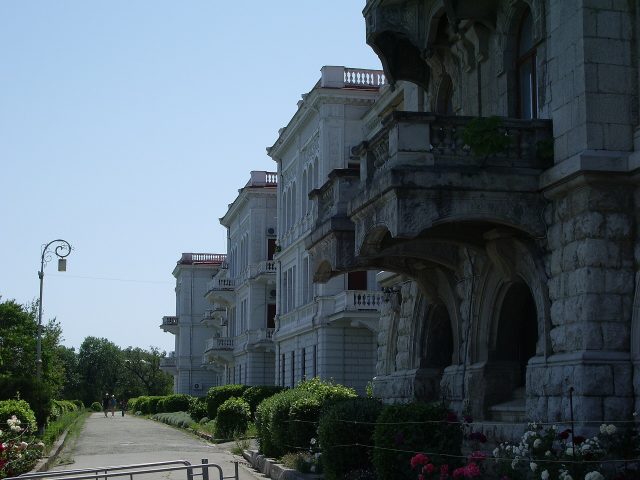
Perched on a gentle hill above the Livadia estate, the Church of the Resurrection of Christ is one of those quiet places that feels suspended in time. From here, the view stretches across vineyards and down to the sea, where the light catches the waves in shifting patterns. The church itself is modest in size, but its white walls and golden domes stand out against the landscape, especially in the late afternoon when the sun turns the gilding into a soft glow. It’s not the kind of place you stumble upon by accident—you have to make a small effort to reach it, and that only adds to its sense of seclusion.
The church was built in the early 20th century, when Livadia was the summer retreat of Russia’s last imperial family. Nicholas II, who spent much of his reign here, wanted a place of worship not just for the court but for the local community, though access was naturally restricted by the presence of the palace. The architect, Nikolai Krasnov, was already well-known for his work in Yalta, and he designed the church in the Neo-Byzantine style that was fashionable at the time. Construction moved quickly, and by 1911, the church was consecrated. It was one of the last major projects completed before the revolution, a detail that gives the building an almost melancholic weight.
Inside, the church is simple but striking. The walls are covered in traditional frescoes, their colors still vivid despite the passage of time. The main altar is dedicated to the Resurrection, while the side chapels honor saints whose names were shared by members of the Romanov family. The white marble iconostasis, crafted by Italian artisans, is particularly fine, its delicate carvings catching the light in a way that makes the space feel both intimate and grand. During the Soviet era, the church was closed, and much of its interior was lost or damaged. It wasn’t until the 1990s that it was returned to the Orthodox Church, and restoration work has been ongoing ever since.
Today, the church remains an active place of worship, with services held regularly. Even when visitors come, the atmosphere stays hushed—there’s an unspoken understanding that this isn’t just another tourist stop. Locals treat the church with reverence, not just as a historical site but as a living part of their community. Occasionally, concerts of sacred music are held here, and the sound of the choir filling the space can be unexpectedly moving, blending solemnity with something almost wistful.
The small garden around the church is a good place to pause. Cypress and laurel trees provide shade, and benches are scattered beneath them. From here, you can see the Livadia Valley unfolding below, the vineyards rolling toward the sea, which on clear days seems to stretch endlessly. In summer, the air is thick with the scent of roses and pine, and the evenings bring the distant glow of Yalta’s lights. Winter transforms the scene—the church’s white walls stand stark against the dark green of the trees and the gray sky, giving it a different kind of quiet grandeur.
What makes the Church of the Resurrection special isn’t just its architecture or its history, though both are compelling. It’s the way the place feels alive with the past. This was where the last tsar came to pray, where courtiers and servants and local villagers would have gathered, each with their own reasons for being there. The church has witnessed revolutions, wars, and decades of neglect, yet it still stands, a quiet witness to all of it. That sense of continuity is rare in a place like Crimea, where so much has been lost or reinvented over the centuries.
If you visit Livadia, the palace will likely be your first stop, but the church is worth the short walk uphill. The view alone is reason enough to come, but stepping inside is even better. The cool, dim interior, the scent of wax and old wood, the way the light filters through the windows—it all invites you to slow down. You don’t have to be religious to feel the weight of the place. It’s enough to stand there, looking at the frescoes or the flickering candles, and think about the generations of people who have done the same. That’s the real draw of places like this: they remind you that history isn’t just something you read about. It’s something you can touch, if only for a moment.