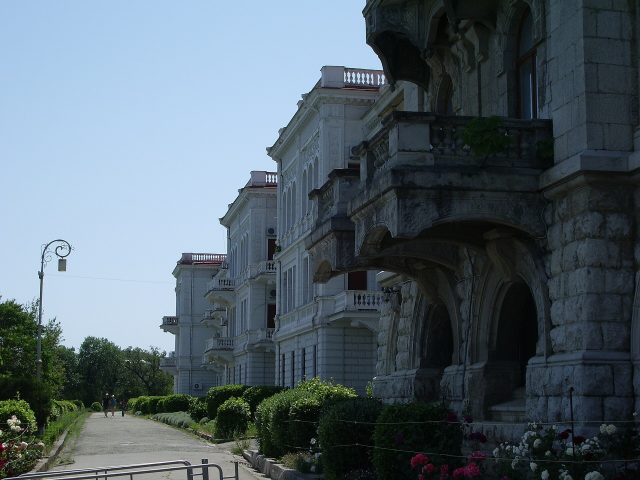
Livadia Palace

(0 reviews)
Free

Overview

Livadia Palace is one of the most famous landmarks on the southern coast of Crimea. The white building, standing among cypress trees and an old seaside park, has long become a symbol of imperial Yalta. The last Romanovs spent their holidays here, the Yalta Conference of 1945 was held here, and today visitors come not only for the history, but also for the unique atmosphere of southern tranquility that is difficult to confuse with anywhere else.

Livadia is located just a few kilometers from the center of Yalta. Once, this area was a small Crimean settlement surrounded by vineyards and orchards. After Crimea became part of the Russian Empire, the southern coast gradually developed into a fashionable resort for the aristocracy. The mild climate, mountains protecting the coast from cold winds, and proximity to the sea made the area especially attractive to the imperial family. In the 19th century, the Livadia estate became property of the Romanovs and turned into one of the main summer residences of the imperial household.

The modern Livadia Palace appeared in the early 20th century. The old residence no longer satisfied Nicholas II, and a decision was made to build a new palace. The project was entrusted to architect Nikolai Krasnov, a man who largely shaped the appearance of pre-revolutionary Yalta. He designed palaces and villas across the southern coast of Crimea for nobility and wealthy industrialists. The new palace was completed remarkably quickly: construction took just over a year and finished in 1911.

The building looked nothing like the strict northern residences of the Russian emperors. Livadia Palace resembles an Italian Renaissance villa more than an imperial palace. Light-colored Inkerman stone, arches, inner courtyards, colonnades, and open terraces blend naturally with the southern landscape. Even on cloudy days, the palace looks bright thanks to the white stone reflecting the light against the greenery of the park.

At the same time, the palace was highly modern for its era. In the early 20th century, it already had electricity, telephone lines, central heating, and elevators. For the imperial family, this was not a ceremonial residence but a place to relax, so the interiors were designed to feel comfortable and intimate. Unlike the grand halls of St. Petersburg, there is no sense of overwhelming palace pomp here. The interiors feel more like a large country home belonging to a wealthy family.

Nicholas II loved Livadia. The family spent long months here, walking through the park, traveling along the coast, and hosting guests. Photographs survive showing the emperor strolling through the alleys with his daughters or sitting on the terrace. It is here that one especially notices how much the last imperial family tried to maintain an ordinary family life, as much as that was possible for people in their position.

After the revolution, the fate of the palace changed dramatically. Like many imperial residences, it was nationalized. During the Soviet era, the building first became a sanatorium. The southern coast of Crimea gradually turned into one of the USSR’s main resort regions, and former palaces were often converted into holiday homes and health resorts.

During World War II, Livadia fell under occupation, but the palace itself survived far better than many other Crimean landmarks. Its greatest international fame came in February 1945, when the Yalta Conference took place here. The American delegation led by President Franklin Roosevelt stayed at Livadia Palace. It was inside the palace’s white halls that the leaders of the USSR, the United States, and Great Britain — Joseph Stalin, Franklin Roosevelt, and Winston Churchill — held negotiations.

The meeting became one of the defining events of the 20th century. The Allies discussed the structure of the postwar world, the future of Germany, the creation of the United Nations, and the future borders of Europe. Opinions about the decisions of the Yalta Conference may differ today, but its significance in world history remains enormous. Rooms connected with those events have been preserved in the palace, including Roosevelt’s study and the conference halls.

Today, Livadia Palace operates as a museum. Its exhibitions focus both on the life of the Romanovs and on the Yalta Conference. Visitors can see the private rooms of the imperial family, ceremonial halls, the inner Italian Courtyard, and historic photographs. Particularly fascinating are the details of everyday life in the early 20th century — furniture, household items, and decorative elements. Thanks to these details, history stops feeling abstract and becomes more human.

One of the palace’s most beautiful places is the Italian Courtyard. Its light arcades, elegant columns, and open space create a feeling of southern ease. Concerts and cultural events are often held here. Even visitors with little interest in history usually remember the courtyard for a long time: it feels both grand and peaceful at the same time.

An equally important part of Livadia is the vast park surrounding the palace. Created in the 19th century, it combines formal and landscape design styles. Cedars, pines, magnolias, plane trees, cypresses, and other southern species grow throughout the grounds. Many people come here simply to walk. Even during the height of tourist season, the park remains fairly quiet, especially away from the main paths.

The famous Sun Trail, once known as the Tsar’s Trail, begins at the palace. It is one of the best-known walking routes along the southern coast of Crimea. The trail stretches for almost seven kilometers along the slopes above the sea toward Gaspra. It was designed specifically for walks by the imperial family, so the route was made as comfortable as possible, without steep climbs or difficult sections. Along the way, visitors enjoy views of the sea, cliffs, and the Yalta coastline.

Livadia remarkably combines several layers of history at once. Here, one can sense the atmosphere of the late Russian Empire, the memory of the Soviet era, and the legacy of mid-20th-century world politics. At the same time, the palace does not feel like a heavy monument to the past. Perhaps it is because of the setting itself — the sun, the sea, and the mild climate. Even in winter, there is plenty of light here, while in summer the palace’s white walls seem to glow against the southern greenery.

A special resort atmosphere has long surrounded the palace. Nearby are sanatoriums, old villas, and small streets descending toward the sea. Many viewpoints overlook Yalta Bay and Mount Ai-Petri. In clear weather, the scenery looks almost postcard-perfect while still feeling completely natural.

Livadia Palace often appears in films and photographs. Its architecture is instantly recognizable, while its history attracts a wide range of visitors — from admirers of the imperial era to those interested in world politics. Yet even without a guided tour, the palace leaves a strong impression. Not only the museum exhibitions matter here, but also the atmosphere itself: the sound of trees, the scent of sun-warmed stone, and the view of the sea between the columns.

It is difficult to imagine the southern coast of Crimea without Livadia. The palace has become as much a part of Yalta’s image as the promenade or the silhouette of Ai-Petri. At the same time, it does not feel like a frozen museum piece. People still stroll through the grounds, tourists take photographs, and exhibitions and concerts continue to be held here. History remains alive not only inside the exhibitions, but in the space itself.

Many travelers say the best time to visit is in the morning or closer to evening, when it becomes quieter and the light softens. At those hours, it is especially noticeable how harmoniously the palace fits into the surrounding landscape. The white walls, dark cypresses, blue sea, and mountains create the classic southern Crimean scenery that has drawn visitors here for more than a century.

Livadia Palace is not simply a former imperial residence. It is a place where personal stories, architecture, politics, and the resort life of Crimea intersect. Here, visitors can glimpse the world on the eve of the great upheavals of the 20th century, experience the atmosphere of old Yalta, and simply spend several peaceful hours surrounded by the sea, the park, and the quiet palace alleys.
Show more

Location & Maps

Contact Info

Review (0)