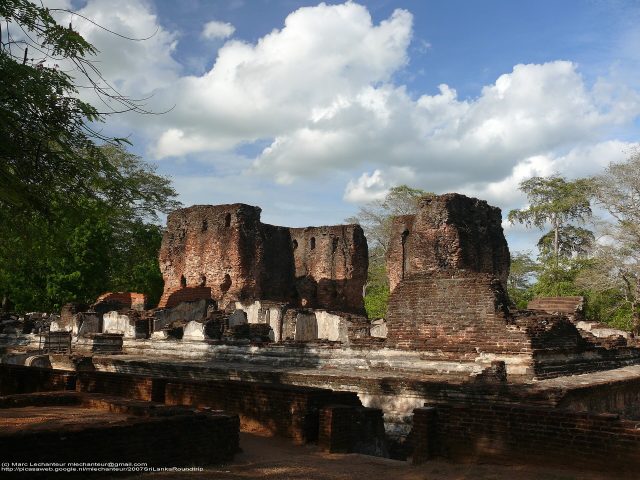
Polonnaruwa doesn’t reveal itself at first glance. There are no bustling streets or crowds of tourists here, just the quiet rustle of palm leaves and the distant chatter of monkeys in the treetops. The city feels suspended in time, its ancient stones holding stories of a kingdom that once thrived.
This was the heart of the Sinhalese kingdom, a capital that rose to prominence after Anuradhapura fell. Among its ruins, Vatadage stands as a quiet testament to that era. Unlike the grand stupas or towering rock fortresses elsewhere in Sri Lanka, this small circular temple feels almost intimate, as if it were built for contemplation rather than display.
Vatadage was constructed in the 12th century under King Parakramabahu the Great, though its exact purpose remains debated. Some believe it once housed the sacred tooth relic of the Buddha, while others suggest it served as a site for royal ceremonies. Whatever its original function, the structure became a defining example of Sinhalese architecture of the period. The temple’s design is deceptively simple—a low circular platform surrounded by a stone railing, with four entrances aligned to the cardinal directions. At its center, a small stupa once rose beneath a wooden spire, now long gone. The real beauty lies in the details: the intricately carved columns that once supported the roof, each one unique, adorned with lions, elephants, and mythical creatures frozen in stone.
What sets Vatadage apart is its sense of lightness. Unlike the massive stupas of Anuradhapura or the dramatic rock temples of Sigiriya, this structure feels almost delicate. The circular layout may have symbolized eternity, while the four entrances suggested inclusivity, a place open to all. It wasn’t meant to dominate the landscape but to blend into it, part of a larger religious complex that has since faded into the earth. Today, only fragments remain—crumbling walls, the bases of other buildings, and the temple itself, standing as a solitary survivor.
Time hasn’t been kind to Vatadage. The roof is gone, some columns have collapsed, and the central stupa is now little more than a grass-covered mound. Yet the place hasn’t lost its power. There are no explanatory signs, no barriers keeping visitors at a distance. You can walk among the columns, run your fingers over the cool stone, and try to imagine the temple as it once was—a place of worship, ceremony, and quiet reflection. The air is still, broken only by the occasional rustle of leaves or the distant call of a bird.
The best time to visit is early morning, when the light is soft and the shadows long. The rising sun catches the carvings, highlighting the craftsmanship in the stone. There’s a sense of solitude then, with only the occasional monkey or a flock of birds for company. By late afternoon, the temple is bathed in golden light, the stones glowing warmly against the greenery. It’s easy to linger, to sit on one of the low walls and watch the day fade.
Vatadage isn’t a place that overwhelms with scale or grandeur. It’s modest, almost understated, yet there’s a quiet strength in its simplicity. Standing among its ruins, you can’t help but feel the weight of history—not as something distant, but as something tangible, almost within reach. That’s why it draws those who seek more than just a photo opportunity. Here, in the silence, the past doesn’t feel so far away.