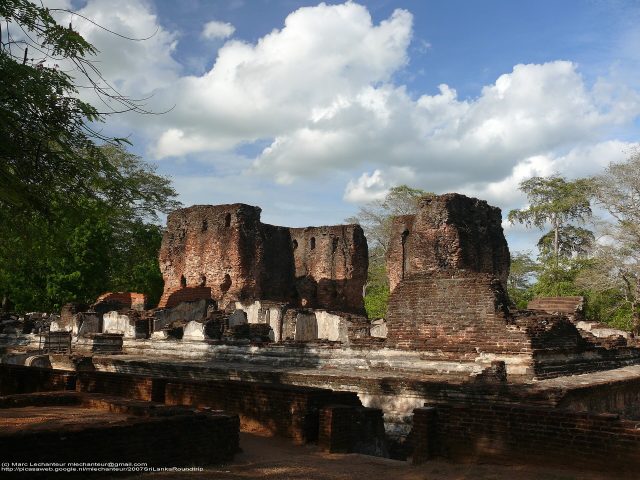
Polonnaruwa carries the quiet weight of history. The past lingers here like the scent of damp earth after rain. Once the capital of medieval Sri Lanka, the city now rests in gentle decay, its ruins softened by time and overgrown with vegetation. Among its scattered remnants of palaces, monasteries, and man-made lakes, Shiva Devale No. 1 stands apart—not for its size, but for its stillness.
Tucked away from the main paths where tour groups gather, the temple is rarely visited. The only sounds are the rustle of leaves and the occasional call of a bird.
Built in the 12th century under King Vijayabahu I, the temple dates to Polonnaruwa’s peak as a center of power. Unlike most structures from that era, which were made of brick and stone, Shiva Devale No. 1 was constructed from granite. The material required extraordinary skill to shape. Its durability suggests the temple held special significance, possibly as a place of worship for the Tamil community in the city.
Sri Lanka has always been a crossroads of cultures. During this period, Hinduism coexisted with Buddhism, which had become the state religion. The temple reflects that coexistence.
The architecture is simple. The temple is a modest rectangular building with thick walls and a flat roof, echoing the style of South Indian shrines. The entrance is framed by carved columns, their surfaces worn smooth by centuries of wind and rain. Inside, dim light reveals a stone pedestal where a statue of Shiva once stood. The statue is gone, but the space feels charged with the echoes of rituals—incense, prayers, the murmur of devotion.
Shiva Devale No. 1 is a fragment of a larger story about how different communities shaped Sri Lanka. By the time the temple was built, Buddhism had taken root on the island, but Hinduism remained part of daily life, especially among traders and artisans from southern India. The temple was likely part of a larger complex where Tamil families lived, worked, and prayed. Today, little remains of that community, but the temple has survived better than many other structures from the same era.
It stands as a silent witness to a time when Polonnaruwa was a melting pot of cultures, where languages, traditions, and beliefs intertwined.
The temple’s history also shows how attitudes toward heritage have changed. After Polonnaruwa’s decline, Shiva Devale No. 1 was abandoned, swallowed by the jungle. It wasn’t until the 19th century, when British archaeologists began exploring Sri Lanka’s ancient cities, that the temple was rediscovered. Rather than restoring it, they preserved its weathered authenticity. The cracks in the stone and the moss creeping up the walls are part of its charm.
Visiting Shiva Devale No. 1 is different from the more famous sites in Polonnaruwa. There are no grand facades or crowds here. Instead, there’s a sense of intimacy, a chance to step into a space that has remained largely unchanged for centuries.
The temple is surrounded by trees, their roots twisting around the stone. Early mornings and late afternoons are the best times to visit, when the light filters through the leaves and casts a golden glow on the granite. In those moments, the past feels close.
What makes Shiva Devale No. 1 special isn’t its size or decoration. It’s the way it invites reflection. It’s a place for those who appreciate history not just as facts, but as something lived. Sitting on one of the worn stone steps, you can imagine the people who once gathered here—their hopes, their fears, the quiet moments of faith that bound them.
The temple doesn’t demand attention. It offers a chance to slow down and listen.
If you’re in Polonnaruwa, take a detour from the well-trodden path to visit Shiva Devale No. 1. While the city’s grand Buddhist monuments are impressive, this small temple has its own quiet power. It doesn’t shout its importance. It simply exists, a survivor of a time when different worlds intersected on this island.