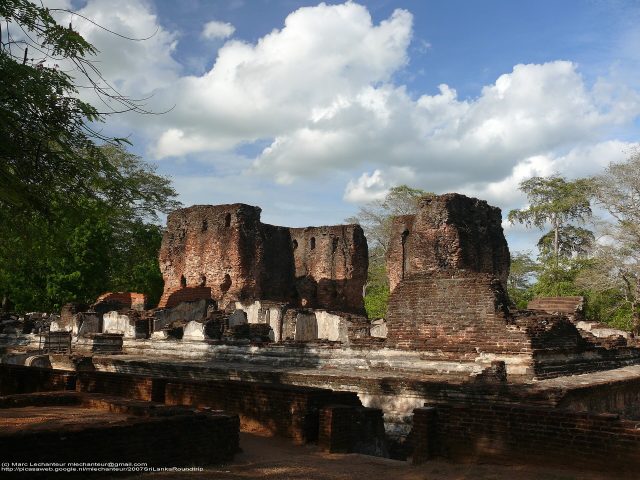
Polonnaruwa is one of those places in Sri Lanka where history isn’t just preserved in museums—it lingers in the very air, etched into the weathered stones of an ancient capital. At the heart of this ruined city stands the Royal Palace, built in the 12th century under the reign of King Parakramabahu the Great. More than just an architectural relic, it’s a silent witness to an era when the island flourished as a center of culture, trade, and military power. This was where the fate of a kingdom was decided, where envoys were received, and where the weight of governance shaped the lives of an entire people.
What remains today are fragments of that grandeur—walls, columns, and the skeletal outlines of chambers that once pulsed with life. The main structure, known as the *Pasada*, was said to have risen seven stories high, though only three levels survive. Inside, thick brick walls, over a meter deep, were designed to shield against both the scorching heat and enemy arrows. The stone floors, worn smooth by centuries, still bear the faint impressions of footsteps—those of rulers, courtiers, and servants who once moved through these halls. It’s easy to imagine the palace in its prime, its walls adorned with frescoes, its wooden beams carved with intricate patterns, and its halls filled with the murmur of voices during grand ceremonies.
The architecture here is distinctly Sinhalese, marked by a sense of restraint rather than ostentation. There’s a practical elegance to the design, with columns arranged to create an illusion of space despite the compact layout. Some chambers still show traces of staircases that once spiraled upward, though the steps themselves have long since crumbled. The builders clearly understood the climate—high ceilings and narrow windows were cleverly positioned to keep the interiors cool, even under the relentless tropical sun.
Beyond the palace, the royal complex sprawls with other remnants of its former life. Nearby lies the audience hall, where the king would have received subjects and foreign dignitaries. Its walls are adorned with stone reliefs depicting scenes of courtly life, offering glimpses into the rituals and hierarchies of the time. Not far off, the ruins of royal baths hint at a society that valued both power and comfort. Water was channeled through an intricate system of conduits, fed by vast artificial reservoirs constructed under Parakramabahu’s rule—a testament to the engineering prowess of the era.
Polonnaruwa’s time as the capital of Sri Lanka was relatively brief, lasting little more than a century and a half, yet it was a period that defined the island’s golden age. Parakramabahu the Great wasn’t just a builder of palaces; he was a unifier, ending decades of internal strife and strengthening the kingdom’s borders. His reign saw the revival of Buddhism, the expansion of irrigation systems, and the consolidation of a nation. The palace wasn’t merely a residence—it was the nerve center of a civilization, where decrees were issued, alliances forged, and the course of history set.
Now, the ruins are wrapped in a quiet that feels almost deliberate. The only sounds are the rustle of leaves, the occasional call of a bird, and the soft footsteps of visitors wandering through the remains. The surrounding landscape is a mix of overgrown shrubs and the distant shimmer of artificial lakes, still holding water after centuries. For locals, this place is more than a tourist attraction—it’s a living connection to the past, a spot where they come to reflect or simply sit in the shade of ancient walls. Time moves differently here, as if the stones themselves are reluctant to let go of the stories they’ve witnessed.
Visiting the Royal Palace isn’t like stepping into a grand, reconstructed monument. There are no vibrant murals or gilded decorations, just the raw, unfiltered presence of history. Each stone feels like a fragment of a larger narrative, one that speaks of the people who built, inhabited, and ruled these halls. Unlike later sites where legend and fact blur, Polonnaruwa offers something more tangible—a glimpse into the realities of medieval Sri Lanka, with all its hardships and quiet majesty.
The best time to experience the palace is in the early morning, when the first light of dawn spills across the ruins, casting long shadows from the columns. The air is cool, the atmosphere hushed, as if the place is still waking from a centuries-long slumber. Or, if you prefer, linger until dusk, when the fading light softens the edges of the stones, turning them golden. In those moments, it’s not hard to picture the scene as it once was—the bustle of markets, the solemn processions of monks, the distant hum of music, and the voices of people for whom this palace was the very center of their world.