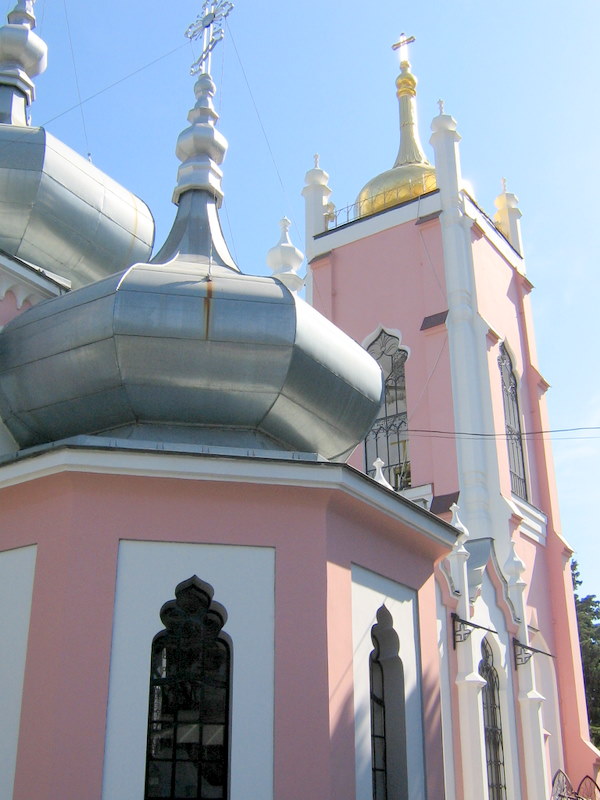
Perched on a gentle hillside overlooking Yalta, the Church of St. John Chrysostom feels like a quiet guardian of the city’s past. Its white stone walls and golden domes catch the sunlight from afar, standing out against the lush greenery and the distant shimmer of the Black Sea. Built in the late 19th century, when Yalta was transforming into a retreat for Russia’s aristocracy, the church was meant to serve not just as a place of worship but as a spiritual anchor for those drawn to the Crimean coast. Its presence is unassuming yet striking, a reminder of the slower rhythms of life that once defined this seaside town.
The church’s origins are tied to the boom of Yalta as a resort destination. As grand estates and villas sprang up along the coast, the need for a proper Orthodox church became clear. Funds were gathered from both wealthy visitors and local residents, a collective effort that reflected the community’s desire for a sacred space in their growing city. Construction took several years, and in 1892, the church was consecrated in honor of St. John Chrysostom, one of the most revered figures in Orthodox Christianity. The choice of patron saint was no accident—his teachings on humility and wisdom resonated with the values of the time.
Architecturally, the church blends traditional Russian elements with the softer, more open styles favored in southern climates. The design leans toward the Neo-Byzantine, a popular choice in the late 19th century, but there’s a lightness to the structure that feels distinctly Crimean. The white stone walls seem to glow in the Mediterranean sun, while the arched windows and high ceilings create a sense of airiness inside. The interior is equally thoughtful, with an iconostasis painted by Moscow artisans, intricate frescoes, and gilded details that lend the space a sense of reverence. The play of light through the stained glass adds warmth, making the church feel both grand and intimate.
Like many places in Crimea, the church has witnessed its share of history. During World War II, it endured shelling but survived, a small miracle in a region that saw so much destruction. In the Soviet era, when religious institutions faced suppression, the church was nearly closed, but local residents fought to keep it open. Today, it remains an active place of worship, hosting services, baptisms, and weddings. On feast days, the sound of the choir and the scent of incense fill the air, drawing both the faithful and curious visitors. It’s a place where history isn’t just preserved—it’s still being written.
The church’s location adds to its charm. A steep staircase lined with cypress and palm trees leads up to the entrance, offering glimpses of Yalta’s rooftops and the sea below. At the top, a small terrace provides a quiet spot to take in the view—whitewashed buildings cascading down to the waterfront, the curve of the bay, and the endless blue of the sea. Around the church, a modest garden invites visitors to sit on a bench, away from the bustle of the city. Unlike the crowded promenades or tourist-packed landmarks, this place feels untouched by time, a rare pocket of tranquility in a resort town.
Inside, the atmosphere is one of quiet reflection. Sunlight filters through the stained glass, casting soft hues over the icons and gilded accents. Even those who don’t consider themselves religious often find themselves lingering, drawn in by the stillness. In summer, the thick stone walls keep the interior cool, while in winter, the glow of candles and oil lamps creates a cozy warmth. The most magical moments come during evening services, when the flickering light makes the church seem to glow from within, as if lit by something beyond the physical world.
Beyond its religious significance, the Church of St. John Chrysostom is a living piece of Yalta’s identity. It’s a counterpoint to the city’s reputation as a playground for sun-seekers, a reminder that this place has depth. The church has seen empires rise and fall, wars come and go, yet it endures, much like the traditions it represents. For visitors, it offers more than just a glimpse into the past—it’s a chance to step out of the present, if only for a moment, and feel the weight of history in a place where time seems to move differently.
Whether you come to pray, to admire the architecture, or simply to escape the crowds, the church leaves an impression. It’s not the kind of place that demands attention, but rather one that rewards those who take the time to notice it. In a city known for its beauty, the Church of St. John Chrysostom stands as a quiet testament to the enduring power of faith, art, and the human need for places that connect us to something greater than ourselves.