Nikitsky Botanical Garden
Overview
Nikitsky Botanical Garden is one of those places on the southern coast of Crimea that people visit not to tick off another landmark in a guidebook, but for the feeling of a slow-paced southern world where the scent of pine blends with sea air and paths disappear into the shade of old cypress trees. Located between Yalta and Gurzuf on slopes descending toward the sea, it has long become more than just a scientific center — it is part of Crimea’s landscape and cultural memory.
The garden was founded in the early 19th century, when the Russian Empire was actively developing Crimea. In 1812, by decree of Emperor Alexander I, a state botanical institution was established here. One of the key figures in its history was Christian Steven, a botanist and scientist often called the “Nestor of Russian botanists.” He began assembling collections of plants from around the world and transformed the garden into an important center for studying southern crops and subtropical species.
The location for the garden was chosen carefully. Crimea’s southern coast is known for its mild climate, with short warm winters and long sunny summers. Thanks to these conditions, plants that could hardly survive in most other parts of Russia were able to take root on the slopes near Nikita. Over the past two centuries, thousands of species of trees, shrubs, and flowers have been brought here from the Mediterranean, Asia, the Americas, and the Caucasus.
Today, Nikitsky Botanical Garden is a vast area where it is easy to spend an entire day. It does not feel like a strict open-air museum. Instead, it resembles a large southern park where scientific work quietly coexists with leisurely walks. Some visitors come for the rare plants, while others simply want to escape the bustle of Yalta and wander through shaded alleys.
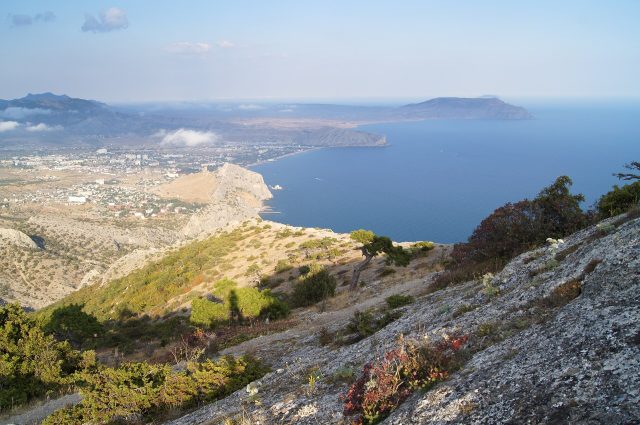
The main entrance welcomes visitors with towering trees and the scent of pine needles. Even during the hottest summer months, the air here feels cool. Old cedars, cypresses, and pines form a dense green canopy through which soft light filters down. Winding paths stretch along the slopes, opening views of the sea between the trees. On clear days, the horizon seems endless.
One of the garden’s best-known sections is the Upper Park. Here, the traditions of the old Crimean botanical school are especially evident: the plants were arranged so the garden would remain beautiful in every season. Magnolias and cherry blossoms bloom in spring, roses fill the air with fragrance in summer, autumn brings the famous Chrysanthemum Ball, and in winter the evergreen shrubs and conifer collections remain vibrant.
The Chrysanthemum Ball is a story of its own. Held for many decades, this exhibition has become one of Crimea’s main autumn traditions. Huge flower beds are covered with hundreds of chrysanthemum varieties in every imaginable shade, from snow white to deep burgundy. Many people travel here specifically for this season, when the garden looks especially vivid against the calm autumn sea.
The rose garden is equally popular. During the warm months, hundreds of rose varieties bloom here, and walking among them feels reminiscent of the old southern resorts of the early 20th century. On hot days, the fragrance of flowers mixes with the scent of warm earth and pine. The garden is especially beautiful in the evening, when the sunlight softens and the slopes glow with golden light.
The atmosphere changes in the Lower Park. There are more old trees and shaded corners here, and many of the plants were planted back in the 19th century. Some of the cedars and sequoias are striking in size, while nearby visitors can see bamboo, palms, laurels, and rare conifer species. Because of the mix of climatic zones, walking through the garden can sometimes feel like traveling through several different countries at once.
The cactus and succulent collection is another highlight. In Crimea, these plants look surprisingly natural: there is plenty of sunshine, and the mild climate allows many species to grow outdoors. Against the backdrop of the sea and rocky slopes, they create an atmosphere that feels almost Mediterranean.
Nikitsky Botanical Garden is known not only as a tourist attraction but also as an important scientific center. Research continues here to this day. Scientists work on plant breeding, study subtropical crops, and preserve rare species. New varieties of fruit trees, grapes, and ornamental plants were developed in Nikita, and for many years the garden played a major role in Crimean agricultural science.
Winemaking also occupies a special place in the garden’s history. In the 19th century, experiments were carried out here to cultivate grapes and study varieties suited to the southern coast. This work influenced the development of Crimean viticulture as a whole. Some of the region’s famous wine-producing areas are located nearby and share similar climatic conditions.
Despite its scientific status, the garden was never a closed space reserved only for specialists. Even before the revolution, holidaymakers from Yalta regularly visited Nikita. Walks through the garden were considered an essential part of resort life. Writers, artists, scientists, and members of the nobility all came here. At that time, Crimea’s southern coast was often seen as a kind of Russian Riviera, and the botanical garden fit perfectly into that atmosphere.
As you walk through the garden, it is easy to notice how the landscape constantly changes. Some paths pass through almost forest-like areas where only birds and cicadas can be heard. Elsewhere, wide sea panoramas open up. The slopes here are quite steep, so the garden descends toward the sea in terraces. Because of this, nearly every turn reveals a new view.
Summer afternoons in the garden can be very hot, so mornings and evenings are usually the best time to visit. Spring is considered one of the most beautiful seasons, when magnolias, wisteria, and tulips begin to bloom. In autumn, visitors come for the chrysanthemums, while winter offers the unusual combination of southern greenery and cool sea air.
The garden lies away from the noisy center of Yalta, and that distance is part of its charm. Even during the height of the tourist season, the air feels lighter here. There are no dense city blocks, and the sound of traffic almost disappears behind the trees. In some corners, the only sounds are the wind and the sea far below.
Many people come here not for specific plant collections, but for the feeling of the place itself. Nikitsky Botanical Garden is a place of slow time. There is no desire to hurry here. Visitors sit for long periods on benches in the shade, photograph ancient trees, and look out at the sea through the branches of cypresses.
It is difficult to imagine Crimea without its southern parks and gardens, but Nikitsky Botanical Garden has become one of the main symbols of this tradition. It combines history, science, and natural beauty. Over two centuries, trees have grown here that survived wars, changing eras, and generations of visitors.
For many travelers, a visit here becomes one of the calmest and most memorable parts of a holiday on Crimea’s southern coast. After the busy promenade of Yalta, the garden feels almost like a separate world — green, quiet, and filled with the scents of plants from around the globe. And perhaps that is why people return again and again: not for a mandatory excursion, but for the feeling of a southern garden by the sea, living at its own unhurried rhythm.
Show more
The garden was founded in the early 19th century, when the Russian Empire was actively developing Crimea. In 1812, by decree of Emperor Alexander I, a state botanical institution was established here. One of the key figures in its history was Christian Steven, a botanist and scientist often called the “Nestor of Russian botanists.” He began assembling collections of plants from around the world and transformed the garden into an important center for studying southern crops and subtropical species.
The location for the garden was chosen carefully. Crimea’s southern coast is known for its mild climate, with short warm winters and long sunny summers. Thanks to these conditions, plants that could hardly survive in most other parts of Russia were able to take root on the slopes near Nikita. Over the past two centuries, thousands of species of trees, shrubs, and flowers have been brought here from the Mediterranean, Asia, the Americas, and the Caucasus.
Today, Nikitsky Botanical Garden is a vast area where it is easy to spend an entire day. It does not feel like a strict open-air museum. Instead, it resembles a large southern park where scientific work quietly coexists with leisurely walks. Some visitors come for the rare plants, while others simply want to escape the bustle of Yalta and wander through shaded alleys.
The main entrance welcomes visitors with towering trees and the scent of pine needles. Even during the hottest summer months, the air here feels cool. Old cedars, cypresses, and pines form a dense green canopy through which soft light filters down. Winding paths stretch along the slopes, opening views of the sea between the trees. On clear days, the horizon seems endless.
One of the garden’s best-known sections is the Upper Park. Here, the traditions of the old Crimean botanical school are especially evident: the plants were arranged so the garden would remain beautiful in every season. Magnolias and cherry blossoms bloom in spring, roses fill the air with fragrance in summer, autumn brings the famous Chrysanthemum Ball, and in winter the evergreen shrubs and conifer collections remain vibrant.
The Chrysanthemum Ball is a story of its own. Held for many decades, this exhibition has become one of Crimea’s main autumn traditions. Huge flower beds are covered with hundreds of chrysanthemum varieties in every imaginable shade, from snow white to deep burgundy. Many people travel here specifically for this season, when the garden looks especially vivid against the calm autumn sea.
The rose garden is equally popular. During the warm months, hundreds of rose varieties bloom here, and walking among them feels reminiscent of the old southern resorts of the early 20th century. On hot days, the fragrance of flowers mixes with the scent of warm earth and pine. The garden is especially beautiful in the evening, when the sunlight softens and the slopes glow with golden light.
The atmosphere changes in the Lower Park. There are more old trees and shaded corners here, and many of the plants were planted back in the 19th century. Some of the cedars and sequoias are striking in size, while nearby visitors can see bamboo, palms, laurels, and rare conifer species. Because of the mix of climatic zones, walking through the garden can sometimes feel like traveling through several different countries at once.
The cactus and succulent collection is another highlight. In Crimea, these plants look surprisingly natural: there is plenty of sunshine, and the mild climate allows many species to grow outdoors. Against the backdrop of the sea and rocky slopes, they create an atmosphere that feels almost Mediterranean.
Nikitsky Botanical Garden is known not only as a tourist attraction but also as an important scientific center. Research continues here to this day. Scientists work on plant breeding, study subtropical crops, and preserve rare species. New varieties of fruit trees, grapes, and ornamental plants were developed in Nikita, and for many years the garden played a major role in Crimean agricultural science.
Winemaking also occupies a special place in the garden’s history. In the 19th century, experiments were carried out here to cultivate grapes and study varieties suited to the southern coast. This work influenced the development of Crimean viticulture as a whole. Some of the region’s famous wine-producing areas are located nearby and share similar climatic conditions.
Despite its scientific status, the garden was never a closed space reserved only for specialists. Even before the revolution, holidaymakers from Yalta regularly visited Nikita. Walks through the garden were considered an essential part of resort life. Writers, artists, scientists, and members of the nobility all came here. At that time, Crimea’s southern coast was often seen as a kind of Russian Riviera, and the botanical garden fit perfectly into that atmosphere.
As you walk through the garden, it is easy to notice how the landscape constantly changes. Some paths pass through almost forest-like areas where only birds and cicadas can be heard. Elsewhere, wide sea panoramas open up. The slopes here are quite steep, so the garden descends toward the sea in terraces. Because of this, nearly every turn reveals a new view.
Summer afternoons in the garden can be very hot, so mornings and evenings are usually the best time to visit. Spring is considered one of the most beautiful seasons, when magnolias, wisteria, and tulips begin to bloom. In autumn, visitors come for the chrysanthemums, while winter offers the unusual combination of southern greenery and cool sea air.
The garden lies away from the noisy center of Yalta, and that distance is part of its charm. Even during the height of the tourist season, the air feels lighter here. There are no dense city blocks, and the sound of traffic almost disappears behind the trees. In some corners, the only sounds are the wind and the sea far below.
Many people come here not for specific plant collections, but for the feeling of the place itself. Nikitsky Botanical Garden is a place of slow time. There is no desire to hurry here. Visitors sit for long periods on benches in the shade, photograph ancient trees, and look out at the sea through the branches of cypresses.
It is difficult to imagine Crimea without its southern parks and gardens, but Nikitsky Botanical Garden has become one of the main symbols of this tradition. It combines history, science, and natural beauty. Over two centuries, trees have grown here that survived wars, changing eras, and generations of visitors.
For many travelers, a visit here becomes one of the calmest and most memorable parts of a holiday on Crimea’s southern coast. After the busy promenade of Yalta, the garden feels almost like a separate world — green, quiet, and filled with the scents of plants from around the globe. And perhaps that is why people return again and again: not for a mandatory excursion, but for the feeling of a southern garden by the sea, living at its own unhurried rhythm.
Russian