Perched on the slopes of Sulayman-Too, the Church of the Holy Archangel Michael is one of those quiet places that lingers in the memory long after you’ve left. Osh has always been a crossroads—of trade routes, cultures, and faiths—and this small Orthodox church feels like a natural part of that layered history. It doesn’t demand attention the way grand cathedrals do, but its presence here, among the winding streets and old neighborhoods, carries a quiet significance. The church seems to have settled into the landscape over time, as if it has always been here, a subtle reminder of the many threads that have woven together to shape this city.
The story of the church begins in the late 19th century, when Russian settlers, merchants, and officials began arriving in Central Asia. For them, Osh was more than just an outpost on the edge of the empire; it was home. By the 1870s, the need for a place of worship became clear, and a wooden church was built. But wood proved no match for the harsh climate—fires were common, and the structure didn’t last. The current stone church took shape between 1902 and 1908, a period when Osh was growing into a key administrative and trading hub in the Fergana Valley. The delay in construction wasn’t just about logistics; it reflected the slow, deliberate way the city itself was evolving.
The architecture is unassuming but telling. Built in the traditional Russian Orthodox style, with a single dome and a modest bell tower, the church also bears the marks of local influences. The light-colored brick walls reflect the sun, while narrow windows and thick doors keep out the heat and dust. Inside, the space is small but warm, with an iconostasis painted in a classic style and soft light filtering through stained glass. There’s no grandeur here, no overwhelming opulence—just a sense of quiet permanence. The worn wooden floors and the faint scent of incense make it feel as though the church has absorbed the prayers and footsteps of generations.
Like many religious sites in the region, the church endured its share of hardship. During the Soviet era, it was closed, repurposed first as a warehouse and later as a workshop. The bells were removed, the icons disappeared, and the building fell into disrepair. Yet even in those years, the church wasn’t entirely forgotten. Some locals still came, quietly lighting candles or standing in silence, keeping a connection alive. When the church was returned to the faithful in the 1990s, restoration began slowly. Frescoes were repaired, lost elements were gradually replaced, and the grounds were tidied. Today, it functions as an active place of worship, though much of its original splendor has faded. What remains is something more enduring—the sense of continuity, of a place that has weathered time and change.
In Osh, the church is more than just a religious site; it’s a piece of the city’s identity. It sits at the intersection of two worlds: on one side, the ancient Sulayman-Too, a sacred mountain for Muslims, and on the other, the bustling modern city with its crowded bazaars and busy streets. Here, you might see Orthodox worshippers praying alongside tourists snapping photos of the view, or local children playing on the steps, oblivious to the sign asking for quiet. The church isn’t set apart from the life around it—it’s woven into the fabric of the city, like an old tree that has grown deep roots in rocky soil.
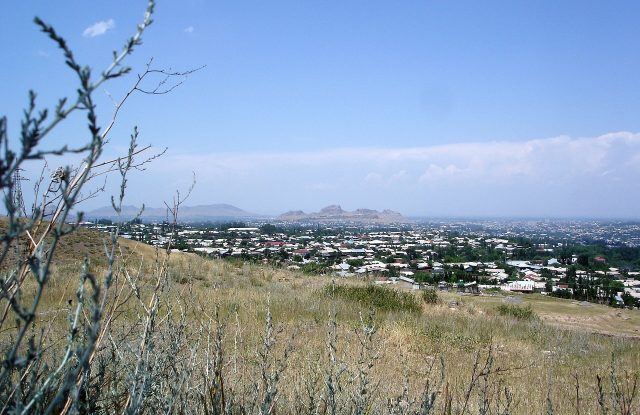
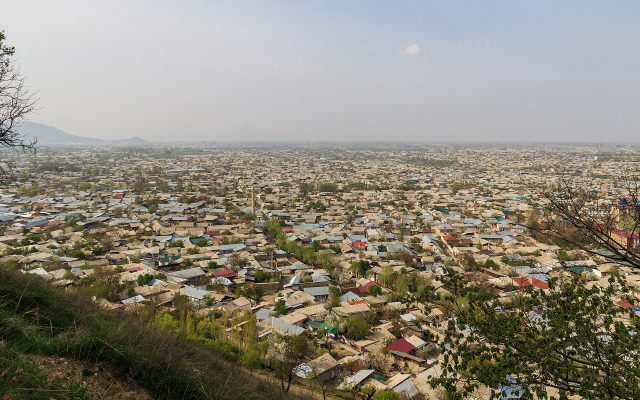
One of the best reasons to visit isn’t just the church itself, but the view from the hill. From here, the entire Fergana Valley stretches out before you: the patchwork of green fields, the winding Ak-Buura River cutting through the city, and the distant mountains fading into the horizon. On clear days, the air is so crisp that the ridges of the Alay Range seem close enough to touch. In the evening, as the sun dips behind the peaks, the church’s dome glows in the fading light, and the city below slowly slips into twilight. It’s a view that makes the climb worthwhile.
The Church of the Holy Archangel Michael isn’t the kind of place that dazzles at first glance. Its strength lies in its understated beauty, in the way it fits into the landscape and the history of Osh. There are no crowds here, no guided tours shouting over one another, no souvenir stalls hawking trinkets. Instead, there’s a chance to step into a quieter rhythm—to hear the creak of old floorboards, to notice the cracks in the walls that tell stories of decades past, and to feel the weight of time. The church isn’t just a building; it’s a living testament to how different cultures and eras can coexist, not by erasing one another, but by adding layers to the same story. For travelers who seek depth as much as spectacle, this is a place that stays with you.