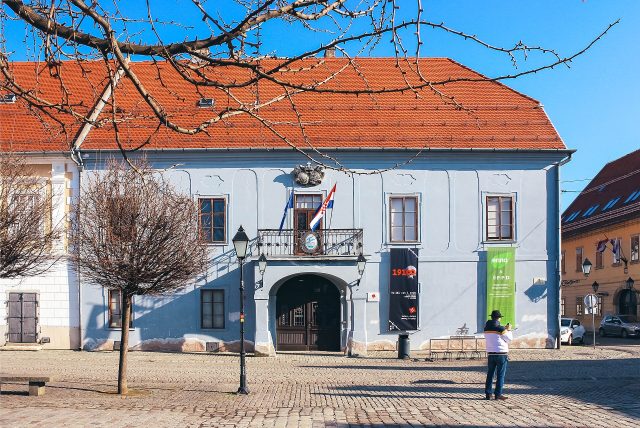
The Croatian National Theatre in Osijek is one of those places that doesn’t demand attention but quietly becomes part of the city’s rhythm. Tucked away on Republic of Croatia Square in the heart of town, it’s easy to walk past without realizing it’s more than just an elegant building—it’s a place where generations of actors, musicians, and audiences have gathered over the decades. Unlike the grander theatres in Zagreb or Split, this one doesn’t try to impress with scale or opulence. Instead, it simply exists, woven into the cultural fabric of Osijek in a way that feels natural and unforced.
The theatre’s origins trace back to the late 19th century, when Osijek was flourishing under Austro-Hungarian rule. As a key commercial and administrative hub, the city’s elite wanted to keep pace with European capitals, and in 1866, the theatre was built to designs by architect Karl Klaus. But by the early 20th century, the original structure felt too small for its ambitions. A reconstruction gave it the appearance it has today—a neoclassical façade with tall arched windows and sculptural details that hint at its historical weight. Remarkably, the building survived both world wars, even as Osijek found itself in the crossfire of conflict. After World War II, it was restored and has since remained one of the city’s most enduring cultural landmarks.
Step inside, and the theatre reveals just as much character as its exterior. The auditorium seats a few hundred people, modest in size but renowned for its acoustics. The ceiling is adorned with intricate plasterwork, while the walls feature murals that strike a balance between intimacy and grandeur. The foyer displays portraits of notable Croatian actors and directors, many of whom launched their careers here. The theatre isn’t just for drama—it hosts opera, ballet, classical concerts, and festivals, with a growing emphasis on contemporary performances that draw younger crowds.
What makes Osijek’s theatre special is its ability to bridge different eras and genres. One night, you might catch a classic play by Marin Držić; the next, a Verdi opera or an experimental performance piece. The repertoire carefully balances tradition and innovation, appealing to a wide range of audiences. In summer, when the city’s festivals are in full swing, the theatre becomes a hub for artists and visitors from across Croatia and beyond. In winter, the warmth of the auditorium contrasts with the chill outside, filling the space with lively conversations during intermissions.
Osijek itself is a far cry from Croatia’s more tourist-heavy coastal cities. There are no crowds rushing toward the sea, just a steady, unhurried pace of life where the theatre plays a central role. Locals come here not only for performances but also for lectures, exhibitions, and social gatherings. It’s a place that draws people who care about culture, and that sense of community is palpable. Even if you don’t speak Croatian, you can sit in the theatre café and watch the city go about its day—a day that feels rich in ways that don’t always show up in guidebooks.
Beyond its artistic role, the theatre is also a keeper of history. Over the years, it has hosted legendary performers and witnessed moments that shaped the country’s cultural identity. During the 1990s war, it never fully closed, even when operations were limited. That continuity mattered—not just for preserving traditions, but for giving people a sense of normalcy and hope. Today, the theatre carries on that legacy, offering a space where art helps people feel connected to something larger than themselves.
If you find yourself in Osijek, the theatre is worth a visit, even if you don’t plan to see a show. Just walking through the foyer, browsing old photographs and posters, feels like stepping through time—from the Austro-Hungarian era to the present day. With luck, you might stumble upon a rehearsal or a small concert, which happen here almost daily. Whether you leave impressed by its grandeur or charmed by its authenticity, the theatre has a way of staying with you—not because it’s flashy, but because it feels real.