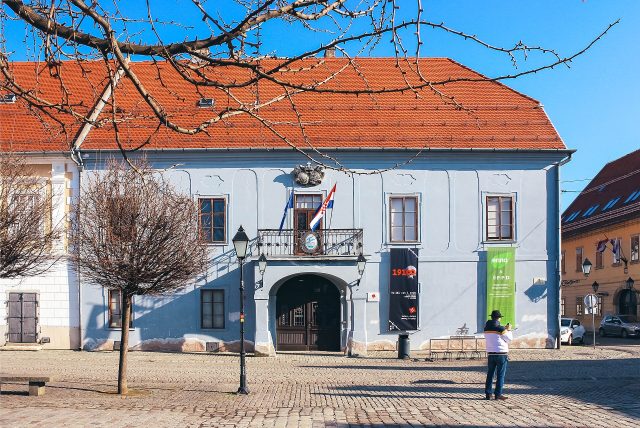
Tvrđa in Osijek is one of those rare places where history doesn’t feel trapped behind glass or roped off for display. It stands as a living part of the city, its walls worn smooth by time but still very much alive. Built in the 18th century, the fortress was a masterpiece of Austrian military engineering, designed to guard the banks of the Drava River. Its purpose was never beauty—it was survival, strategy, and control. Yet today, it doesn’t feel like a relic. It feels like a quiet witness to everything that has passed through Osijek over the centuries.
There’s nothing grand or ornate about Tvrđa’s architecture, and that’s precisely what makes it compelling. This wasn’t a castle meant to impress with towers and turrets; it was a fortress built for war, where every rampart, ditch, and bastion served a purpose. The Austrians constructed it with the latest military science of the time, and even now, you can see how carefully it was planned. The earthen walls absorb sound, the moats channel water, and the casemates were designed to withstand sieges. It wasn’t meant to be admired—it was meant to endure. And it has.
Inside, the fortress still carries the rhythm of an old garrison. The barracks, warehouses, and officers’ quarters once buzzed with the daily life of soldiers, craftsmen, and merchants who kept the military outpost running. Now, these same buildings house museums, galleries, and cultural spaces, but the echoes of the past linger. Walk through the inner courtyards, and you can almost hear the footsteps of soldiers drilling centuries ago. Some rooms still bear traces of old murals or the scars of renovations, reminders that Tvrđa has never been static. It has reinvented itself again and again—hospital, prison, barracks—always adapting to the needs of the time.
Osijek has always been a city on the edge of empires, and Tvrđa is proof of that. It has stood through Austrian rule, Hungarian influence, Yugoslav socialism, and now independent Croatia. Each era left its mark, not just in the architecture but in the stories buried within its walls. During World War II, it was a prison. In the 19th century, it housed a military hospital. Under socialism, it was still a working barracks. Today, it’s a place where history and modern life overlap seamlessly. Locals don’t call it a monument—they just call it Tvrđa, as if it’s always been there, as if it’s always belonged.
One of the most interesting spots inside is the Osijek Archaeological Museum. It’s not a grand institution, but the artifacts it holds tell a sweeping story of the region, from Roman settlements to medieval towns. The exhibits go beyond military history, offering glimpses into everyday life through coins, tools, and household items unearthed in the area. There’s something quietly powerful about seeing these objects up close—they make the past feel tangible, not just something read about in books.
Tvrđa isn’t just about looking backward. It’s a place where the present takes shape, too. Throughout the year, the fortress hosts exhibitions, concerts, and theater performances. In summer, the courtyards fill with music and crowds; in winter, the mist from the Drava rolls over the walls, giving the place an almost mystical air. Locals come here to walk, to sit on benches, to take photos against the old stone. It’s become a part of Osijek’s daily rhythm, a quiet refuge in the middle of the city.
Climb onto one of the bastions, and the view opens up across the Drava. The river is wide and slow here, its banks lined with a mix of old buildings and modern industry. It’s a striking contrast—the past and present side by side, neither overshadowing the other. Tvrđa reminds you that Osijek hasn’t always looked the way it does now, that every street and building has layers of history beneath it.
Visiting Tvrđa isn’t like touring a typical historic site. There’s no rigid path to follow, no scripted experience. You can wander the grounds, step into the museum, or just sit in one of the cafés that have opened in the old barracks. The fortress doesn’t demand anything from you except curiosity. It doesn’t need to be grand or dramatic—it just is. And that’s why it feels so real. Here, history isn’t something you observe from a distance. It’s something you walk through, something you can almost touch.