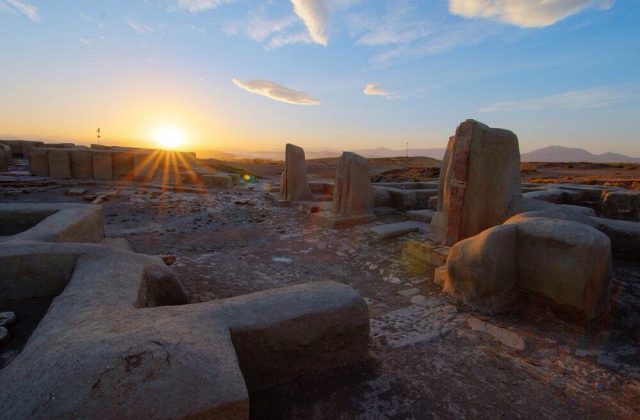
Hasanlu is one of those rare places where the past feels almost tangible, as if the weight of centuries has settled into the very earth beneath your feet. Tucked away near the quiet Iranian town of Naqadeh, this ancient mound rises from the landscape like a silent witness to a civilization that thrived over two and a half thousand years ago. There are no grand reconstructions here, no modern restorations—just the raw, unfiltered remnants of a city that once stood at the crossroads of empires. The wind sweeps across the stony slopes, carrying with it the echoes of a time when Hasanlu was a bustling hub of trade, craftsmanship, and conflict.
The story of Hasanlu began to unfold in the mid-20th century, when archaeologists first turned their attention to this unassuming hill. What they uncovered was nothing short of extraordinary. Among the most striking discoveries was the Hasanlu Gold Bowl, unearthed in 1958. This intricately crafted artifact, adorned with scenes of battle and mythological figures, offers a glimpse into the artistic sophistication of its creators. Dating back to the 9th century BCE, the bowl is now housed in Tehran’s National Museum of Iran, though replicas can be found in local museums dedicated to the region’s history. Its discovery was a turning point, not just for Hasanlu, but for our understanding of the Mannaean kingdom—a powerful yet often overlooked civilization that once dominated this part of the world.
The Mannaeans were a people of skill and ambition, carving out a kingdom that stretched across what is now northwestern Iran and parts of modern-day Iraq. Hasanlu appears to have been one of their most important centers, a fortified city that thrived on trade and diplomacy. The ruins suggest a place of considerable wealth, with workshops producing everything from pottery to metalwork, and temples where rituals were performed to honor gods whose names are now lost to time. The city’s strategic location made it a prize worth fighting for, and its walls bore witness to the rise and fall of neighboring powers like Assyria and Urartu. By the 8th century BCE, Hasanlu had met its end, likely destroyed in a violent conflict that left it abandoned for good.
Today, the site is a sprawling mound covered in grass and low shrubs, its contours softened by time. The remains of its fortifications and buildings still cling to the hilltop, their stone and mudbrick walls standing as a testament to the ingenuity of their builders. Archaeologists have identified multiple layers of occupation, the oldest dating back to the Bronze Age, each one telling a different story. Some layers speak of prosperity, others of sudden destruction, but all of them offer clues about how people adapted to life in this harsh yet fertile region. Walking among the ruins, it’s easy to imagine the city as it once was—a place of bustling markets, clanging workshops, and the distant hum of daily life.
What makes Hasanlu so compelling is its sense of quiet dignity. There are no crowds here, no vendors hawking trinkets, no signs urging you to hurry along. The only sounds are the rustle of the wind through the grass and the occasional cry of a bird circling overhead. Locals treat the site with reverence, often referring to it as a sacred place. It’s not uncommon to see shepherds guiding their flocks across the hillside or farmers tending to fields nearby, their presence a reminder that life in this region has continued, uninterrupted, for millennia. For visitors, the experience is less about ticking off a tourist attraction and more about stepping into a different era, one where the past feels closer than the present.
For those with an interest in history, Hasanlu is a treasure trove. The site offers a rare opportunity to see how ancient societies functioned—how they built their homes, crafted their tools, and worshipped their gods. Excavations continue, though not with the same intensity as in the mid-20th century. Each new season brings fresh discoveries, even if they’re not as dramatic as the Gold Bowl. A fragment of pottery here, a broken tool there—these small pieces help fill in the gaps of a story that is still being written. The local museums in Naqadeh and the surrounding area provide context, displaying artifacts and explaining the significance of the Mannaean civilization. For many, a visit to Hasanlu is part of a larger journey through Iran, a country where every town and village seems to hold its own secrets.
Hasanlu is a humbling reminder of how fleeting human achievement can be. A city that once commanded trade routes and wielded influence over vast territories now lies in ruins, its glory reduced to dust and memory. Yet, in its own way, it still speaks. The stones beneath your feet, the layout of the streets, the remnants of walls—all of it tells a story of resilience, ambition, and ultimately, impermanence. That’s why this place matters. It’s not just a collection of old bricks and broken pottery; it’s a connection to a world that existed long before ours, a world that shaped the one we live in today.
If you find yourself in this part of Iran, Hasanlu is worth the detour. It’s not the kind of place that dazzles with grandeur or spectacle, but that’s precisely what makes it special. Here, history isn’t polished for tourists or packaged into neat narratives. It’s raw, unfiltered, and all the more powerful for it. Standing on that hill, surrounded by the silence of centuries, you can’t help but feel the weight of time—and the quiet persistence of the past.