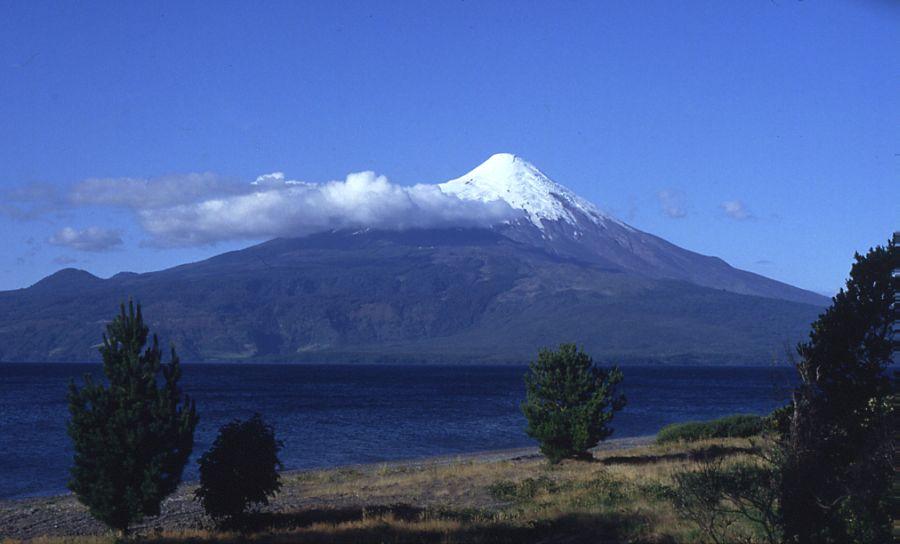
Osorno Volcano rises like a silent sentinel over the southern Andes, its near-perfect cone dusted with snow for much of the year. From the shores of Lake Llanquihue, the city of Osorno, or even across the border in Argentina, its outline is unmistakable—a landmark that has shaped the identity of this part of Chile. For those who live in its shadow, it’s more than just a mountain; it’s a presence that defines the landscape, a reminder of nature’s quiet power and its unpredictable force. Artists, writers, and travelers have long been drawn to its slopes, finding in its symmetry something both reassuring and awe-inspiring.
Geologically, Osorno is a stratovolcano, built layer by layer from hardened lava, ash, and volcanic rock. It stands at 2,652 meters, its last eruption recorded in the late 1800s, though the exact date remains a point of debate among scientists. While it hasn’t shown signs of activity in over a century, it’s still considered active, monitored closely by geologists. The lower slopes are thick with temperate rainforest—southern beech trees, monkey puzzle pines, and dense undergrowth that give way to rocky scree and permanent snowfields as you climb higher. On clear days, the summit offers sweeping views of Lake Llanquihue, the jagged peaks of Calbuco and Puntiagudo, and the fractured coastline of Chile’s lake district.
The mountain’s history is woven into the fabric of the region. For the Mapuche people, it was a sacred site known as Perakenya, or Great Stone, believed to be the dwelling place of spirits. They approached it with reverence, seeing in its slopes a connection to the divine. When Spanish colonizers arrived in the 16th century, they renamed it after the town of Osorno in Spain, a nod to one of the conquistadors’ hometowns. By the 19th century, the volcano had become a subject of scientific study, and later, a challenge for mountaineers. Today, it stands as a bridge between the past and present, a place where indigenous traditions, colonial history, and modern exploration intersect.
Climbing Osorno is as much about the journey as the destination. The lower forests are alive with wildlife—tiny pudú deer, the world’s smallest, darting between the trees, while woodpeckers and Chilean pigeons call from the branches. As you ascend, the vegetation thins, replaced by stark rock and patches of snow. The route varies with the seasons; in winter, it demands proper gear and experience, while summer offers a more accessible, though still demanding, trek. The air grows thinner, the silence deeper, and the sense of isolation more pronounced. It’s a place where you’re reminded of your own smallness against the vastness of the landscape.
Beyond its natural beauty, Osorno plays a quiet but vital role in the local economy. Tourism here is low-key, avoiding the crowds that flock to more famous destinations. Small lodges, campsites, and family-run restaurants dot the surrounding area, serving hearty Chilean dishes made from local ingredients. In summer, hikers and horseback riders explore the trails, while winter transforms the northern slopes into a modest ski resort, where the snow is reliable and the runs uncrowded. It’s a place where visitors can step away from the rush of modern travel and find something slower, more deliberate.
The mood around Osorno shifts with the light and weather. In the early morning, when mist clings to Lake Llanquihue, the volcano seems to float above the clouds, its reflection shimmering in the still water. At sunset, the slopes glow in soft gold and pink, casting long shadows across the landscape. On overcast days, the mountain disappears behind a veil of gray, its presence felt rather than seen—a quiet force lurking just beyond view. Locals often say Osorno breathes, and there’s truth in that; even on windless days, the air above the summit seems to tremble, as if the mountain itself is alive.
For those who don’t climb, there are other ways to experience Osorno. The shores of Lake Llanquihue, particularly near the village of Ensenada, offer some of the best views. From here, you can rent a kayak or take a boat tour, watching the volcano’s reflection ripple across the water. Another vantage point is the lookout in Vicente Pérez Rosales National Park, where the mountain dominates the horizon, framed by forests and lakes. These spots capture the essence of Osorno—not as a distant peak, but as a living part of the landscape.
What lingers after a visit to Osorno isn’t just the memory of its shape against the sky, but the sense of stillness it imparts. There are no crowds here, no tourist traps, just the sound of wind through the trees or the distant cry of a bird. It’s a place where time feels different, where the weight of history and the vastness of nature settle over you like a quiet revelation. Osorno doesn’t demand attention; it simply exists, and in that simplicity lies its enduring appeal. For those who take the time to look, it offers something rare—a moment of connection to a place that has stood unchanged for centuries, watching over the land and the people who call it home.