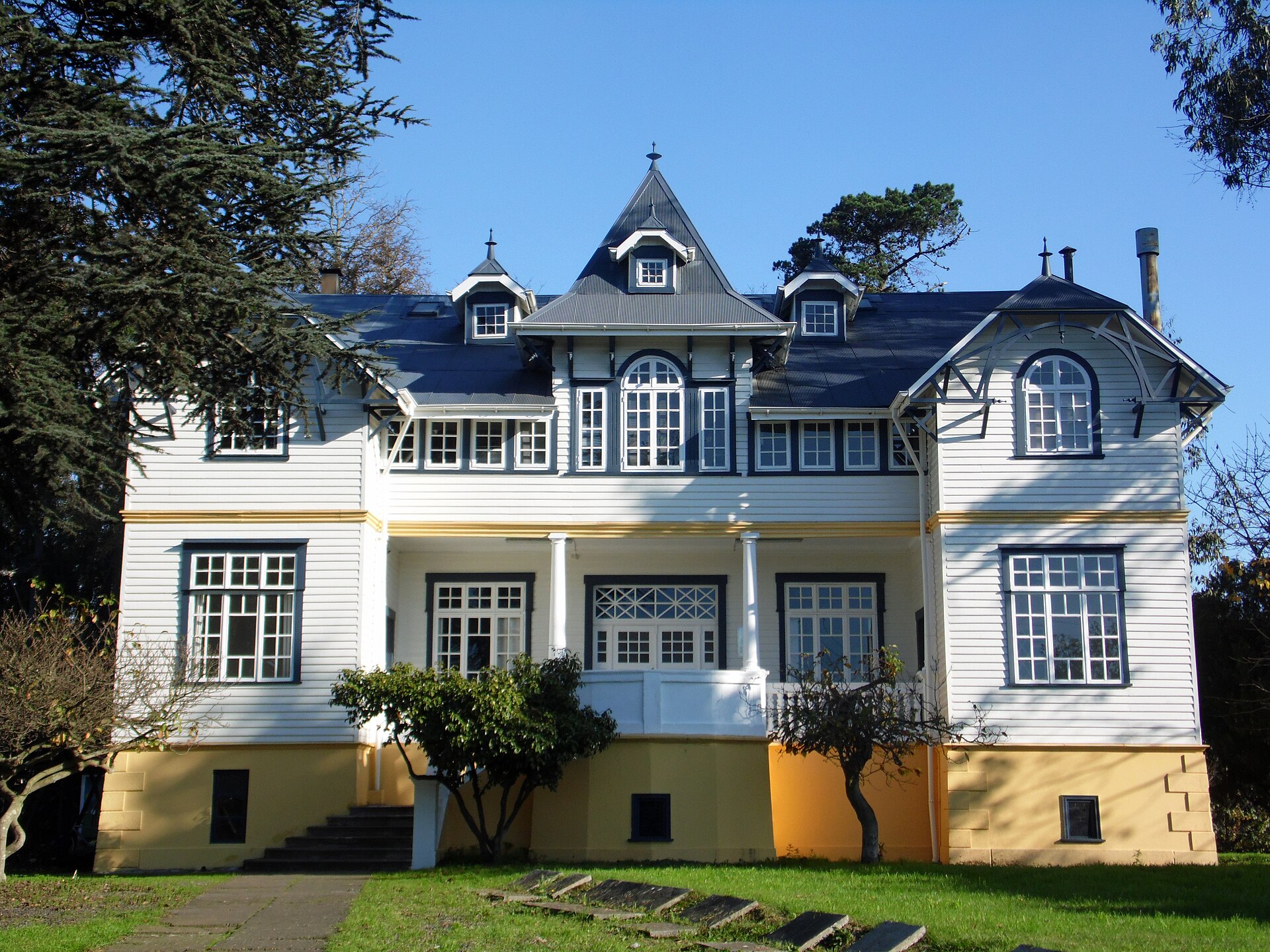
The Hollstein House in Osorno is one of those quiet places that carry the weight of a city’s past without needing to say a word. Built in the early 1900s, it sits at a street corner like a patient observer, watching the changes unfold in this corner of southern Chile. The architecture is unmistakably of its time—thick walls, high ceilings, and large windows that once flooded the rooms with light. From the outside, it appears modest, but the details reveal a craftsman’s care: intricate woodwork around the windows, wrought-iron grilles, and stonework laid with precision. It was built to last, and it has.
Osorno in those days was a city caught between worlds. Founded by Spanish conquistadors in the mid-16th century, it had long served as a waypoint between the coast and Chile’s interior. By the turn of the 20th century, the city had absorbed waves of settlers, including German immigrants who brought their own building traditions. The Hollstein House likely emerged from this blend of influences—German techniques adapted to local materials like wood, stone, and clay, chosen to withstand the damp winters and the cool winds rolling down from the Andes. It’s a structure shaped as much by necessity as by design.
Little is known about the man behind the name. The surname is German, and Hollstein was probably one of the many immigrants who arrived in Chile seeking opportunity. In Osorno, Germans often worked in trade, farming, or skilled crafts, and the house may have doubled as both a home and a workshop. Inside, the layout would have been practical: spacious ground-floor rooms for business or gatherings, with living quarters upstairs. It’s easy to imagine German being spoken here, neighbors dropping by for coffee or a glass of local wine, the scent of freshly baked bread drifting from the kitchen.
Over the decades, the house saw its share of changes. By the mid-20th century, Osorno was expanding—new neighborhoods sprang up, roads widened, and many older buildings were torn down or repurposed. The Hollstein House endured, perhaps because of its sturdy construction or simply because it stood just far enough from the main currents of development. Today, it shows its age: paint peeling from the walls, wooden shutters cracked by time. But these signs of wear only add to its character. It remains remarkably intact, a rare survivor of an earlier era.
The house doesn’t draw crowds. Osorno isn’t a tourist hub, and most visitors pass through quickly. But those who wander down its streets sometimes pause here, drawn by something unspoken. There are no museum plaques or guided tours, just the quiet presence of a building that has seen generations come and go. You can almost hear the creak of floorboards underfoot, the murmur of voices in the evening, the glow of kerosene lamps through the windows. The past lingers in the air, even if the details are lost.
Now, the Hollstein House is just another part of the cityscape, easy to overlook amid the newer buildings. But it serves as a reminder that Osorno has a history, even if it’s not as dramatic as Santiago’s or Valparaíso’s. There are no grand palaces or ancient ruins here, just ordinary places that have quietly witnessed the passage of time. The house stands at its corner, watching the city evolve around it, unchanged in its own way.
If you ever find yourself in Osorno, take a walk through the older neighborhoods. You won’t find trendy cafés or art galleries, but you might stumble upon buildings like this one—places that remember a different version of the city. The Hollstein House doesn’t demand attention, nor does it push you away. It simply exists, as it has for over a century, waiting for someone to notice and wonder about the stories it could tell if only it could speak.