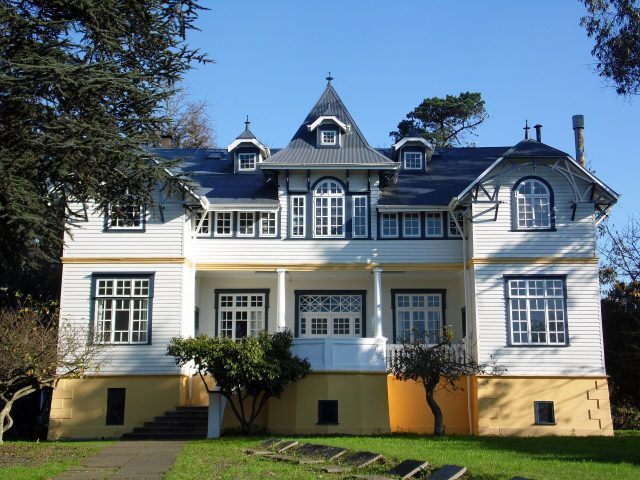
The Osorno Historical Heritage Museum is one of those quiet places where the past doesn’t just sit behind glass—it breathes. Housed in a building that has witnessed the city’s transformations firsthand, the museum occupies a structure from the early 1900s, once an administrative hub, now a keeper of stories that shaped this corner of southern Chile. Walking through its rooms feels less like a tour and more like flipping through the pages of a living archive, where every object has a voice.
Osorno’s identity is deeply rooted in its German heritage, a legacy that seeps into the museum’s exhibits as much as it does the city’s architecture. The displays here trace the arrival of European settlers in the mid-19th century, their struggles and adaptations to a land far removed from what they knew. Tools, clothing, and faded photographs reveal the daily rhythms of those who turned dense forests and untamed soil into farms and communities. The museum doesn’t romanticize this history; it presents the hard work of clearing land, building homes, and establishing the agricultural foundations that would define the region’s economy for generations.
Yet the story of Osorno isn’t just one of European settlement. The museum dedicates significant space to the Mapuche, the indigenous people who have inhabited these lands for centuries. Their presence is felt in woven textiles, intricate silverwork, and ceremonial objects that speak of a culture deeply connected to the land. The exhibits don’t treat the Mapuche as a relic of the past but show how their traditions have endured, adapted, and intertwined with the city’s development. It’s a rare acknowledgment of how two worlds—one arriving, one already here—shaped what Osorno would become.
Industrialization arrived in Osorno in the late 19th and early 20th centuries, and the museum captures this shift with models of early factories, logging equipment, and samples of goods that once traveled beyond Chile’s borders. This was a time when the city’s forests and fields became commodities, and its people turned raw materials into products that reached distant markets. The exhibits don’t glorify progress but present it as it was: messy, transformative, and full of contradictions. For anyone curious about how a small southern town became an economic force, this section offers a grounded look at the machinery, labor, and ambition behind that change.
Outside, the museum’s courtyard extends the narrative into the open air. Here, reconstructions of Mapuche rukas and early settler homes stand alongside rusted agricultural machinery, a tangible contrast between the old ways and the new. Walking among them, it’s easy to imagine the backbreaking work of plowing fields by hand or the communal effort of building a home from scratch. The courtyard isn’t just a collection of objects; it’s a reminder of how quickly life here moved from manual labor to mechanization, and how much of that history is still visible in the land itself.
Photographs play a central role in the museum’s storytelling. Black-and-white images line the walls, capturing Osorno in moments of transition: streets lined with wooden houses, the first automobiles navigating unpaved roads, festivals where locals gathered in their finest clothes. These aren’t just snapshots; they’re fragments of a city in motion, showing how people dressed, worked, and celebrated across decades. The faces in these photos—some stern, some smiling—make the past feel immediate, as if the people in them might step out of the frame at any moment.
What makes the museum special is its lack of pretension. There’s no grand narrative here, no attempt to oversell Osorno’s place in history. Instead, it offers something more valuable: a sense of continuity. The exhibits don’t just display objects; they connect them to the people who used them, the hands that crafted them, and the lives they touched. It’s a place where history feels personal, where the past isn’t abstract but rooted in the everyday.
For visitors, the museum does more than inform—it changes how you see the city. After wandering its halls, a walk through Osorno becomes a different experience. The streets, the buildings, even the way the light falls on the square all carry echoes of what came before. The city stops being just another stop on a map and starts to feel like a place with layers, where every corner has a story to tell. That’s the museum’s real gift: it doesn’t just preserve the past; it makes you see the present through its lens.