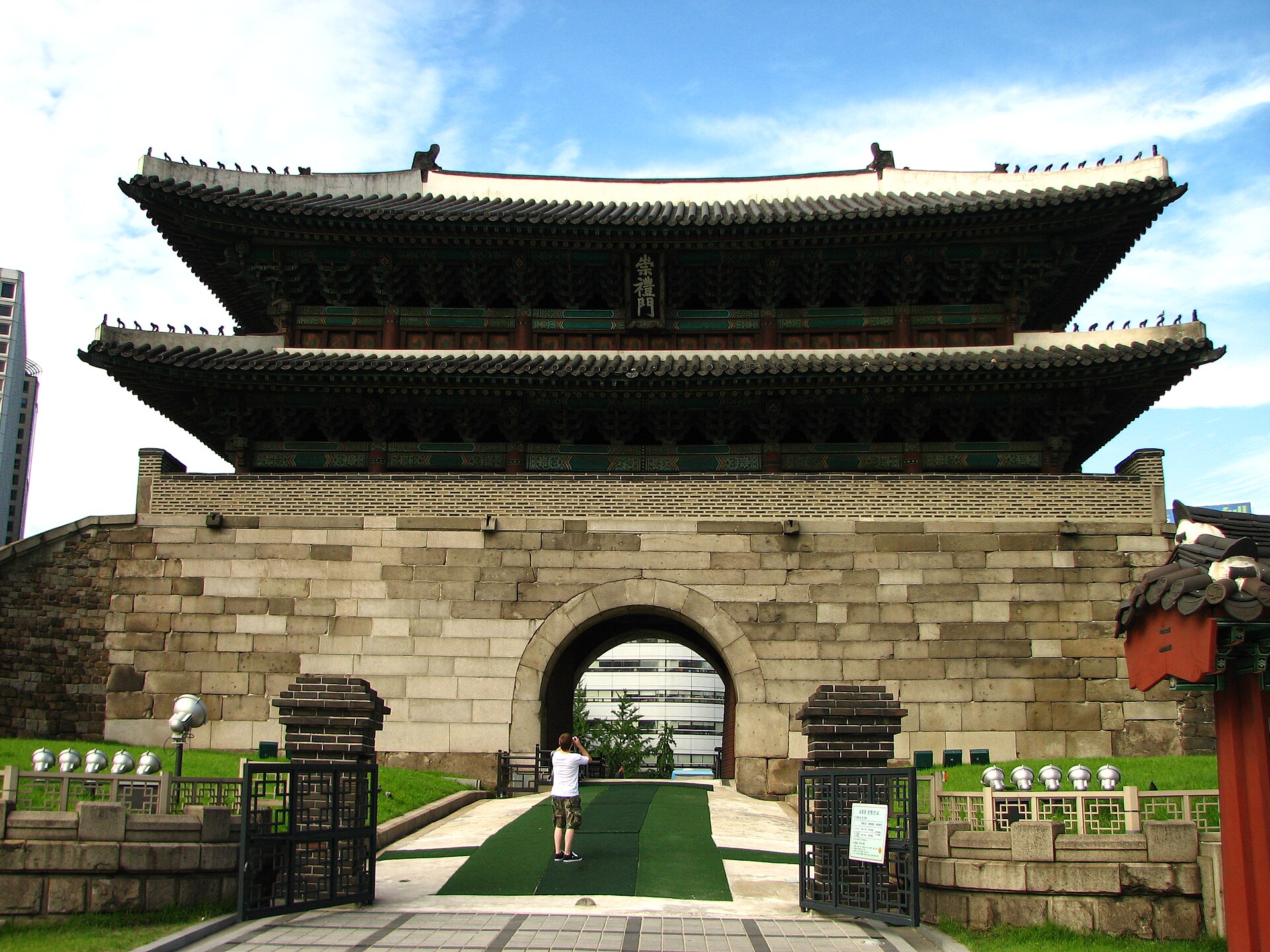
Namdaemun, officially known as Sungnyemun, stands where Seoul’s past and present intersect in the most tangible way. Built in the 14th century as the main southern gate of the city’s ancient fortress walls, it has witnessed centuries of history—wars, fires, and reconstructions—yet remains a quiet but powerful symbol of the city’s endurance. Today, it sits at the heart of a modern metropolis, surrounded by towering skyscrapers and bustling markets, yet its presence feels almost timeless, as if the weight of history itself slows the pace of those who pass through its arches.
The architecture of Namdaemun is a striking example of Joseon-era craftsmanship, blending strength and elegance in a way that feels both imposing and graceful. The massive stone base, constructed from precisely cut blocks, forms a sturdy foundation, while the two-tiered wooden structure above showcases the intricate joinery techniques of the period. The curved eaves of the roof, adorned with delicate carvings, seem to defy gravity, a testament to the skill of builders who worked without nails, relying instead on interlocking wooden pegs. Though the gate has been rebuilt multiple times—most recently after a devastating fire in 2008—each restoration has aimed to preserve its original character, making it difficult to distinguish the modern structure from its centuries-old predecessor.
Namdaemun was never just a functional part of the city’s defenses. It served as a ceremonial gateway, a symbol of authority and stability, through which foreign envoys, merchants, and even kings once passed. Over the centuries, it bore witness to military parades, royal processions, and vibrant market days, its arches framing moments of both triumph and hardship. During the Japanese occupation, the gate faced the threat of destruction, like many other Korean landmarks, but it survived, though not without scars. Its resilience mirrors the broader story of Seoul itself—a city that has repeatedly risen from ruin.
The fire of 2008 was a national tragedy, reducing the wooden upper structure to ashes and leaving only the stone base standing. For many Koreans, the loss felt personal, as if a piece of their collective memory had been erased. Yet the response was swift and determined. Using historical records, photographs, and traditional techniques, restorers painstakingly rebuilt the gate, ensuring that the new structure honored the old. When Namdaemun reopened in 2013, it stood not as a replica, but as a continuation of its own history—a reminder that some things, no matter how fragile, are worth preserving.
The area around the gate is as lively as the monument itself. Namdaemun Market, one of Seoul’s oldest and largest traditional markets, sprawls outward from the gate’s shadow, a labyrinth of narrow alleys and crowded stalls. Here, the past and present coexist in the most ordinary ways: vendors selling handmade goods alongside modern electronics, the scent of sizzling street food mingling with the hum of commerce. The market has been a fixture of Seoul life for centuries, its rhythm largely unchanged. It’s a place where locals and visitors alike can lose themselves in the sensory overload of sights, sounds, and flavors, a microcosm of the city’s relentless energy.
At night, Namdaemun takes on a different character. Soft lighting bathes the gate in a warm glow, highlighting its architectural details while making it feel more approachable, almost intimate. The area around it buzzes with activity—couples strolling, tourists snapping photos, street performers adding a soundtrack to the evening. The gate no longer guards the city’s entrance, but it still serves as a gathering place, a backdrop for the everyday rituals of urban life. The contrast between the ancient stone and the modern cityscape around it is striking, yet somehow harmonious, as if the two eras have learned to coexist.
Namdaemun is more than a historical landmark; it’s a living part of Seoul’s identity. It reminds visitors that the city is not just a hub of technology and modernity, but a place with deep roots, where every street corner holds layers of history. Walking through its arches, it’s easy to imagine the processions that once passed beneath them—the clatter of hooves, the murmur of merchants, the distant sound of a royal trumpet. Today, the gate no longer welcomes kings, but it still offers a passage, not just between neighborhoods, but between eras. In a city that moves at breakneck speed, Namdaemun invites you to pause, to look closer, and to remember that the past is never as far away as it seems.