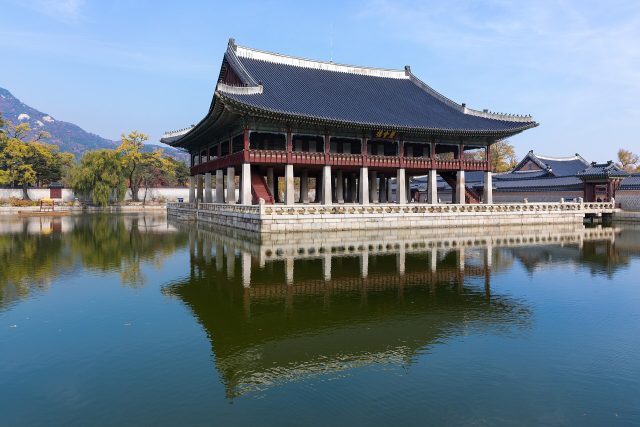
Bukchon is one of those places in Seoul where the past hasn’t just been preserved—it’s still part of daily life. Tucked between Gyeongbokgung and Changdeokgung palaces, this neighborhood has nearly nine hundred traditional *hanok* houses. The name means "northern village," a reference to its history as a home for high-ranking officials during the Joseon Dynasty, who lived near the royal court.
The *hanok* here are built around inner courtyards. Their curved tiled roofs form a pattern that spills down the hillside. Underneath the floors runs the *ondol* heating system, where smoke from a wood or charcoal fire warmed the rooms above. Some houses still have wooden beams and sliding doors. Others have glass windows or tiny patios instead of gardens. The result is a neighborhood that feels both old and lived-in.
The streets wind uphill. The best views come from looking down. From certain spots, the rooftops cascade toward the modern skyline. This view is so well-known that signs point visitors to the most photogenic spots. But Bukchon isn’t just a backdrop for photos. History here isn’t behind ropes or glass. It’s in the light across a courtyard or the sound of a door sliding open in the morning.
Bukchon is still a residential area. Some alleys are off-limits to visitors, marked with signs asking for quiet. After years of crowds, residents pushed for restrictions on group tours between 10 PM and 10 AM. The rules aren’t meant to keep people out. They’re meant to keep the neighborhood’s character intact.
A few *hanok* have been turned into small museums, workshops, and teahouses. You might find a space where artisans make *hanji* paper, its sheets dyed with natural pigments. Others show embroidery, calligraphy, or the tools of *seonbi* scholars. Entry fees are modest. These places are run by people who care about preserving the skills of the past.
Just beyond Bukchon, the energy changes. To the east, Samcheong-dong has cafés, galleries, and boutique shops in renovated *hanok*. To the south, Insadong’s streets are lined with antique dealers and tea stalls. Bukchon sits between these two worlds. It’s neither a tourist attraction nor a trendy enclave.
Walk from a quiet alley into a café serving single-origin coffee. Then step back into a lane where the only sound is leaves rustling in a courtyard.
The nearest subway station is Anguk, a five-minute walk away. The neighborhood is best explored on foot. The paths are steep and uneven. Signs are in English, and volunteers remind visitors to keep their voices down. Early morning is the best time to visit. The streets are quiet before the tour groups arrive.
Bukchon isn’t a place to check off a list. It’s a neighborhood to wander. The charm isn’t in any single landmark. It’s in the way the whole area feels suspended in time. The houses, the streets, the light through the trees—it all adds up to something rare in a fast-paced city like Seoul. History isn’t just in books here. It’s under your feet.