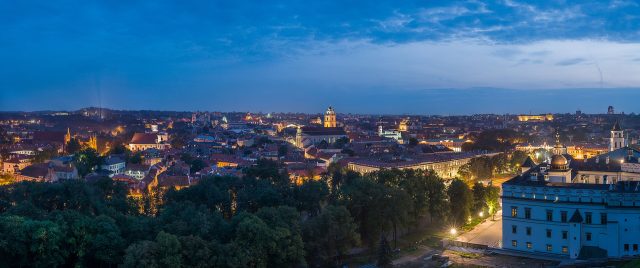
The streets of Vilnius’s Old Town are narrow and winding, lined with pastel-colored buildings that lean slightly with age. Cafés spill onto cobblestone squares, and tourists pause to admire the baroque facades or snap photos of the ornate churches. But beneath this picturesque surface lies a history that refuses to be forgotten. During the Nazi occupation, this same district was carved into two sections known as the Vilnius Ghetto, where nearly forty thousand Jews were confined between 1941 and 1943. Today, the area shows little physical trace of that time—no barbed wire, no watchtowers, no ruins. Yet if you walk slowly, paying attention to the small plaques and the way the light falls on certain doorways, the past begins to reveal itself.
The ghetto was divided into two parts: the Large Ghetto, stretching between Rūdninkų and Arklių streets, and the Small Ghetto, closer to Lydos Street. Life here was marked by overcrowding, hunger, and disease. Families were crammed into apartments meant for a fraction of their number, and basic necessities were scarce. Despite these conditions, the Jewish community found ways to resist despair. Underground schools operated in basements, secret libraries preserved books in Yiddish and Hebrew, and a clandestine theater staged performances. Even in the face of annihilation, people clung to culture as an act of defiance.
One of the most significant sites within the ghetto was the Great Synagogue of Vilnius, which once stood on Rūdninkų Street. Though the building itself was destroyed during the war, fragments of its walls and cellars remain buried beneath later constructions. Archaeologists have uncovered parts of the old foundation, offering glimpses of what was once a spiritual and cultural hub for the city’s Jewish population. Nearby, in 1942, a resistance group called the Fareynikte Partizaner Organizatsye (FPO) was formed. It became one of the most active Jewish partisan movements in Nazi-occupied Europe, organizing escapes, smuggling weapons, and gathering intelligence for the broader resistance.
The ghetto’s existence came to a brutal end in September 1943, when the Nazis liquidated it. Most of its inhabitants were deported to concentration camps, where the majority perished. Yet the story of the Vilnius Ghetto is not just one of victimhood. It is also a story of resilience. The FPO, led by figures like Yitzhak Wittenberg and Chaim Yelin, fought back in whatever ways they could. Some managed to escape and join partisan units in the forests; others sabotaged Nazi operations from within. Their actions, though ultimately unable to save the ghetto, became a symbol of resistance in the face of impossible odds.
Today, the Old Town of Vilnius is a lively place, filled with the sounds of laughter and the clinking of coffee cups. The physical remnants of the ghetto are few—a plaque here, a memorial stone there, the occasional preserved doorway or fragment of a wall. One of the most visible markers is a small monument on Arklių Street, dedicated to the victims. Nearby, the Museum of Genocide Victims touches on the broader history of oppression in Lithuania, though its focus is more on the Soviet era than the Holocaust. For those seeking a deeper understanding, the Vilna Gaon Jewish State Museum offers exhibits on the history of Lithuanian Jews, including the ghetto period.
Walking these streets, it’s easy to overlook the past. The buildings that once housed the ghetto’s inhabitants have been renovated or replaced, their facades scrubbed clean of history. But if you know where to look, traces remain. On Dysnos Street, for example, stands a building that once served as a Jewish hospital during the war. Its architecture is unremarkable, but the knowledge of what happened there lingers. In courtyards and alleyways, you might stumble upon old doorframes or sections of wall that have survived decades of change. These fragments are quiet witnesses to a time when this neighborhood was a prison.
The ghetto was not just a place of suffering; it was also a place of quiet resistance. In hidden rooms, people wrote and distributed underground newspapers. Children were taught in secret schools, and musicians performed in cramped apartments. One of the most remarkable examples of this defiance was the ghetto’s clandestine library, which held thousands of books in Yiddish and Hebrew. A small memorial on Žvejų Street marks the site of one of the underground printing presses that kept the spirit of resistance alive. These acts of cultural preservation were as much a form of rebellion as any armed uprising.
Vilnius has made efforts to preserve the memory of the ghetto. Annual commemorations honor the victims of the Holocaust, and educational programs aim to teach younger generations about this dark chapter of the city’s history. Yet memory is not just about official ceremonies or museum exhibits. It lives in the way people pause at a plaque, in the conversations between strangers who stop to read an inscription, in the quiet moments when the past feels closer than the present. The Old Town’s charm can make it easy to forget, but for those who listen, the echoes are still there.
Visiting the former ghetto is not like visiting a preserved historical site. There are no reconstructed buildings or curated displays to guide you. Instead, it’s a place that demands attention, a willingness to look beyond the surface. The streets are the same ones where people once hurried to work, where children played, where families said goodbye for the last time. The buildings, though changed, still stand in the same places. The difference is in the way you walk them—slowly, with the weight of history pressing lightly on your shoulders.
This part of Vilnius is a reminder of how quickly the world can change, and how fragile memory can be. After the war, the city rebuilt itself, erasing much of the physical evidence of the ghetto. Yet the past is not so easily discarded. It lingers in the details—the shape of a window, the curve of a staircase, the way the light falls on a particular corner. For those who take the time to notice, the Old Town becomes more than just a picturesque backdrop. It becomes a place where history is not just remembered, but felt.