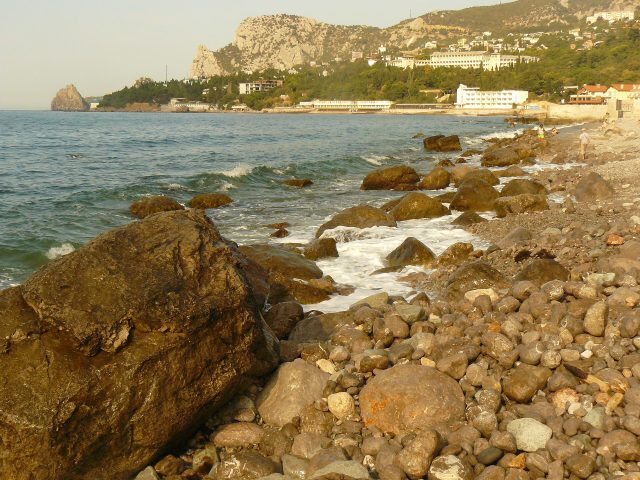
Perched on the slopes of Mount Koshka, Villa Xenia is one of those rare places where time seems to pause, allowing the past to linger just a little longer. Built in the early 20th century, the villa overlooks the Black Sea from a height that makes the bustle of the world below feel distant and unimportant. Its architecture blends the flowing lines of Art Nouveau with the restrained elegance of neoclassicism, a style favored by the wealthy who once built their summer retreats along this stretch of the Crimean coast. The whitewashed walls, adorned with delicate stucco, rise above large arched windows and intricate wrought-iron balconies, giving the building an air of effortless grace. Despite its lightness, the villa feels solid, as if every detail was considered with care—from the way the sunlight spills across the façade in the morning to how the sea breeze carries the scent of pine through its open verandas.
The villa’s story begins with Nikolai Bogdanov, a businessman and patron of the arts who owned it in the decades following its construction. In those years, Simeiz was the kind of place where St. Petersburg and Moscow high society gathered to escape the northern winters. Villa Xenia, named after one of Bogdanov’s daughters, was more than just a summer home—it was a gathering spot for the creative elite. Writers, artists, and musicians came here, drawn by the quiet beauty of the landscape and the promise of long, unhurried conversations on the terrace. The villa’s name, whispered in letters and memoirs from the time, evokes an era when leisure was an art form, and the Crimean coast was its most refined setting.
Like many grand estates of its time, Villa Xenia didn’t escape the upheavals of the 20th century. After the revolution, it was nationalized and repurposed, first as a sanatorium, then as a guesthouse for Soviet vacationers. The interiors were altered to suit new needs, but the exterior remained largely unchanged, a silent witness to the shifting tides of history. Today, the villa is still part of Simeiz’s resort infrastructure, though it isn’t always open to the public. Even from a distance, its presence is striking—a reminder of a time when this stretch of coast was a playground for the privileged, where the rhythms of life moved to the sound of waves and the clink of tea cups on porcelain.
The surroundings of Villa Xenia are as compelling as the building itself. Mount Koshka, with its rugged slopes and sweeping views, has been a landmark for centuries. Ancient settlements once dotted its foothills, and the paths winding up to its summit were laid long before the villa was built. Walking these trails today, you can almost hear the echoes of the past—the crunch of gravel underfoot, the murmur of voices in a language no longer spoken. The air is thick with the scent of pine and salt, and the only sounds are the cry of gulls and the rustle of leaves in the wind. It’s a place where history feels tangible, not just something read in books.
Simeiz in the early 1900s was a world apart, a retreat for those seeking inspiration or simply a respite from the demands of city life. The villa was one of the symbols of that era, when the Crimean coast was often compared to the French Riviera or the Italian lakes. Guests arrived not just for the sea air, but for the company—artists debating the latest movements in painting, writers reading aloud from unfinished manuscripts, musicians playing impromptu concerts on the piano in the drawing room. The villa’s terraces, shaded by vines, were the perfect setting for these gatherings, where time seemed to stretch endlessly, and the outside world felt far away.
The architectural details of Villa Xenia are worth lingering over. The façade is adorned with stucco motifs that resemble vines and flowers, a hallmark of Art Nouveau’s love for organic forms. The balconies, with their delicate ironwork, curve gently outward, as if reaching toward the sea. Tall windows with semicircular arches let in streams of light, while the heavy wooden door at the entrance hints at the solidity within. Inside, despite the changes over the years, traces of the original design remain—parquet floors worn smooth by decades of footsteps, ornate ceilings that once framed chandeliers, and fireplaces that still hold the faint scent of woodsmoke. These elements are like fragments of a larger story, one that speaks of a time when beauty was measured in craftsmanship and attention to detail.
Today, Villa Xenia is more than just a historical landmark; it’s a living part of Simeiz, a place where the past and present coexist. It stands as a reminder of how much has changed—how empires rose and fell, how borders shifted, how the very idea of leisure was redefined. Yet some things remain constant: the way the light plays on the sea at dawn, the sound of waves against the shore, the quiet dignity of a building that has seen it all. For those who visit Simeiz with an interest in history, the villa offers a glimpse into a world that no longer exists, a world where the Crimean coast was a crossroads of cultures, ideas, and dreams.
A visit to Villa Xenia can easily be part of a larger exploration of Simeiz. From here, it’s a short walk to other landmarks—the observatory on Mount Koshka, the dramatic rock formation known as the Diva, or the seaside promenade lined with old mansions. Each of these places has its own story, but Villa Xenia has a particular magic. It’s not just a building; it’s a portal to another time, a place where the past feels close enough to touch. Whether you see it from a distance or manage to step inside, the villa leaves an impression—one of elegance, history, and the quiet beauty of a place that has endured.