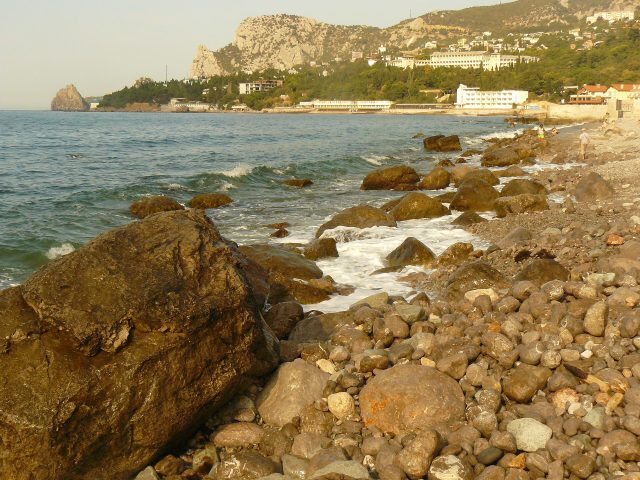
Perched on the southern slope of Mount Koshka, the Simeiz Observatory feels like a place where time moves differently. From its quiet perch above the Black Sea, it overlooks the small Crimean town of Simeiz and the rugged cliffs that rise from the coastline. The air here is still, the nights are dark, and the sky stretches endlessly—conditions that made this spot ideal for studying the stars when the observatory was founded in the early 20th century. Back then, astronomy was entering a golden age, and Crimea, with its clear skies and distance from industrial pollution, became one of the most important centers for celestial observation in the Russian Empire.
The observatory’s origins trace back to a private passion. In 1900, amateur astronomer Nikolai Maltsov, captivated by the idea of establishing a southern scientific outpost, donated his estate in Simeiz to the Pulkovo Observatory near St. Petersburg. The first instruments arrived in 1908, and within a few years, the site had grown into a fully operational research center. By 1925, it housed a one-meter reflector telescope, one of the largest in Europe at the time. With this powerful tool, astronomers discovered new asteroids, studied variable stars, and mapped distant nebulae. By the 1940s, Simeiz had earned its place among the country’s leading astronomical institutions.
The buildings themselves are unassuming, their whitewashed walls and domed roofs blending into the hillside. There’s a certain charm in their simplicity—more like a scientific village than a high-tech research facility. The metal domes, designed to rotate and track the movement of celestial objects, still function today, though some of the mechanisms inside are relics of an earlier era. The main building, a modest two-story structure with laboratories and living quarters for staff, holds the quiet legacy of discoveries that once made their way into textbooks.
Today, the observatory remains a working scientific site, though its role has shifted over the decades. Visitors are rare, but those who make the journey may get the chance to step inside the domes, listen to astronomers share stories of their work, or even peer through a telescope if the weather cooperates. On clear nights, the stars here feel almost close enough to touch. The Milky Way arcs across the sky, its luminous band stretching from one horizon to the other, creating the illusion of standing at the edge of the galaxy itself.
Life at the observatory moves at its own pace. During the day, the place is quiet—scientists analyze data, technicians maintain equipment, and researchers work on new projects. But as night falls, the rhythm changes. The domes open, telescopes align with distant objects, and observation begins. In recent years, funding has dwindled, and some of the instruments have grown outdated. Younger astronomers often gravitate toward more modern facilities, leaving Simeiz to rely on a smaller, dedicated team. Yet the work continues, even if on a more modest scale than before.
For those who visit Simeiz, the observatory is more than just a scientific landmark—it’s part of the landscape’s character. The town itself is a mix of rugged cliffs, pine forests, and vineyards, with the sea always visible in the distance. A walk from the settlement to the observatory takes you along winding paths lined with wild shrubs and scattered boulders. Along the way, you might pass the ruins of old dachas, remnants of a time when Simeiz was a fashionable retreat for St. Petersburg and Moscow’s intellectual elite. The observatory seems to carry the spirit of that era, when science and romance were intertwined.
Winter brings a particular stillness to the place. Snow is rare, but when it does fall, the white domes against the dark rocks and sea create a scene that feels almost otherworldly. In summer, the observatory attracts a different crowd—amateur astronomers, photographers, and curious travelers. Some stay overnight to watch the sunrise paint the cliffs in gold, a reminder of why this spot was chosen in the first place. Here, the boundary between earth and sky blurs, making the vastness of the universe feel just a little more tangible.
Simeiz Observatory isn’t a museum or a tourist attraction, though it occasionally opens its doors to visitors. It’s a place where science persists, despite challenges and changing times. It serves as a reminder that astronomy isn’t just about equations and data—it’s about curiosity, about looking beyond the familiar and wondering what lies in the darkness. That sense of wonder is what draws people here, even those who aren’t scientists. Standing under the Crimean sky, it’s impossible not to feel connected to something larger than everyday life. And perhaps that’s the real reason the observatory endures.