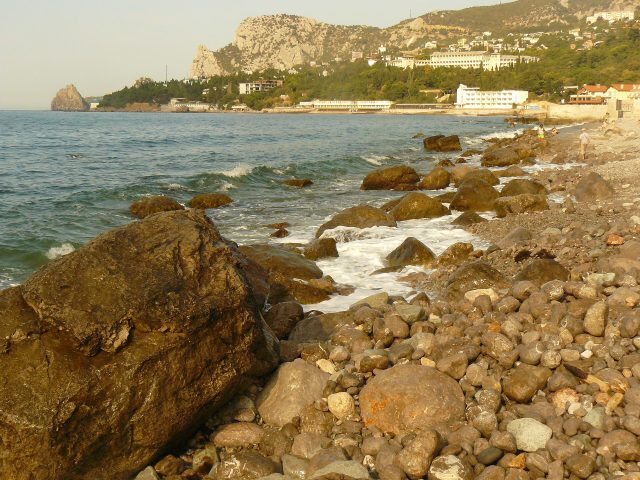
The Diva Rock juts from the sea near Simeiz, where the Crimean mountains meet the Black Sea. This forty-five-meter limestone formation, shaped by wind and waves, is one of the region’s most recognizable sights. Alongside the Cat Rock, it frames the village, its jagged outline sharp against the sunset.
The climb up is steep. Over two hundred steps, some smooth from decades of use, others patched with concrete, twist upward. The last stretch demands careful steps, especially after rain. At the top, the platform is tiny—space for just a few people—but the view repays the effort. To the east, the Swallow’s Nest clings to the cliffs. To the west, Katsiveli sprawls along the shore. Behind you, Mount Ai-Petri rises, its plateau often lost in mist. Below, the sea shimmers, broken only by boats or paddleboarders.
Until the early 20th century, another sea stack stood nearby—the Monk Rock. It resembled a robed figure gazing at the sea. In 1931, an earthquake toppled it. Now, only a fragment remains visible at low tide. Locals still point to where it once stood.
The base of the rock has a narrow pebble beach. The stones are polished by waves. The water here is deep and clear, popular with divers exploring underwater caves. In summer, kayaks and paddleboards fill the water. Small boats ferry tourists along the coast. The beach has a few cafes serving grilled fish and cold drinks. Sun loungers are available for rent.
Simeiz mixes old and new. Early 20th-century mansions line its streets, some restored, others crumbling. Walking through the village feels like stepping into the past, especially in the morning when the streets are quiet. Palm trees rustle. Waves crash in the distance.
The Crimean Astrophysical Observatory overlooks the village. Its domed telescopes have studied the skies since 1900. Visits are limited, but the observatory is visible from the coast.
From Yalta, a bus follows the coastal road, passing through cliffside tunnels. The trip takes about half an hour. The drop-off point is a short walk from the Diva Rock. The staircase is open in warmer months. There’s a small fee to climb. Wear sturdy shoes—the steps can be slippery, and the wind at the top is strong. Morning is the best time to visit. The light is soft, and the sea sparkles.
The rock makes you feel small. Up close, its sheer face is imposing. From a distance, it looks fragile, as if the next storm might change it. For now, it stands as it has for centuries—a silent sentinel over the sea.