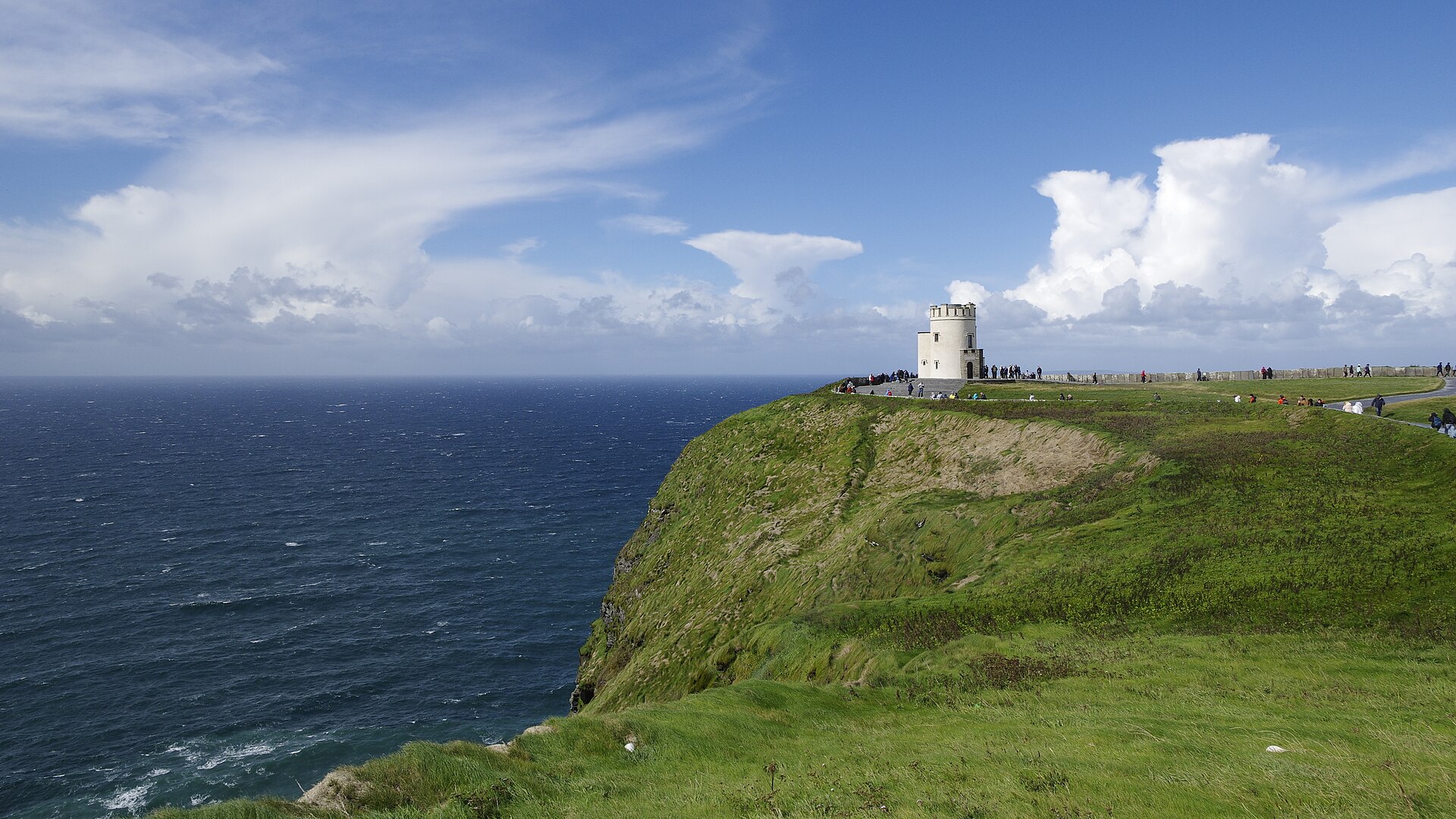
The Cliffs of Moher rise from the Atlantic like a natural fortress, their sheer walls stretching for nearly five miles along Ireland’s western edge. At their highest point, they tower 700 feet above the ocean, a vertical drop that makes the waves below seem small, though they crash against the rock with relentless force. On clear days, the view extends beyond the churning water to the Aran Islands, their low profiles just visible on the horizon, and sometimes even to the distant peaks of Connemara. The wind here is constant, carrying the salt of the sea and the cries of gulls, and it’s easy to lose track of time while standing at the edge, watching the light shift across the water.
These cliffs weren’t always the tourist landmark they are today. Their formation began millions of years ago, when layers of sandstone, shale, and limestone were compressed and folded by the slow, relentless pressure of the earth. For centuries, they served as more than just a dramatic backdrop—they were a practical part of life in County Clare. In medieval times, their height made them a natural defense against raids, while their unmistakable silhouette guided fishermen and travelers along the coast. The name Moher itself comes from an old fort that once stood at the southern end of the cliffs, its ruins still faintly visible among the grass. Over time, the cliffs became a symbol of endurance, a place where the land itself seemed to stand firm against the elements.
The experience of visiting the cliffs changes with the seasons. In summer, the long daylight hours soften the landscape, and the paths along the edge fill with walkers—tourists snapping photos, locals out for a stroll, children running ahead of their parents. The cliffs feel almost welcoming then, their greens and browns vibrant under the sun. But come autumn or spring, the weather turns unpredictable. Fog rolls in without warning, swallowing the tops of the cliffs and muffling the sound of the waves. The wind picks up, strong enough to make you lean into it just to stay upright. Winter strips the scene down to its raw essentials: the ocean darkens, the waves grow louder, and the few visitors who brave the cold feel the full weight of the place, its scale and solitude pressing in.
There are several ways to explore the cliffs, each offering a different perspective. The most popular route starts at the visitor center and follows the edge north toward O’Brien’s Tower, a 19th-century stone lookout built when the cliffs were already a curiosity for travelers. The tower was never a military post—it was more of a folly, a place for Victorian tourists to admire the view in relative comfort. From its base, the cliffs stretch out in both directions, their layers of rock exposed like pages in a book. On a good day, you can watch seabirds wheeling below, their wings catching the updrafts. For those who prefer quieter paths, the trail south toward Hag’s Head offers a different kind of beauty. The cliffs here are lower but no less striking, their jagged edges softened by grass and wildflowers. The crowds thin out, and you might see a shepherd moving a flock of sheep or hear nothing but the sound of the wind and the distant roar of the ocean.
The cliffs are also a haven for wildlife. Thousands of seabirds nest here, including puffins with their brightly colored beaks, cormorants drying their wings on the rocks, and gulls circling overhead. In spring and early summer, the cliffs come alive with the sound of chicks calling for food, and you can watch parents returning from the sea with fish clutched in their beaks. Less common but still present are peregrine falcons, their sharp eyes scanning the water for prey. Below the cliffs, seals sometimes haul themselves onto the rocks, and if you’re lucky, you might spot dolphins or even whales far out in the water. The cliffs themselves are a geologist’s dream, their exposed layers telling the story of ancient seas and glaciers that once covered this part of Ireland.
Despite their popularity, the Cliffs of Moher retain a sense of wildness. They’ve inspired countless artists, writers, and musicians, drawn not just to their beauty but to the way they seem to exist outside of time. In Irish folklore, places like this were often seen as thresholds between the human world and the otherworld, where fairies or spirits might linger. Even today, there’s something about the cliffs that feels almost mythic. Standing at the edge, it’s easy to imagine them as they were centuries ago—unchanged, indifferent to the people who come and go. The wind, the waves, the birds: they all move to rhythms older than human memory.
If you’re planning a visit, it’s worth preparing for the weather. The cliffs are notorious for their mood swings—sunshine can turn to rain in minutes, and fog can descend without warning. A waterproof jacket and sturdy shoes are essential, as the paths can be slick and uneven. The visitor center offers more than just practical information; there’s a small exhibit on the history and ecology of the cliffs, as well as a café where you can warm up with a cup of tea or try a bowl of Irish stew. The food is simple but hearty, the kind that makes sense after a long walk in the wind.
The Cliffs of Moher aren’t just a place to check off a list. They’re a reminder of how small we are in the face of something much larger. There’s no rush here, no noise beyond the wind and the waves, no distractions from the sheer scale of the landscape. The cliffs have stood for millennia, and they’ll stand for millennia more, long after the last visitor has gone. Maybe that’s why people keep coming back—to feel, if only for a moment, the weight of something enduring. To step away from the everyday and remember that the world is vast, and we are only passing through.