Perched on a bluff overlooking the slow, wide waters of the Pripyat River, the site of Turov’s ancient detinec feels like a quiet conversation with history. There are no towering walls or grand reconstructions here—just the gentle swell of earth beneath the grass, where once stood the fortified heart of one of medieval Rus’ most influential cities. Over a thousand years ago, this was the political and spiritual nucleus of the Turov Principality, a place where princes ruled, merchants traded, and scholars like Kirill of Turov shaped the intellectual life of the region.
The first fortifications rose in the 10th century, when Turov emerged as a key center of power in the early East Slavic world. The detinec wasn’t merely a military stronghold; it was the administrative core of the city, housing the prince’s residence, churches, and the institutions that governed daily life. By the 12th century, Turov had reached its zenith, rivaling even Kiev in religious and cultural significance. The detinec expanded into a formidable complex, encircled by wooden palisades and a defensive moat, its earthen ramparts designed to withstand sieges and floods alike.
Archaeological excavations have peeled back the layers of time, revealing a surprisingly sophisticated settlement beneath the surface. Alongside the expected remnants of weapons and household items, researchers have uncovered fragments of intricately carved white stone—evidence of skilled stonemasons who once adorned the city’s churches with elaborate reliefs. These finds suggest that Turov’s detinec was not just a fortress but a place of beauty, where sacred and secular life intertwined. Sadly, little remains of those structures today; the wooden buildings have long since rotted away, and the stone was likely repurposed over the centuries.
What survives is the land itself, shaped by human hands a millennium ago. The earthworks, though eroded, still trace the outline of the old fortress, their curves softened by time and vegetation. The best view comes from the opposite bank of the Pripyat, where the river’s bend frames the detinec like a natural stage. From here, it’s easier to imagine the bustling activity that once filled this space—traders haggling in the shadow of the walls, priests processing to the churches, and the distant clang of a blacksmith’s hammer echoing across the river.
Walking the site today, there’s a sense of stillness that feels almost deliberate. There are no crowds, no guided tours with loudspeakers, no reconstructed gates to pose in front of. Instead, the detinec offers something rarer: the chance to stand in a place where history isn’t performed for visitors but simply *is*. The wind rustles through the grass, the river flows as it always has, and the past feels close enough to touch—if you’re willing to listen. It’s the kind of place where you might pause and wonder about the people who once stood here, looking out over the same landscape, their lives as vivid to them as yours is to you.
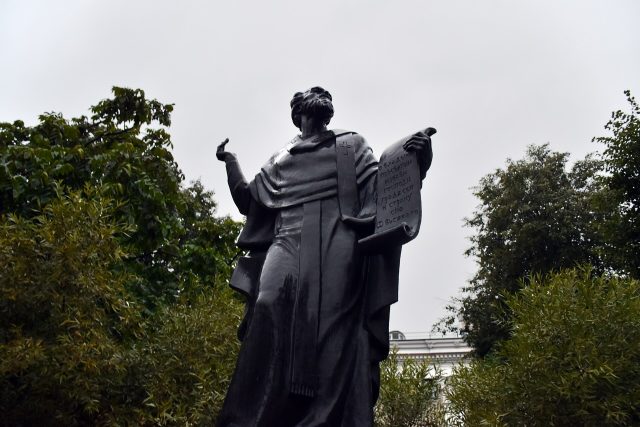
Turov’s detinec is also inseparable from the legacy of Kirill of Turov, one of the most revered figures of medieval Rus’. A bishop, theologian, and writer, Kirill left behind a body of work that remains a cornerstone of Orthodox Christian literature. His sermons and allegories, written in the 12th century, are celebrated for their eloquence and depth, blending spiritual insight with a keen understanding of human nature. While there’s no definitive proof that Kirill lived or preached within the detinec’s walls, his presence in Turov during its golden age lends the site an added layer of significance. It’s easy to picture him here, perhaps walking along the ramparts or composing his homilies in the quiet of a monastery cell.
Modern Turov is a sleepy town where life moves at the unhurried pace of the Pripyat. The detinec, now little more than a grassy mound, has become a subtle landmark, a reminder that history isn’t always grand or obvious. There are no souvenir stands or cafes here, no signs pointing out every historical detail. Instead, the site invites a different kind of engagement—one that relies on imagination and a willingness to see beyond the surface. It’s a place where the past isn’t preserved in glass cases but woven into the land itself, waiting to be discovered by those who take the time to look.
If you find yourself in this corner of Belarus, the detinec is worth a visit—not for the monuments, but for the atmosphere. Climb the earthen ramparts, feel the breeze off the river, and let the silence settle around you. In a world where history is often packaged and sold, Turov’s detinec offers something far more valuable: the chance to experience it raw, unfiltered, and entirely on its own terms. It’s a quiet testament to the idea that some places don’t need to shout to be remembered.