Bucharest’s Triumphal Arch stands where the city’s grand boulevards converge, a quiet sentinel at the edge of one of the capital’s busiest intersections. It isn’t just a monument but a marker of Romania’s journey toward independence, a journey that began in the late 19th century when the country broke free from Ottoman rule. The first version of the arch was hastily built in 1878, a temporary wooden structure erected to celebrate the return of Romanian troops after the War of Independence. It was more of a spontaneous gesture than a lasting tribute, but the idea took root, and over time, the need for something permanent became clear.
By 1922, plans were underway for a stone arch that would honor not only military victories but also the unification of Romanian lands. The task fell to architect Petre Antonescu, who drew inspiration from Paris’s Arc de Triomphe but infused the design with a distinctly Romanian character. Construction stretched over years, finally completing in 1936. The result was a neoclassical structure adorned with intricate bas-reliefs depicting scenes from Romania’s history—battles, allegorical figures, and portraits of key historical figures. Inscriptions in Latin and Romanian serve as reminders of the events that shaped the nation, though the passage of time has softened some of the lettering, leaving the stories half-told.
The arch hasn’t always stood as it does today. During World War II, it suffered damage from bombings, and in the decades that followed, under communist rule, its significance was downplayed, much like other pre-Soviet symbols. It wasn’t until after the fall of Nicolae Ceaușescu’s regime that the arch regained its place in the country’s cultural memory. A restoration in the mid-2010s returned it to its original appearance, reinforcing its structure so it could endure for future generations. Now, it stands as a bridge between eras, a reminder of both resilience and renewal.
Today, the Triumphal Arch is more than just a historical monument—it’s a stage for national ceremonies. On December 1st, Romania’s Independence Day, crowds gather here to honor those who fought for the country’s freedom. Military parades, speeches, and solemn moments unfold beneath its arches, turning the site into a focal point for collective memory. On ordinary days, though, it’s a peaceful presence, surrounded by a small park with fountains and benches where locals come to unwind. The area feels removed from the city’s hustle, a place where history and everyday life intersect without fanfare.
Inside the arch’s base, a modest museum offers a glimpse into its past. Displays include photographs, documents, and models showing how the monument evolved over the decades. It’s a small space, but it effectively ties the arch to the broader narrative of Romania’s 20th century—its struggles, its triumphs, and the shifting tides of politics and identity. For visitors curious about the country’s history, the museum provides context, framing the arch not just as a static structure but as a witness to change.
Architecturally, the Triumphal Arch blends neoclassical grandeur with elements of Romanian romanticism. Its proportions are balanced, its details meticulously crafted. The bas-reliefs, created by prominent sculptors of the time, depict scenes of war and peace, victory and sacrifice. Some figures are allegorical, others historical, but all contribute to a sense of solemnity. Even without knowing the specifics of Romania’s past, the craftsmanship and scale of the arch convey a sense of importance, as if the stones themselves are holding onto stories worth remembering.
The arch is set in one of Bucharest’s greenest districts, where the city’s energy gives way to quieter spaces. Nearby, Herăstrău Park stretches along a lake, offering walking paths, boat rentals, and shaded spots to sit. In warmer months, the area buzzes with activity—families picnicking, couples strolling, joggers weaving through the trees. The arch seems to anchor the scene, a reminder that even in a modern capital, history is never far away. It’s a place where the past isn’t just preserved but lived alongside the present.
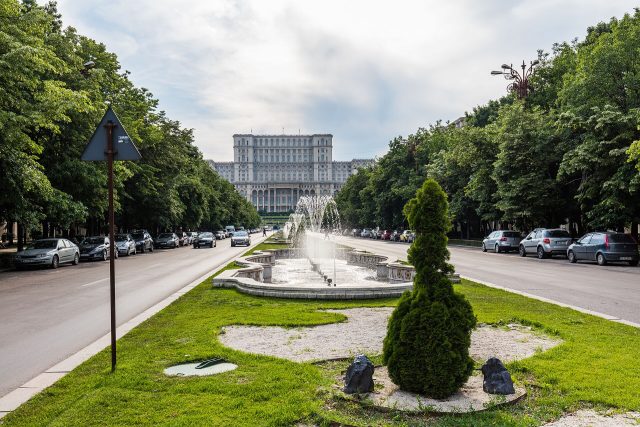
For visitors, the Triumphal Arch serves as a natural starting point for exploring Bucharest. From here, Victory Avenue leads toward the city center, passing landmarks like the colossal Palace of the Parliament and the former Royal Palace. The arch doesn’t just mark a spot on the map; it invites you to step into Romania’s story, then follow the threads of that story through the streets beyond. It’s a monument that doesn’t demand attention but earns it, quietly asserting its place in the city’s rhythm. Locals pass by it daily, sometimes pausing to reflect, sometimes barely glancing up—proof that history, when it’s truly part of a place, doesn’t need to shout to be heard.