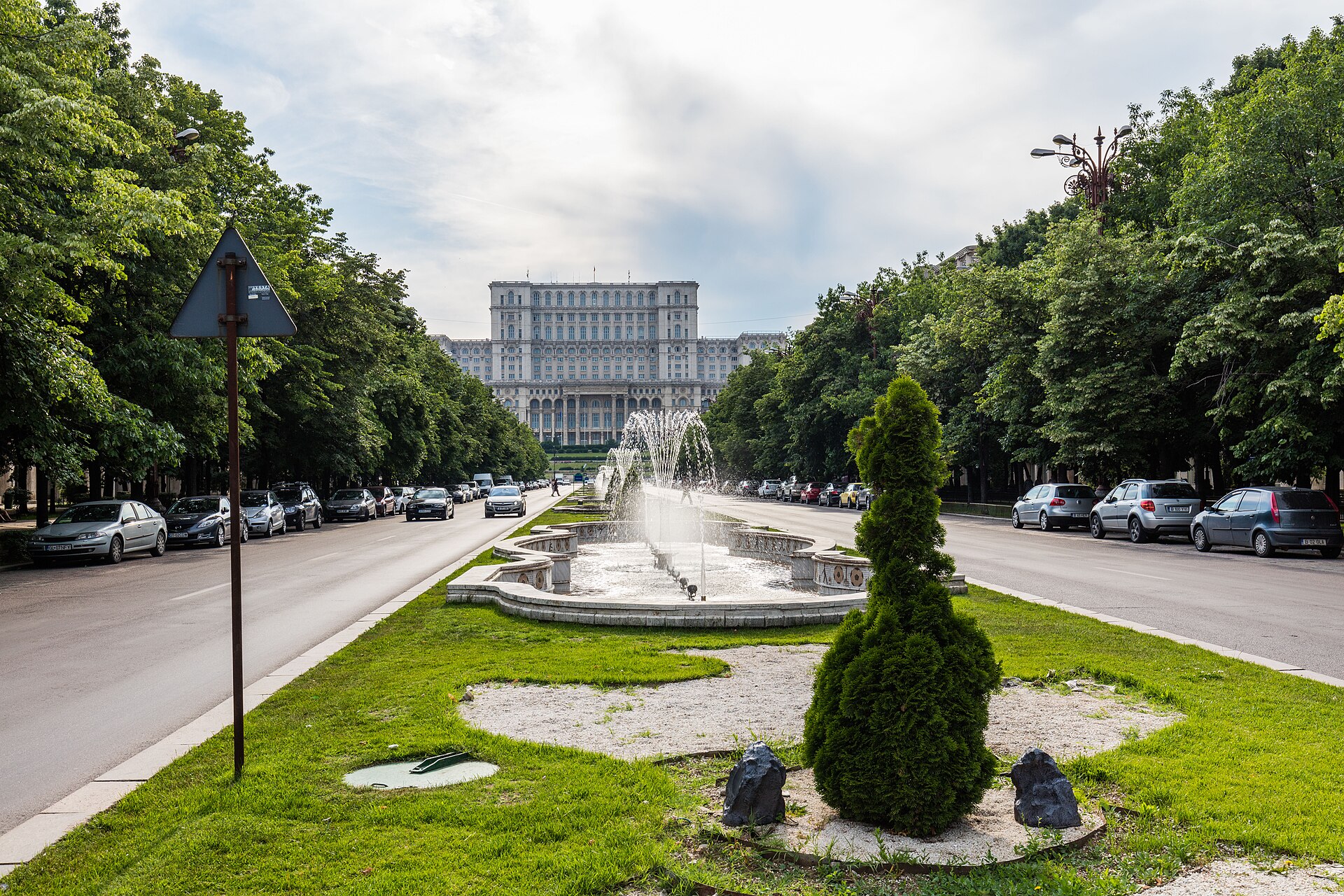
The Palace of the Parliament in Bucharest is a building that defies easy description. It’s not just its sheer size—officially the heaviest building in the world—that makes it stand out, though that alone would be enough to leave visitors speechless. The structure is a monument to ambition, a physical manifestation of a regime’s desire to reshape reality itself. Walking toward it along the wide, straight boulevards that lead to its entrance, you can’t help but feel the weight of its history pressing down, even before you step inside.
Construction began in 1984 under Nicolae Ceaușescu, Romania’s last communist leader, who envisioned the palace as the centerpiece of his grand urban redesign, known as Centrul Civic. The project was meant to erase much of old Bucharest, replacing its winding streets and historic neighborhoods with a vast, symmetrical complex that would house government institutions, a personal residence for Ceaușescu, and a venue for state ceremonies. Over 40,000 workers labored in shifts around the clock, using materials sourced almost entirely from within Romania—marble, oak, crystal, and gold, all meant to showcase the country’s self-sufficiency. The scale of the undertaking was staggering: entire districts were demolished, including churches, synagogues, and hospitals, their residents displaced with little warning. By the time Ceaușescu was overthrown in 1989, the building was still unfinished, and its completion in the years that followed was as much about pragmatism as it was about legacy.
The architecture is a blend of styles that somehow manages to feel both imposing and oddly eclectic. The exterior is dominated by neoclassical elements—columns, arches, and pediments—arranged in a way that feels more like a stage set than a functional building. The symmetry is relentless, with identical wings stretching out on either side of the central dome, as if the palace were designed to be admired from a distance rather than inhabited. Inside, the opulence is overwhelming. The grand halls are lined with Romanian marble, their floors inlaid with intricate patterns, and the ceilings adorned with chandeliers that weigh several tons each. The sheer excess of it all is hard to process; it’s as if every surface was meant to remind visitors of the regime’s power, down to the last gilded detail.
Yet for all its grandeur, the palace feels strangely hollow. The vast corridors, designed to accommodate thousands of bureaucrats, now echo with the footsteps of tourists rather than officials. The rooms that were meant for state functions are often empty, their purpose unclear in a post-communist Romania. The building’s most famous space, the Unirii Hall, is a cavernous chamber with a ceiling so high it feels like standing in a cathedral. It’s here that the contradictions of the palace become most apparent: a space built for spectacle, now used mostly for guided tours and the occasional government event. The sheer scale of the place makes it difficult to imagine it ever feeling lived-in, even when it was in use.
The palace’s legacy is as complicated as its architecture. For some, it’s a symbol of Romania’s darkest period, a reminder of the human cost of Ceaușescu’s megalomania. The stories of the workers who built it—many of them conscripted, some of them injured or killed in accidents—are rarely told, but they linger in the margins of the building’s history. For others, it’s a point of national pride, a testament to Romanian craftsmanship and resilience. The fact that the building was completed at all, despite the political upheavals of the 1990s, is seen as a kind of victory. Today, it houses the Romanian Parliament, as well as a museum and a convention center, though its primary role seems to be as a monument to itself.
Visiting the palace is an experience that’s hard to compare to anything else. The guided tours, which are the only way to see the interior, take you through a carefully curated selection of the building’s most impressive spaces. You’ll walk through halls lined with handwoven carpets, past walls covered in gold leaf, and under chandeliers that seem to stretch into infinity. The sheer repetition of luxury—room after room of marble, crystal, and oak—can start to feel numbing after a while, as if the building’s excess is designed to wear down your sense of awe. And yet, there are moments when the scale of it all hits you anew, like when you stand in the balcony overlooking the Unirii Hall and realize just how small you are in comparison.
Outside, the palace is just as imposing. The vast square in front of it, Piața Constituției, is one of the largest in Europe, designed to accommodate military parades and mass rallies. Today, it’s mostly empty, a vast expanse of stone that feels more like a stage waiting for a performance that will never come. The boulevards leading to the palace are lined with identical apartment blocks, their uniformity broken only by the occasional tree or statue. It’s a landscape that feels frozen in time, a relic of a vision that never quite came to pass. The contrast with the rest of Bucharest is striking; just a few blocks away, the city’s older neighborhoods retain their charm, with narrow streets, crumbling facades, and a sense of history that feels more organic, less forced.
The Palace of the Parliament is a building that demands to be seen, not just for its size or its opulence, but for what it represents. It’s a reminder of the power of architecture to shape not just skylines, but entire societies. The fact that it still stands, decades after the regime that built it fell, is a testament to its enduring presence in the Romanian imagination. Whether you see it as a monument to tyranny or a marvel of engineering, there’s no denying its impact. It’s a place that leaves you with more questions than answers, a building that seems to defy its own purpose even as it fulfills it. And perhaps that’s the most fascinating thing about it: that something so grand, so meticulously planned, can still feel so unresolved.