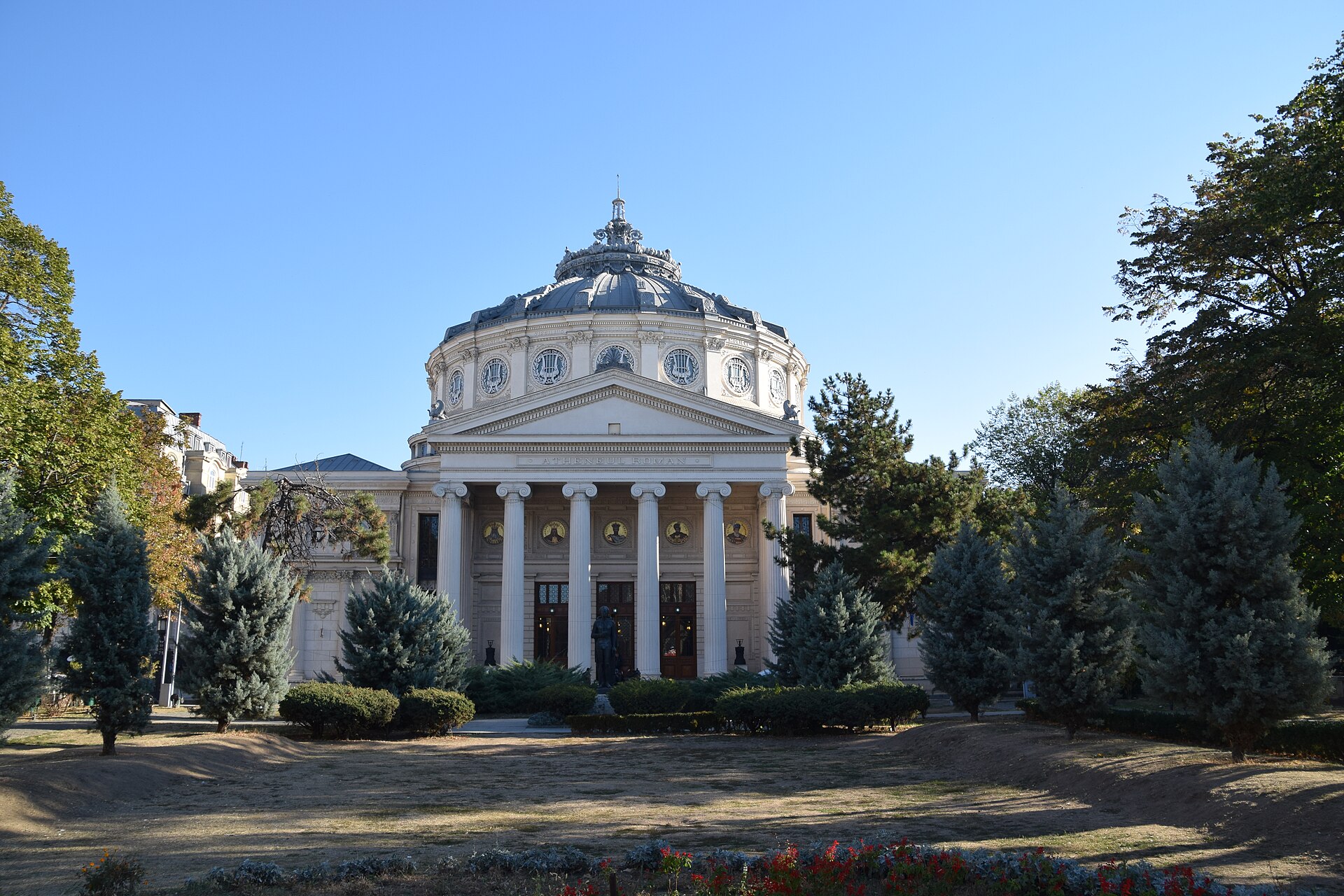
The Athenaeum stands as one of Bucharest’s most recognizable landmarks, a building that has witnessed the city’s transformations over more than a century. Its neoclassical façade, crowned with a dome and framed by columns, gives it the air of an ancient temple transplanted into the heart of Romania’s capital. Yet its purpose has always been far from sacred—it was conceived as a cultural sanctuary, a place where music, art, and ideas could flourish in a city that was rapidly modernizing in the late 19th century.
Construction began in 1886, funded by a mix of public donations and private contributions, a testament to the civic pride of Bucharest’s growing middle class. The architect, Albert Galleron, a Frenchman who left his mark on several of the city’s grandest buildings, designed the Athenaeum to evoke the grandeur of European concert halls while retaining a distinctly Romanian character. The circular auditorium, with its intricate frescoes and gilded balconies, was intended to be both intimate and imposing—a space where every note of a symphony could be heard with clarity, yet where the sheer scale of the architecture would inspire awe.
The fresco that spirals around the interior of the dome is one of the Athenaeum’s most striking features. Painted by Costin Petrescu, it depicts key moments in Romanian history, from the founding of the principalities to the unification of 1918. The mural is more than decoration; it’s a visual narrative, a reminder of the nation’s struggles and triumphs, woven into the very fabric of the building. Over the decades, the fresco has become a backdrop to countless performances, its scenes of battles and coronations silently observing the ebb and flow of audiences.
For much of its history, the Athenaeum has been the home of the George Enescu Philharmonic Orchestra, named after Romania’s most celebrated composer. Enescu himself conducted here, and the hall’s acoustics, often praised for their warmth and precision, have made it a favored venue for musicians from around the world. The annual George Enescu Festival, held every two years, draws orchestras and soloists of international renown, turning Bucharest into a temporary hub for classical music lovers. But the Athenaeum isn’t just for the elite; it has always been a place for the public, hosting everything from student recitals to community concerts.
Beyond its musical significance, the Athenaeum has played a role in Romania’s political and social life. In the early 20th century, it was a gathering place for intellectuals and activists, a venue for lectures and debates that shaped the country’s cultural identity. During the communist era, it became a symbol of resistance to ideological control, a space where art could exist, if not entirely free, then at least with a measure of autonomy. Even today, the building carries that dual legacy—both a monument to Romania’s artistic heritage and a living institution that continues to evolve.
The exterior of the Athenaeum is just as compelling as its interior. The small park in front, with its manicured lawns and benches, offers a quiet respite from the bustle of central Bucharest. The building itself is set back from the street, its columns and pediment creating a sense of grandeur even from a distance. At night, when the façade is illuminated, the Athenaeum takes on a different character, its golden glow reflecting off the surrounding pavement, as if the building itself is radiating the music played within.
Visiting the Athenaeum is more than just attending a concert; it’s stepping into a piece of Romanian history. The building has survived wars, regime changes, and economic upheavals, yet it remains a place of beauty and purpose. Whether you’re there for a performance or simply to admire the architecture, the Athenaeum offers a glimpse into the soul of Bucharest—a city that has always balanced its modern ambitions with a deep reverence for its past. The air inside is thick with the echoes of countless performances, the weight of history pressing gently against the present, making every visit feel like a small act of continuity.