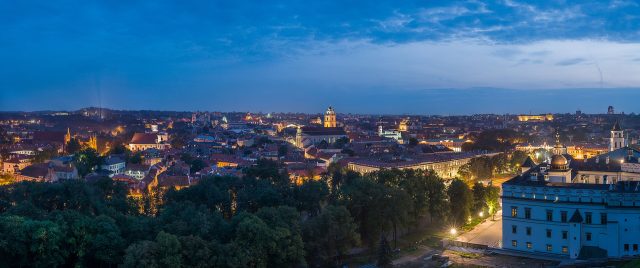
Perched on a hill overlooking Vilnius, the Three Crosses stand as one of the city’s most enduring symbols. From this vantage point, the old town unfolds below in a patchwork of red-tiled roofs, church spires, and winding streets, where medieval lanes brush against Soviet-era blocks and baroque facades. The crosses themselves—tall, stark, and white against the sky—carry the weight of centuries, their presence a quiet reminder of the city’s layered past.
The story of this place begins in the 17th century, when, according to legend, seven Franciscan monks were executed here for spreading Catholicism during a time of religious strife. Thrown from the hill, they became martyrs, and wooden crosses were erected in their memory. Over the years, these crosses were destroyed and rebuilt, each time reaffirming their significance. The hill, known as Crooked Hill or Cross Hill, became a site of pilgrimage, a place where faith and history intertwined.
The first permanent monument appeared in 1916, designed by architect Antoni Wiwulski in the Art Nouveau style. Three concrete crosses, clad in white stone, rose from the hill, a tribute to the fallen monks. But in 1950, Soviet authorities demolished the structure, viewing it as an ideological threat. For decades, the hill stood empty, though locals continued to visit in secret, leaving flowers and candles in defiance.
After Lithuania regained independence, the crosses were restored in 1989. Sculptor Henrikas Šilgalis reimagined the monument, keeping its original form but refining its proportions—taller, more slender, yet unshakably solid. Today, they appear timeless, as if they’ve always watched over the city, though their current incarnation is barely three decades old.
The climb up Cross Hill is steep, especially in summer, but the view from the top makes it worthwhile. Vilnius stretches out below, its landmarks visible in every direction—the Gediminas Tower, the spires of St. Anne’s Church, the winding Neris River. At dusk, the city lights up, turning the panorama into a living postcard. Many come here not just for the history, but for the stillness, a rare quiet in the heart of the capital.
The Three Crosses mean different things to different people. For some, they are a religious symbol, a testament to faith. For others, they represent resilience—a reminder of Lithuania’s struggles for independence. Tourists snap photos, school groups gather for history lessons, and locals stroll the paths, each finding their own connection to the place. On holidays like Easter or Christmas, the hill glows with candles and flowers, the air thick with the scent of pine and wax.
The monument’s design is simple but striking. Three crosses stand together on a shared base, their white forms stark against the green of the hill and the blue of the sky. At the foot of the slope, a small plaza offers information about the site’s history, while the path upward winds through trees, making the ascent feel like a journey through time.
Over the years, the Three Crosses have become woven into Vilnius’s identity. They appear on postcards, souvenirs, and even the coat of arms of one of the city’s districts. Yet their true value lies beyond their visual appeal. This is a place where history feels tangible, where the past isn’t just remembered but experienced. Standing here, it’s easy to imagine the monks who once walked this hill, the builders who raised the first monument, or the people who gathered here in times of hardship.
Today, the hill remains a peaceful retreat. In summer, it’s lush and green; in winter, snow dusts the crosses and trees, lending the scene a quiet magic. Spring and autumn bring their own beauty, the city below bathed in soft light. Whether you come for the view, the history, or simply by chance, the Three Crosses leave an impression that lingers. It’s a place where time seems to pause, inviting reflection on what truly matters.