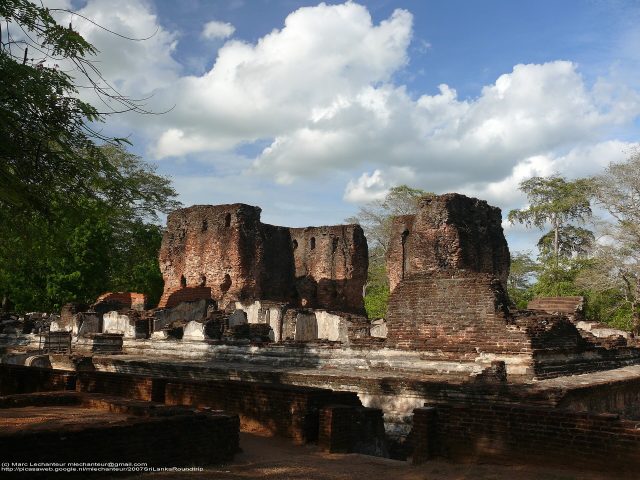
Polonnaruwa’s ancient ruins hold many quiet corners where history lingers in the air, but few places carry the same sense of stillness as Thivanka Pilimage. This Buddhist monastery, nestled within the remains of Sri Lanka’s medieval capital, feels like a pause in time—a place where the past hasn’t so much faded as settled into the stones, waiting to be noticed. Built in the 12th century under the rule of King Parakramabahu the Great, it was once part of a thriving monastic complex, a center of learning and devotion that shaped the island’s spiritual and cultural life. Today, its crumbling walls and weathered sculptures tell a story not just of faith, but of the people who once gathered here, their voices now replaced by the rustle of leaves and the occasional call of a bird.
The architecture of Thivanka Pilimage reflects the height of Polonnaruwa’s golden age, when Buddhist art and scholarship flourished. The main structure, a *vihara* or monastic hall, was constructed from massive stone blocks, their surfaces still bearing traces of the craftsmanship that once adorned them. Fragments of carvings remain—delicate floral patterns, the outlines of columns, and niches where statues of the Buddha once stood. But the true treasure lies in the monastery’s murals. Though time has worn them down, the surviving frescoes are among the finest examples of medieval Sri Lankan art, depicting scenes from the Buddha’s life and the *Jataka* tales of his past incarnations. The colors have dulled, the lines blurred, yet the figures retain a quiet vitality, as if the stories they tell are still unfolding.
The name *Thivanka*—meaning "bent" or "curved"—comes from the monastery’s most striking feature: a towering statue of the Buddha in *tribhanga*, a pose where the body gently sways, one hip slightly raised. Carved from a single block of stone, the figure exudes a sense of movement and grace, its contours softened by centuries of wind and rain. Though parts of the statue have been lost, the remaining form still conveys a profound serenity, the kind that might have inspired meditation in those who once knelt before it. Nearby, other sculptures—boddhisattvas, deities, and guardians—stand in various states of preservation, their presence hinting at the monastery’s former grandeur.
In its prime, Thivanka Pilimage was more than a place of worship. It was a hub of intellectual and spiritual life, where hundreds of monks lived, studied, and debated. The complex included living quarters, assembly halls, libraries, and even a hospital, all arranged with the precision of a self-sustaining community. Today, little remains of these structures beyond low walls and scattered foundations, but the layout is still discernible. Walking through the ruins, it’s easy to imagine the daily rhythms of monastic life—the chanting of sutras at dawn, the quiet rustle of robes as monks moved between buildings, the murmur of scholarly discussions under the shade of trees.
The setting adds to the monastery’s atmosphere. The ruins sit in a grove of ancient trees, their gnarled roots weaving through the stones like nature reclaiming what was once hers. Tamarinds and banyans cast dappled shadows over the ground, their leaves whispering in the breeze. The heat of the day softens here, the thick walls offering respite from the sun. In the late afternoon, when the light slants low, the stones seem to come alive, their edges sharp against the golden glow. It’s a place where time feels elastic, where minutes stretch into something deeper, something closer to the pace of the monks who once walked these paths.
Visiting Thivanka Pilimage isn’t like touring a museum. There are no glass cases or explanatory plaques, just the quiet persistence of history underfoot. It’s a place that invites reflection, where the past isn’t confined to textbooks but lingers in the texture of the walls, the curve of a statue’s smile, the faded pigments of a mural. You can almost hear the echoes of footsteps, the distant hum of prayers, the crackle of palm-leaf manuscripts being turned. Even in its ruined state, the monastery retains the essence of what it was meant to be—a sanctuary for the mind, a retreat from the noise of the world.
For those exploring Polonnaruwa, Thivanka Pilimage offers a counterpoint to the more famous sites nearby. The colossal Buddha statues of Vatadage or the towering stupa of Rankot Vihara are undeniably impressive, but they lack the intimacy of this smaller, more contemplative space. Here, the scale feels human, the details personal. It’s a reminder that history isn’t just about grand monuments, but about the lives that unfolded within them—the students who memorized scriptures, the artists who painted the walls, the pilgrims who traveled for days to pay their respects.
It’s worth remembering that Thivanka Pilimage isn’t just a relic; it’s still a sacred site. Though the monastery has long been abandoned, locals and devotees continue to visit, leaving offerings of flowers or incense at the feet of the statues. Visitors are expected to treat the place with respect—no climbing on the ruins, no touching the fragile murals, no loud conversations. This isn’t a place for selfies or hurried snapshots, but for quiet observation, for the kind of stillness that allows the past to speak.
In a country where ancient sites are often crowded with tourists, Thivanka Pilimage remains one of those rare places where you can step away from the noise and feel the weight of centuries. It doesn’t demand attention the way some ruins do; instead, it waits, patient and unassuming, for those who are willing to slow down and listen. Whether you’re drawn by history, art, or simply the promise of a quiet moment, the monastery offers something deeper—a connection to the people who built it, the faith that sustained it, and the quiet resilience of the past. You don’t need to be a scholar to feel it. Sometimes, all it takes is sitting on a sun-warmed stone, watching the light shift across the walls, and letting the silence do the rest.