Perched on a gentle hill overlooking the quiet streets of Mazyr, St. Michael’s Church feels like a place where time has paused, allowing the past to linger just a little longer. Built in the early 20th century, the church stands as a silent witness to the changes sweeping through the town below, its presence both unassuming and striking. With its slender bell tower and traditional five-domed silhouette, it rises above the low-slung wooden houses and old brick mansions of Mazyr’s historic center, a reminder of the town’s layered history.
The architecture of St. Michael’s reflects the retrospective Russian style that gained popularity in the late 19th and early 20th centuries, blending it with local traditions. The whitewashed walls, adorned with subtle stucco details, contrast sharply with the golden domes that catch the sunlight, their brightness softened by the surrounding greenery. Inside, the church is equally understated yet evocative. The dark-toned iconostasis, intricately carved royal doors, and faded frescoes on the walls create an atmosphere of quiet reverence. There’s no grandeur here, just a sense of harmony born from simplicity and sincerity.
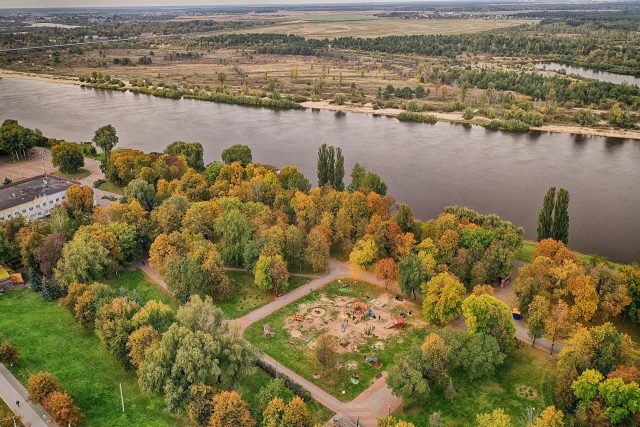
Mazyr itself has long been a crossroads of trade and culture in the Polesia region, its fortunes tied to the winding Pripyat River that flows nearby. In the 19th and early 20th centuries, the town saw a surge in church construction, and St. Michael’s became one of its enduring symbols. Like many places of worship in Belarus, it weathered wars, revolutions, and the Soviet era, when religious sites were often destroyed or repurposed. Restored to the faithful in the 1990s, the church has since reclaimed its role as a spiritual and cultural landmark.
Today, St. Michael’s is more than just an active place of worship—it’s a living piece of Mazyr’s heritage. Visitors come not only to pray but also to admire the preserved icons, some dating back to the 19th century, and the church utensils that have survived from pre-revolutionary times. The small donations left by parishioners—embroidered towels, candles, and modestly framed icons—speak to the church’s deep connection to the community. These details make it feel less like a museum and more like a place where history is still being written.
The area around the church is worth exploring as well. From the hill, the view stretches over Mazyr’s old quarter, where narrow streets wind past houses with carved window frames and courtyards overgrown with lilacs. Nearby, the remnants of Mazyr Castle—a medieval earthwork fortification—hint at the town’s past as a frontier stronghold of the Grand Duchy of Lithuania. A walk through these streets, especially in the late afternoon when the setting sun casts a golden glow over the Pripyat, offers a sense of stepping back in time.
St. Michael’s Church is more than an architectural monument; it’s a place where the past and present intersect. On weekdays, the church is open to anyone seeking a moment of quiet, whether to light a candle, listen to the bells ringing over the town, or simply sit on a bench outside and watch life unfold at its own unhurried pace. On feast days, the church comes alive with light, flowers, and hymns, its atmosphere becoming even more moving. The absence of crowds makes it easy to linger, to reflect, or to simply soak in the stillness.
For those visiting Mazyr for the first time, St. Michael’s can serve as a natural starting point. From here, it’s a short walk to the town’s historical center, the local history museum, or the riverbank, where fishermen and strollers gather in warmer months. Mazyr is small enough that its main sights can be explored in a day, but even a brief visit to the church offers a chance to see the town from above and to feel its quiet, steady rhythm.
In recent years, interest in Belarus’s historic churches has grown, and St. Michael’s has become a quiet star in guidebooks and photo collections dedicated to the Polesia region. Locals speak of it with pride, not just as a relic of the past but as a place that remains woven into daily life. Weddings, baptisms, and funerals are still held here, and the church continues to be a gathering point for the community. It’s this blend of living faith and historical significance that makes it special—a place where history isn’t just remembered but still very much alive.