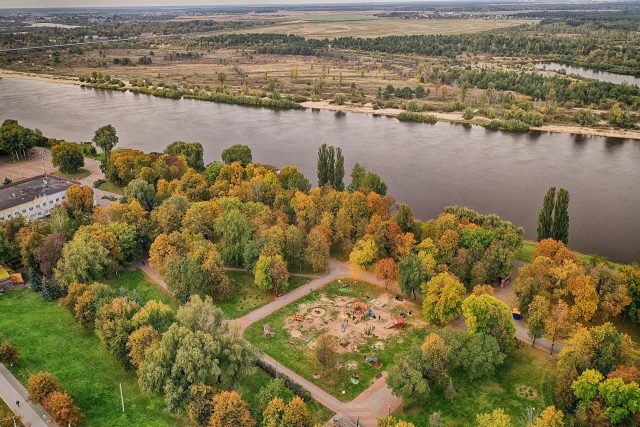
Perched on a bluff overlooking the slow, wide waters of the Pripyat River, the Cathedral of the Archangel Michael is one of those places that doesn’t announce itself with fanfare. Its white walls catch the eye from a distance as you approach Mozyr from the river, but it doesn’t dominate the skyline like the grand cathedrals of larger cities. Instead, there’s something quietly enduring about it, as if it has always belonged here—among the unhurried flow of the river, the low-hanging skies, and the weathered wooden houses that dot the outskirts of town.
The cathedral’s story begins in the late 18th century, when Mozyr was a modest district town in the Polish-Lithuanian Commonwealth. A wooden church once stood on this spot, serving the community for nearly a hundred years before it burned to the ground. In its place, a stone cathedral rose in 1848, funded by local merchants and parishioners. At the time, Mozyr was a small but bustling hub along trade routes, and the cathedral became more than just a place of worship—it was a gathering point for the town. Travelers would come here to pray before long journeys, and prominent citizens were laid to rest in its courtyard, their gravestones still visible today.
The architecture is simple and unadorned, yet that’s where its charm lies. Built in the late neoclassical style, the cathedral’s design is marked by symmetry and restraint. Pilasters frame the facades, and a modest bell tower with a once-gilded dome rises above the entrance. Inside, the space feels surprisingly airy—high vaulted ceilings, pale walls, and large windows let in plenty of light, softening the weight of the massive columns. The 19th-century iconostasis has survived largely intact, though some icons were repainted or restored during the Soviet era.
The 20th century was not kind to the cathedral. Like many religious sites, it was closed in the 1930s and repurposed as a warehouse. During World War II, German forces used it as a field hospital, and after the war, it became a sports school. It wasn’t until the 1990s that the building was returned to the faithful, and a slow process of restoration began. Today, the cathedral is active again, though it no longer looks exactly as it did in its 19th-century prime—some frescoes are lost, the gilding on the dome has faded, and the years have left their mark. Yet the sense of history here is palpable.
This isn’t a place that overwhelms you at first glance. Its beauty lies in the quiet—the way sunlight filters through the windows onto old icons, the scent of incense and beeswax, the echo of footsteps on stone floors. It’s rarely crowded, which only adds to the atmosphere. Locals come not just for services but to sit in silence, especially on weekdays when the cathedral is nearly empty. Visitors who stumble upon it often linger longer than they intended, as if the building itself holds them there for a moment.
The Cathedral of the Archangel Michael is more than just an architectural landmark; it’s a living record of how the town and its people have changed. It once stood at the heart of a thriving trade center, where merchants prayed before journeys and families mourned their dead. Today, it sits slightly apart from Mozyr’s more frequented spots, and many who come to see the town’s famous castle or historic streets never make it here. But those who do find it leave with something intangible—a quiet, bittersweet feeling that lingers.
If you approach the cathedral from the river, the path takes you past old wooden houses, some still lived in, others long abandoned. This part of Mozyr isn’t on the tourist trail, but it’s where the real city reveals itself—not the polished version, but the one that exists beyond guidebooks. The cathedral seems to absorb this atmosphere, content to simply be what it is, with its layers of history, the scars of time, and a quiet dignity that doesn’t demand attention.
In recent years, the cathedral has found a new role in the town’s cultural life. Concerts of sacred music, exhibitions of antique icons, and small festivals celebrating Orthodox traditions have all taken place within its walls. Local artists sometimes display their work here, setting modern creations against the backdrop of ancient stone. None of this turns the cathedral into a museum or a tourist attraction—it remains, first and foremost, a place of worship, but it has also become a bridge between past and present.
Mozyr is a town that doesn’t rush to reveal itself. It doesn’t clamor for attention or draw crowds of visitors, and perhaps that’s why those who do come remember it so vividly. The Cathedral of the Archangel Michael is one of those places where you can sense the rhythm of the town—its unhurried pace, its depth. There’s nothing flashy here, but there is something that’s hard to put into words: the feeling of time moving at its own pace, untouched by the rush of the outside world. If you ever find yourself in Mozyr, it’s worth climbing that hill, standing by the cathedral’s walls, and listening—you might hear something worth remembering.