Jongmyo Shrine sits quietly in the heart of Seoul, a place where the past lingers in the air like the scent of aged wood and pine needles. Unlike the city’s bustling streets just beyond its walls, this sanctuary feels suspended in time, its low-slung buildings and shaded paths untouched by the rush of modern life. It was built in the late 14th century under King Taejo, the founder of the Joseon Dynasty, not as a palace or a fortress, but as a sacred space where the spirits of royal ancestors could be honored. For over six hundred years, it has served this purpose, its rituals and rhythms unchanged by the centuries.
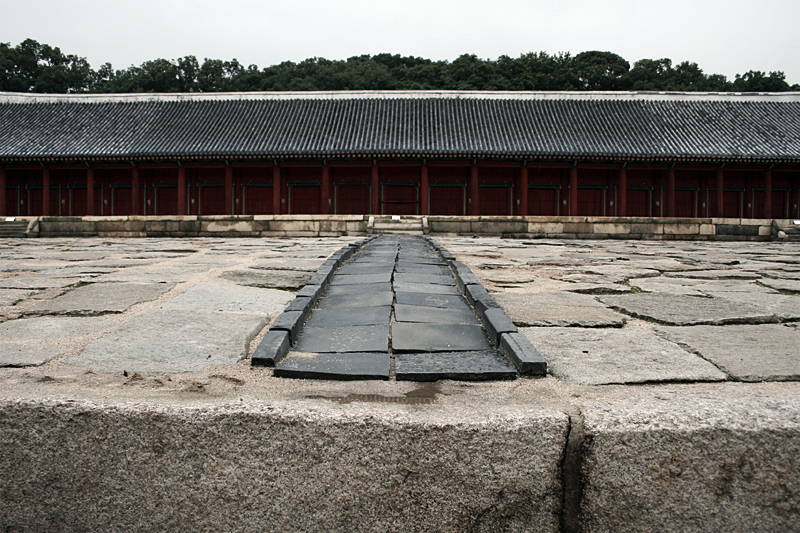
The architecture here is deceptively simple. The two main halls, Jeongjeon and Yeongnyeongjeon, stretch long and low, their gray-tiled roofs curving gently against the sky. On rainy days, the tiles glisten like polished stone, and the wooden beams beneath them—fitted together without a single nail—bear the weight of history. The wide verandas, once filled with courtiers during ceremonies, now stand empty, their silence broken only by the occasional footsteps of visitors. Stone platforms elevate the buildings, protecting them from the damp earth, while carved dragons on the roof ridges watch over the grounds, symbols of the monarchy’s enduring power. Even the doors are adorned with intricate patterns, not for decoration, but to ward off misfortune.
Jongmyo’s true significance lies in its rituals. The most famous, Jongmyo Jerye, has been performed since the 15th century and remains one of South Korea’s most important state ceremonies. It is a meticulously choreographed act of remembrance, lasting hours, where offerings of food, wine, and silk are made to the spirits of the Joseon kings and queens. Musicians play instruments that have survived since the dynasty’s early days, their melodies drifting through the air like echoes of another era. Dancers in vibrant hanbok move in slow, deliberate steps, their movements dictated by ancient manuscripts. The ceremony is a living link to the past, a reminder that even in a modern republic, some traditions refuse to fade.
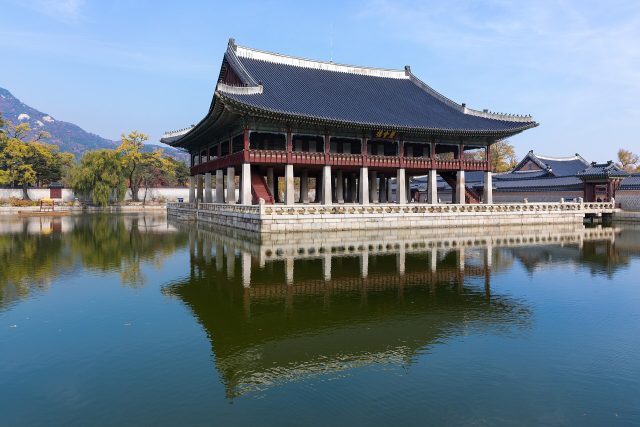
Walking through Jongmyo feels like stepping into a different world. The path begins at the main gate, where stone guardians stand watch, their fierce expressions a reminder of the sacredness of the place. Beyond them, a long avenue lined with stone lanterns leads deeper into the shrine. In the evening, their soft glow reflects off the wet pavement, creating a quiet magic. At the heart of the complex lies Hyangwonji Pond, a still body of water surrounded by pine trees. The pond was said to have been dug by King Sejong, who wanted the spirits of his ancestors to have a place of natural beauty to enjoy. Today, it mirrors the roofs of the halls, its surface unbroken except by the occasional ripple from a passing breeze. Students sketch the scene, while elderly visitors sit on the benches, lost in thought.
Jongmyo has not always been at peace. During the Japanese occupation in the early 20th century, the shrine was looted, its relics stolen, and its structures damaged. After Korea regained its independence in 1945, restoration began, and today, the complex looks much as it did during the Joseon era. Its survival is a testament to the resilience of Korean culture, and in 1995, UNESCO recognized its importance by designating it a World Heritage Site. It is more than just a historical landmark; it is a place where the nation’s identity is preserved, where every stone and tree carries the weight of memory.
What makes Jongmyo special is its lack of pretense. There are no crowds here, no loud tour guides, no souvenir stalls. Instead, there is silence, broken only by the rustle of leaves and the distant murmur of voices. On a weekday, you might find yourself alone on the paths, the only sounds your own footsteps and the occasional call of a bird. In spring, cherry blossoms drift like pink snow over the ground; in autumn, the maples blaze red and gold. Winter transforms the shrine into a monochrome landscape, the white roofs blending seamlessly with the overcast sky. It is a place that invites contemplation, where the past feels close enough to touch.
For those trying to understand Korea, Jongmyo is essential. It doesn’t shout its history; it lets you discover it at your own pace. Here, you can see how Koreans view their ancestors—not as distant figures, but as a living presence, deserving of respect and remembrance. The rituals, the architecture, even the way the light filters through the trees, all speak to a culture that values continuity. In an age where so much is disposable, Jongmyo stands as a reminder that some things endure.
Perhaps that is why it feels so different from other historical sites. There is no need for grand explanations or dramatic storytelling. The shrine speaks for itself, in the quiet dignity of its buildings, the precision of its rituals, and the way the seasons change around it. It is a place where history is not just remembered—it is lived. And in that living memory, the past remains alive, breathing, waiting for the next visitor to pause and listen.